Tuesday, April 29, 2014

Illustrated Gaming: The Lost Art of Game Boxes

If you've been following Retro Revelations for long enough now, you've probably gotten the feeling that I have a "thing" for classic gaming. In fact, I'd go so far as to say that while, yes, I do enjoy many modern games, personally, I consider the old, sprite-based games of yore to be "true" video games. I think of most modern games, quite frankly, as "interactive entertainment", more than "video games", because to me, that just seems to be the direction that the industry has been going in now for a good decade plus.

Sufficed to say, I'll always love the classics the most. There were so many things that were unique and, yes, "special" about the good old days, from Atari 2600 on through Super NES, And not the least of which, among so many great facets such as gameplay, sprite graphics, "chip tune" music, etc., were the games' box artwork. Now mind you, not every game was created equal, naturally, and neither was all box artwork great, let alone good. Some of it, like many games themselves, just straight out sucked. But, there was also a whole lot of really, genuinely great, classic box art as well. There was even an ongoing phenomenon, dating back to the 2600, where many games had amazing box art, and that alone would lure potential buyers in, only to be revealed to have crappy games underneath once brought home.


Quite literally a work of art.


Above is a perfect example. Asteroids for Atari 2600 wasn't exactly the best port of that arcade classic. It's not terrible by any means, but the 2600 simply couldn't pull off the real thing in it's full glory. But that box art? It's absolutely fantastic! That is the stuff of classic movie posters or old sci-fi novel covers. Bottom line: it's just really good art, in and of itself. And that's what I'm talking about. You saw that a lot with old Atari games, and even those of it's direct competitors like the Colecovision or Intellivision. Even if many of the games absolutely sucked, a fair lot of them, actual game be damned, had really good looking artwork that was used specifically to sell the games.


Simple, yet elegant.


This one in particular holds memories for me. Space Invaders was one of the few 2600 games that I actually owned as a small child, inherited as a hand-me-down from an aunt of mine. While I, at the tender age of 4 or 5 years old, was absolutely no good at the game itself, and actually kinda hated it because it was so damn hard to me at the time, I really loved the artwork for it. Even though those spaceships don't look anything like the actual "Space Invader" enemies from the game itself, this art still captivated my attention as a child. I would often just hold the cartridge and stare at the seemingly giant cities in the domes on these ships, and wonder to myself where they came from and what they were all about. They say "a picture is worth a thousand words", and it really can be, as my childhood fascination with this particular box art is a testament to the power of art in general.


The epitome of "Classic".


Now when the NES first launched, its initial lineup did not sport what you would call great art. While there is a certain charm now to the old "Black Box" set of launch titles, they were hardly "artwork" at all, simply displaying sprites from the games, in a fashion. But thankfully that certainly didn't last for long, as good lord, did the NES have it's share of gorgeous game covers. The one pictured above is, I think, the quintessential perfect example. It's perfect, not only in the elaborate, great design of the artwork itself, but it's also economical in how it's used. Unlike some game art, which tells you too little or nothing at all in vague images, Castlevania's did a superior job of conveying to the buyer exactly what they were getting into and precisely what the game was about.

You have the hero, Simon Belmont, standing prominently in the foreground, brandishing his trademark whip. Next you have a mist-covered, mysterious landscape before you, with this great, foreboding castle in the distance, and above it all, the haunting, almost laughing specter of the game's main adversary, Count Dracula. In that one image, you are told everything about the game that you need to know: You are a hero, who uses a whip, and has to make his way through a haunted castle to defeat an evil vampire. The end. That is literally perfection, and I would have a hard time imagining any game box art ever crafted doing a better job.


Vague, but beautiful.


Another good example, for a different reason, is this box art for the North American version of Final Fantasy on NES. It doesn't do the same things the Castlevania art did, telling you all you need to know about the game. In fact, it kind of does the opposite in some respects. On the one hand, it does show you some medieval weapons, as well as a mysterious crystal ball, showing some kind of floating city. This does (SPOILERS) literally foreshadow a location you travel to late in the game, and that's cool. The art piece as a whole also hints to the buyer of battles and magic, things heavily featured within Final Fantasy itself. So in that respect, it does tell you a bit about the game, if you're paying attention. But on the other hand, of course, it is also incredibly vague, perhaps by design, the kind of evocative art that is meant only to grab the viewer's attention, and leave them curious enough to want to find out what it's all about. It's not the same pure classic example such as Castlevania, but at the same time, I for some reason have always loved this particular art, and think the simplicity and vagueness still serves the game very well.


So awesome, yet so misleading.


Another good, but in some ways also bad example, is the above pictured box art for the NA release of Mega Man 2. This was one of my favorite games as a kid, and one of my favorite game boxes as well, because of this art. This box art alone, similar in a fashion to the Space Invader box art of old, really sparked my imagination, and filled me with a bunch of box art fueled backstory for Mega Man that as it would turn out, sadly, would be proven dead wrong as I got older and learned more about the series and it's hero. At that young age, inspired by this infamous yet erroneous artwork, in my head evolved a story about a Mega Man who was actually a human being, who was hired by the benevolent Dr. Light to fight evil robot creations, using a souped-up robotic power suit, ala Iron Man. And if you ask me, to this day, I honestly still think that sounds pretty bad ass, and kinda wish that it was Mega Man's actual story. You see, this box art, and in fact one of the box art pieces for Mega Man 1 as well, show a very human looking hero, wielding a gun, and fighting bad guys. Now mind you, the gun bit didn't really grab me so much, I knew that he used an arm canon weapon, called the "Mega Buster", but hey, for all I knew he could have been just like another human hero who also used a suit of power armor and an arm canon: Metroid's hero Samus Aran.

Well no, in fact, as it turns out, Rock, the hero who becomes Mega Man (or Rockman in Japan), was always a robot. According the series' story, Dr. Light created him originally as a lab assistant, but later when his other creations went haywire thanks to that dastardly Dr. Wily, he refitted Rock and turned him into the "Super Fighting Robot" Mega Man, who could battle evil and save the day. Still a cool backstory, absolutely. But to this guy, somewhere deep down, the 10 year old in me still thinks that an armored dude fighting evil is somewhat cooler than a robot doing it. But I digress. As for the art itself, even though this image is somewhat infamous today as a bit of "cheese art", as some consider it, I personally consider the quality of the artwork itself to be rather good, and in spite of it's misleading bent, concerning the nature of our titular hero, it does still tell you what the game is about: you play a guy who shoots things, fighting evil robots, and taking down a mad scientist (even IF the dude pictured in the art looks more like Dr. Light, not Dr. Wily). All of that still rings mostly true, so at the end of the day, Mega Man 2's art still holds up, and does it's job.


Lighting bolts and dragons....that's pretty much all anyone needs.

The great art of Tom duBois.


As you can see, the jump from the 8-bit to the 16-bit era of gaming didn't create a lack of good box art. In point of fact, the 16-bit generation was truly the last stronghold of great, hand-drawn game art. Sega Genesis, Super NES, and even other more obscure systems like Turbo Graphx 16 and Neo-Geo, had many games with great artwork. Mystic Defender happens to be a great choice to show off, because it combines elements of what was great both about the Castlevania and Final Fantasy art, in that it tells you certain bits about what the game is, you play a guy who throws lightning and fights monsters, but at the same time, it is vague and cryptic enough to leave you wanting to know more. And then the artwork for one of my top favorite games of all time, Super Castlevania IV, much like the CV series boxes before it, is just beautiful. As in that would make a great painting in a gallery somewhere, whether it has to do with a video game or not.

But, as I intimated, the 16-bit era really was the last stand for the regular use of great, hand-drawn/painted game art. In the following generation, of the Sega Saturn, Sony PlayStation, and Nintendo 64, a new trend arose to go along with the "leap" to 3D, polygon-based graphics, and that was the prolific use of pre-rendered 3D images for game covers, in place of traditional art. Now don't get me wrong, not all of this pre-rendered stuff was bad. But feast your eyes on the picture below, just to get a taste of the difference I am talking about.


Just......blah.


This is just one example of how, as the pic quote says..."Blah" many of these "3D" game covers could look. Castlevania 64 (as it's unofficially known), was a nice first attempt at taking the series into 3D. But honestly, the series has never really worked as well in 3D, and this box art in particular was just uninspired and painful. Part of a game cover's job, is to make you want to buy the game, it's supposed to be an evocative image that jumps out at you and makes you interested enough to want to check the game out. This cover? Wouldn't make much of anyone interested, if you ask me. I rented this game because I loved the series and I wanted to try it. But people who knew nothing of Castlevania, but saw this box on store shelves? Likely would pass it up, because it just screams "Blah". Honestly, it looks like rushed demo art that they decided to slap on the box. And this wasn't uncommon in those early 3D days.


Better, but still missing something....


And in the interest of fairness, from the same early 3D era, here is the box art for Super Mario 64. A much better game with MUCH better art. It's simple, to the point, shows Mario using one of his new power-ups, shows just a glimpse of the kind of game worlds you might find when playing, and otherwise gives the viewer the sense that "It is still Mario after all". But even for all it's positives, and honestly, it looks okay, it's still just missing that "something" that the cool, hand-drawn Mario artwork of old had. Those old images looked like a cartoon. This? Just kinda looks like a....pre-rendered image. I'll fully admit that I am biased in this estimation, but I also just firmly feel that the old-style, hand-drawn game art had more "life and spirit" to it. Plus it quite simply tended to be more beautiful.

Now, game box art has come a long way, it's continued to evolve, and while it's improved, the fact remains that hand-drawn art is still used rarely, especially for home console games. It IS used, but not nearly enough. And since 3D gaming has taken on a much more "realistic" bent in modern times, you will often get modern box art that looks something like this:


Yup.

Double Yup.


The images for these games are fine, they're certainly not poorly made, they're well-rendered, and they convey what the games are about: guns, fire, smoke, explosions, war, lots of brooding, etc. They're not BAD by any means. But for my money, they also don't really spark the imagination the way that old box art used to either. It's just kind of very cut, and dry, and to the point. In some cases they're almost literally just images directly from the games, and in others, they may have stylized titles, but they're still just terribly uncreative or unimaginative. That isn't to say there aren't still some cool, creative, and interesting looking game covers. There certainly are. It's just that, as far as I've managed to notice anyway, they seem to be relatively few and far between.

I realize that in these articles of mine, in this ongoing blog of mine, I do rather often seem to frame things in a very stark "things were better back then" slant. And I don't really apologize for this, because at least in my view, when it comes to a lot of things in the realm of entertainment, things really WERE better back whenever. There's a reason it's called "Retro" Revelations, and there is most certainly a reason why I tend to focus mostly on things that are usually no younger than, let's say, 15 or more years old, usually far older. But when it comes to the matter of game box art, I really do feel like it has become a mostly lost art. And I can't help but wonder, what ever became of all of those amazing artists who used to so regularly find employment making these great (and sometimes not so great) game covers that so many of us would still wonder over for decades to come?

Whatever happened to them, I'd like to thank them for adding an important part to the overall appeal of the phenomenon that was video gaming in the 1980s and early-to-mid-90s. Because in many ways, some of those game covers are just as important, and just as classic, as the games themselves. So to you mystery men (and women), I'd just like to tip my proverbial hat, and say "Cheers".


Friday, March 28, 2014

My Favorite Pro Wrestlers

One of the earliest articles I wrote for this blog, was an article about The Undertaker. He is my favorite wrestler of all time, and he is the reason I ever got hooked on professional wrestling in the first place. As a younger person, in my teens, I was actually able to suspend disbelief, before I learned so much about the "inner workings" of the business, and just watch and enjoy the show for what it was. And in that sense, I totally bought that this guy was supernatural and had powers and strength that no mortal man possesses. It was that aspect of pro wrestling that made me originally love it: the fact that I actually was able to buy into the characters these people played, to forget that I knew and understood it was "fake", and just enjoy the show. And to be perfectly honest with all of you, there is a part of me that wishes I was still that way. Because to be perfectly honest, I enjoyed wrestling far more back then, than I have in many years in more recent times.

Considering that the 30th Wrestlemania event is right around the corner, even though that means a lot less now than it used to, I decided it's time to share with you some more of my wrestling fandom. And what better way to kick that off, than with a look at some of my top favorite wrestlers of all time? As with some of my other "Top Lists", the top five or so spots are pretty much set in stone, but after that it gets kind of sticky, but I'm gonna attempt it anyway. So here we go:


My fav. version of Taker, circa 1997-1998.

1. The Undertaker
    Height: 6'10"
    Weight: 300 lbs

    Finisher: Tombstone Piledriver

I already went into great length with my original Undertaker article as to why I love this character so much. But in short, he's a supernatural entity that comes back from the fuckin' dead every time he's defeated, and draws on the power of the "Dark Side" to give him supernatural strength and endurance. And he summons lightning bolts to scare his foes. What's not to like about that? In his prime, this guy shrugged off chair-shots and finishing moves alike, first with the power of his manager Paul Bearer's mysterious golden urn, and later simply by drawing upon the "Dark Side" itself. And as a little bit of my own personal lore, it just so happens that from his 1990 debut, on through the decade, the more he would defeat people, over time it just so happened that his arms got more and more covered with tattoos. I like to think of them as symbols of all the souls he's taken over the years, as one of his nicknames is "The Reaper of Wayward Souls". See why I love this guy?

For his size, he was very quick and graceful, and was able to pull off a lot of technical wrestling and high flying moves that most "big men" couldn't dream of. He had multiple reigns as world champion, and even main-evented a few Wrestlemania events, considered the pinnacle of the sport. And while I personally think he should have retired several years ago (to preserve his legacy, and his health), the fact is undeniable that he is one of the greatest wrestlers of all time, and certainly one of the most distinct and memorable personalities of all time.


The Best There Was or Ever Will Be....

2. Bret "The Hitman" Hart
    Height: 6'0"
    Weight: 230 lbs. 
    Finisher: The Sharpshooter

One of his nicknames, "The Excellence of Execution", was entirely accurate when it comes to my second favorite wrestler of all time, Bret Hart. Born into wrestling royalty, son of the legendary Stu Hart, and growing up with a family who ran a wrestling promotion, and brothers who were all wrestlers, he was destined for greatness. After forming one half of one of the greatest tag teams of all time, the "Hart Foundation" with partner Jim "The Anvil" Neidhart (brother-in-law), he then went on to become one of the greatest singles wrestlers of all time. He won pretty much everything there was to win in his era, two time Tag Team Champion, two time Intercontinental Champion (beating the likes of Mr. Perfect and "Rowdy" Roddy Piper), the only two time King of the Ring tournament winner in WWF history, the co-winner of the 1994 Royal Rumble, and a five time WWF Heavyweight Champion. He also main-evented three Wrestlemania events, Wrestlemania IX and X against the great Yokozuna, and XII against Shawn Michaels.

What really matters in all of that though, is that after establishing himself as a top singles star in the WWF in 1991, in an era that saw the end of "Hulkamania" and an exodus of most of the big, muscle-men stars of the 80s, Bret Hart went on to become a world famous and respected "everyman", a "People's Champion" so to speak, long before Diamond Dallas Page or The Rock called themselves such. He was just a regular-sized guy, who won with great technical wrestling ability, and a lot of (pardon the pun) Heart. But why is he my second favorite wrestler? Because, simply put, he was arguably the most technically gifted and sound wrestler of the modern era. And because, even as a "bad guy" in 1997, he always managed to embody class, respect, and in the professional realm, uncompromising integrity. He was incredible in the ring, and while no one is perfect, he was also a great person outside of it. Make no mistake about it, for all the talk given to the likes of Shawn Michaels, Sting, the NWO, "Stone Cold" Steve Austin, or even my beloved Undertaker, from 1991-1997, The Hitman was THE man of the wrestling world.


They totally reeked of awesomeness.

3. Edge
    Height: 6'5"
    Weight: 240lbs
    Finisher: Spear

For a certain span from late 1998 to mid-2001, the team of Edge and Christian were arguably the best tag team in the world. But Edge first captivated my attention when he debuted as a mysterious loner in the summer of '98, appearing through the crowd, with a long trench coat and a brooding attitude. I was interested, and became a fan, because of this early (but sadly short-lived) singles run. He was quickly inducted into the "vampire" faction known as "The Brood" with leader Gangrel and his storyline brother (real life childhood best friend) Christian. They later joined Undertaker's "Ministry of Darkness", before breaking away as fan favorites and ultimately Edge & Christian alone rising to tag team dominance. But through all of this, I was a fan, and they were my favorite tag-team for that entire duration.

From mid-2001 onward, the team splintered, and Edge broke out, much as Bret Hart had once done, as one of the top young stars of the new millennium. In fact, nearing 2003, I had high hopes of him possibly main eventing a Wrestlemania someday, and becoming the WWF Champion. Sadly, my hopes, and his career, were derailed when he suffered what could easily have been (and many years later ultimately was) a career-ending neck injury. The injury kept him out for over a year, and he wound up missing both Wrestlemania 19 and 20. I honestly feared the worst, as many new stars came and went during his recuperation. He did finally come back in 2004, and though it wasn't as the shining "good guy" star he could have been back in 2003, he did eventually become WWE Champion in 2006, and would ultimately be a multiple time world champ, even main eventing Wrestlemania 24 against The Undertaker, a dream match for me. I wasn't always a fan of many of the stupid antics they had him doing as the "Rated R Superstar", but I always remained a big Edge fan regardless, and cheered for him until his neck problems eventually forced his retirement in 2012. But when all was said and done, he had one of the most successful careers anyone has ever had, and cemented himself as one of the best ever.


Still the Best in the World.
4. CM Punk
    Height: 6'2"
    Weight: 220 lbs.
    Finisher: The Anaconda Vice

While unfamiliar with his early work in other promotions like Ring of Honor and TNA for the most part, I was certainly aware of his existence. And when this guy named CM Punk debuted for WWE programming (namely the ill-fated "ECW" show they attempted) in the summer of 2006, I was instantly sold from the beginning, for several reasons. For one, I liked that he was another quote-unquote "small guy", who wasn't bulked up, and he used skill rather than power to win. For another, he displayed a unique mix of "martial arts" type moves, along with sound technical prowess, which I've always preferred. Thirdly, his original (and only real if you ask me) finisher, the "Anaconda Vice", was one of the coolest submission holds I'd ever seen, and I've always been a big fan of wrestlers who use submission finishers. And last but not least, though I don't "make a point" of it, considering that I myself am technically "Straight Edge" (don't drink, smoke, do drugs, etc.), I appreciated and identified with that aspect of his character and real-life personality.

Long story short, Punk easily became and remained one of my top new favorite guys for years. And though it appeared at times like the "powers that be", who often seem to only give opportunities to the big, hulking muscle-men of the wrestling world, would never truly give him a chance to be "the man", Punk defied all the odds and eventually became a multi-time world champion. He even had the longest title reign since the prime of the '80s multi-year "Hulkamania" run. Through it all, much like my man Bret Hart, he stayed true to himself, and maintained his own personal integrity and respect over selling out to stay on top. And the fans, myself included, loved him for it.


Andre, holding star NFL quarterback Joe Theisman.
5. Andre the Giant
    Height: 7'4"
    Weight: 500+ lbs.
    Finisher: Any move he felt like.


Andre Rene Roussimoff, born in Grenoble France in 1946, could have had no way of knowing that he would one day grow into one of the biggest, both figuratively and literally, stars the wrestling world would ever know. I'm very sorry to say that, as I mentioned in my Undertaker article, I did not grow up watching wrestling as a kid. I wish I had, because I would have loved it, but I simply wasn't allowed. As such, I missed out on even the later part of Andre's WWF career, the part of it that most people remember, when he was getting older, fatter, and with progressively worse health. But even then, he still inspired love and fear in people, and captured the imagination of the entire world.

Probably the most infamous single moment in the long history of professional wrestling, was when Hulk Hogan slammed Andre and beat him at Wrestlemania 3 in 1987. The reason this was such a monumental occasion, is that no one had (officially) pinned Andre and beat him clean for some 15 or so years. It was a passing of the torch moment, and even though Andre would stick around for several years after, even enjoying a brief but awesome WWF Championship win over Hogan in '88, that moment signified both the true beginning of Hogan's infamy, as well as the end of Andre's long and storied career of dominance.

I wish I could have watched back then, as I would have secretly loved Andre, even if my little-kid mind probably would have been obligated to hate him as a bad guy for beating up on hero Hogan. My first real exposure to him, as with many people, actually came later in life when I finally saw the film "The Princess Bride", a film in which an ailing Andre still managed to practically steal the show, as the lovable giant "Fezzik". I think it's very unfortunate that people remember Andre at the end of his career and life though, when he had slowed down due to weight gain and increasing back pain. Because the reality is, before those issues set in, Andre had become a world famous superstar, before wrestlers were world famous, as a much more slender and athletic giant who wowed audiences the world over. He was even the first professional wrestler to grace the cover of "Sports Illustrated" magazine. For his immense size, in his prime, he was still one of the best in the ring, and the "finisher" statement above was no joke, he could and would beat people with whatever move he felt like. That isn't to say he could do it all, but for his incredible size, he could do more than a lot of wrestlers half as big. But regardless of how people remember him, the important thing is he is remembered, and he should be remembered, because he was one of the true greats.


He's the whole fuckin' show.
6. Rob Van Dam
    Height: 6'0"
    Weight: 235 lbs.
    Finisher: Five Star Frog-Splash

Much like CM Punk, I was not really familiar with RVD or his work prior to his WWF debut in 2001. I was aware of his name, and who he was, but I had never seen him wrestle, because I never watched the promotion he worked for, Extreme Championship Wrestling. But when he DID finally debut for WWF in the summer of 2001, after ECW had gone under, much like CM Punk, I was instantly a fan as soon as I saw his first match. And even though he was supposed to be a part of the "heel" WCW/ECW "Invasion" faction that was going on at the time, most of the fans agreed with me, because he was relentlessly cheered, regardless of his alignment. If you ask me, given "old school rasslin'" logic, that should have been WWF's clue to push this guy to the fuckin' moon after the Invasion angle ended in late 2001. But while they certainly gave him a spotlight, WWF (or more specifically owner Vince McMahon), has always been rather slow on the uptake when it comes to "pushing" guys that got famous outside of his company. Thus they never quite did ride with RVD the way they should have, which is insane, because he was crazy popular for years, far more so than most of the guys they DID treat as top stars at the time.

 But ignoring wrestling politics and semantics, the reasons I fell in love with RVD were, again like Punk, many. Many but far different. RVD was a "different kind of cat", if you will, who also marched to the beat of his own drum. Despite not quite being of "cruiserweight" (IE under 200 lbs.) size, RVD wrestled a fast, high-flying style, and he mixed in a bit of his own real-life martial arts abilities. His offense consisted, in short, of a fine-tuned mix of various martial arts kicks, and high flying, high impact moves. He was a human highlight real, and at least early on in his WWF run, he pulled moves out of nowhere that I had never seen before. Plus, I just liked his nonchalant attitude, and the colorful, decorative, custom-made outfits he would wear. Overall, I just liked his style, he stood out and was different in a good way. He may not be remembered by everyone as "one of the greatest of all time" like the guys above him on this list, but to me he still is.


"Well it's time....it's time.....IT'S VADER TIME!"
 7. Vader (Big Van Vader)
    Height: 6'5"
    Weight: 450 lbs.
    Finisher: Vaderbomb

Again, having missed out on his monster run in WCW in the early-to-mid-90s, on account of not watching wrestling, I was however lucky enough that just as I was starting to get into wrestling in 1996 thanks to my friend Brandon, Vader came into the WWF. Even though he was initially a monster bully type of character, I can't really explain it but I still liked him. If you hadn't noticed from reading my articles, most of my favorite things in any given category, tend more often than not to be things that are unique and "had their own style", and it's no different with wrestlers. Vader was Vader, period. There were and are many other "big men" in the business, but none of them ever have or ever will be quite like Vader. In fact, WWF during a certain span of time, was lucky enough, in my view, to have THE four greatest "fat guy" wrestlers of all time: Yokozuna, Bam Bam Bigelow, Mable (later called Viscera), and Vader. 

When it comes to wrestling and wrestlers, in spite of my Undertaker love, I tend to prefer smaller, more technical, or athletic/high flying guys. When I do like "big guy" wrestlers, I usually like them because, like Undertaker, they are more than just a hulking behemoth, but rather they have ability and can do things that guys their size shouldn't be able to do. And that was absolutely true of Vader, who was famous for doing his "Vaderbomb" splash, as well as the occasional moonsault (backflip move) from the top rope. I loved Vader because, while he was a bully, he was a hilarious and awesome bully. He was a tough guy who was SO tough that it was charming, and even though he was supposed to be mean as hell, I think somehow his real-life teddy-bear personality tended to accidentally bleed through. He was just a likeable guy, and one hell of a character, which is why he'll always be one of my favorites.


He was rowdy, before rowdy was cool.


8. "Rowdy" Roddy Piper
     Height: 6'2"
     Weight: 230 lbs.
     Finisher: The Sleeper Hold


I won't bother going into how I also missed out on his prime as a kid. Although I do feel obligated to mention that perhaps the single biggest crime this side of the infamous "Montreal Screwjob" (look it up if you care) incident, in the history of pro wrestling, is the fact that Roddy Piper, at his height of villainy in the mid-80s, was never WWF Champion. Make no mistake about it, he was one of THE biggest stars in the world back then, and Hulk Hogan's stratospheric popularity would never have taken off the way it did, had it not been for him having such an amazing adversary as Piper. Piper wasn't huge like Hogan, but he was mean as hell, never gave up, and did whatever he had to do to win. The ultimate bad guy. He would later become a beloved fan favorite, but I just think it kind of goes without saying, that for all the great business WWF did back in the mid-80s because of their feud, it could have been that much better if Piper had somehow swindled the belt away from Hogan. That would have put it over the top, and besides that, the guy deserved it.

The reason I love Piper, is because of his attitude. Whether it was in the ring, on the mic, or in one of his movies (such as the amazing and underrated John Carpenter's "They Live"), he always did things his way, and made sure to have a smart remark ready and waiting at any given moment to go with it. He was a far better wrestler than he is often given credit for, and he certainly had every right to consider himself just as big a reason for WWF's rise to dominance as Hogan was. Love him or hate him, the "Hot Rod" always had people talking.


He had the look, he had the talent.
9. Test
    Height: 6'6"
    Weight: 285 lbs.
    Finisher: The Big Boot

Perhaps some would consider this a random and somewhat "oddball" entry to have in a Top Ten list, but hey, it's my list, so it's my top guys. And Test was one of my top guys. When it comes to big powerhouse, muscley guys, there's a reason that Test is really the only one on this list. The main reason being, that he wasn't merely a muscle guy. He was certainly a powerhouse, but unlike most big powerhouse wrestlers, he was an engine of destruction. He was fast, he was strong, and most importantly, he had arguably the most crisp (as in it really looks like he's killing people out there) style I think I've ever seen. Everything he did tended to look "real", within reason, and while a lot of "big guys" have a tendency to be slow and as I call them, "floppy" in the ring, Test wasn't. He brought everything fast and hard-hitting, and he was just awesome.

He might be the only guy on this list who won me over strictly on his in-ring ability alone. They never gave him much mic time to really get "good at talking", or portray much of a character. But who needs character, when you've got this guy who just comes out and smashes people in convincing fashion? And I don't mean just Goldberg style smashing. Most of Test's repertoire consisted of various slams, but two of his most memorable moves, were probably his two best. One of them, was a "Macho Man" homage in the form of a flying elbow off the top rope. For a 6'6", nearly 300 pound guy to leap into the air and drop a flying elbow? That's pretty awesome. And the absolute best, his finisher, was his running big boot. Now, it should be said that a LOT of tall "big man" wrestlers do a big boot as part of their move-set. Undertaker does it, Kane does it, Diesel/Kevin Nash did it, Psycho Sid, etc. etc. etc. But the thing that set Test apart from most of those guys, is what sets his version of the big boot apart as well. He didn't just throw a guy into the ropes and kind of stick his leg up in the air for them to run into, which is how the move is usually done. No, HIS big boot was more like a train-wreck, because he would usually wait in the corner for his opponent to turn around, crouched and ready to pounce, and when they did, BAM, he hit them with a full head of steam, foot right to the mush, that you'll never forget. For an industry these days well-known to feature "fake violence", Test had an ability to make you believe that he really was caving faces in. You could always hear that big boot hit, every time.

Sadly, while he was amazing, and did at one point get "pushed" as a rising star, Andrew "Test"  Martin was never given the chance to really be a top guy like I hoped he would be. He eventually retired from the business, and tragically died at only 33 years old in 2009. But though he didn't reach their heights, Test was absolutely part of that same "Great Canadian Wrestler" mold as so many others, such as Bret and Owen Hart, Edge and Christian, Chris Jericho, Chris Benoit, etc.


"Stand BACK, there's a Hurricane comin' through!"
10. The Hurricane
      Height: 6'0"
      Weight: 215 lbs.
      Finisher: Eye of the Hurricane

While I am a big fan of the wrestler Shane Helms (also known as Gregory Helms), because he is a fantastic, high flying and highly talented guy, I'm not sure that he alone would have made my "Top 10". BUT, he does make it, on account of the most infamous character he has portrayed in his career. In the WWF, shortly after he had come over as part of the World Championship Wrestling "Invasion" in 2001, of his own free will and completely his own idea, he transformed himself from his former pretty-boy gimmick as "Sugar" Shane Helms, into this marvelous comic book super-hero character known as "The Hurricane". Once he did this, he, much like Rob Van Dam, even though they were "bad guys", won the audience over, because his antics were hilarious, and he was just so damn fun to watch. He would speak in overly-dramatic "Super Hero Tone", and give speeches about heroism and daring-do, even though he would win matches by cheating. He originally formed a "Hurri-League" with wrestler Lance Storm and female wrestler Ivory, as well as picking up his own sidekick Molly Holly, who became "Mighty Molly", and the two of them would enter the arena in his "Hurricycle".

Eventually, after the "Invasion" was over, he "won" a spot on the WWF roster, and continued his antics as a full-blown hero to the fans. In 2003 he even had arguably the biggest stretch of his career, as he got TV wins over the likes of Ric Flair and The Rock (pictured above). Though Molly would leave his side, he would form other heroic partnerships, such as with the monster Kane, and later enormous Samoan wrestler Rosey, who became his "Super Hero In Training", S.H.I.T. for short. Rosey would eventually become a hero in his own right, and get his own costume, and they would go on to have tag team championship success. By late 2005, he left the Hurricane gimmick behind, much to my sadness, and started wrestling under his real name, Gregory Helms, as just a regular trash-talking bad guy. He briefly came back after an injury years later as The Hurricane, but he never reached his previous heights. But regardless, he was awesome, and the reason I love this character is self-evident: He's a fuckin' super hero, and a wrestler. It's like chocolate and peanut butter! He was a small, high-flying wrestler, and his in-ring talent combined with this ingenious character, made him one of my top favorite guys from late 2001-2005.


Even in Heaven, Macho Man is Champion.


There are, of course, far more wrestlers that land on my "Top Favorites" list, and as I said, forming those last few slots in a Top 10 is always rough because of who you have to leave out. But to round out the Top 20, others on the list include the likes of "Macho Man" Randy Savage (pictured above), "Mankind" Mick Foley, Christian (of Edge & Christian), Bryan Danielson (known in WWE as "Daniel Bryan"....genius name, right?), Owen Hart, Yokozuna, Ultimo Dragon, Raven, Lance Storm, and Ken Shamrock. Those guys pretty much make up the Top 20. Then of course there are even more guys that it would take too long to go into, but certain names should be mentioned, such as Chris Jericho (who was way cooler with long hair and tights), Umaga, King Mable/Viscera, Bam Bam Bigelow, Al Snow, Goldust, The British Bulldog, and "Diamond" Dallas Page.


The single greatest tag-team in wrestling history.


Lastly, while I could certainly do another whole article about my love of tag-team wrestling, and my favorite tag-teams of all time, I figured I'd at least mention some of my favorites here, as some of them count as some of my favorite wrestlers of all time, but I count them as a team, not merely singles stars.

First and foremost on that list, as you can see above, were the "Road Warriors", also known as the "Legion of Doom", Hawk pictured on the Left and Animal on the right. They were a couple of big bruisers, and similar to Test, while they didn't have a super-technical move-set, what they did do they did crisper than anybody in the business, and they genuinely looked like they were kicking the shit out of guys. They took their image and their name from Mel Gibson's star-launching classic "The Road Warrior" (Mad Max 2), and ran with it, having success in all the major promotions of the 1980s (AWA, NWA, etc.). They came to the WWF in 1992, and had a great, though sadly short-lived run, and later returned in 1997 and had a second run, which is when I fell in love with them. They are one of the most successful and dominant teams of all time, holding gold wherever they went, and they were simply one of, if not the best tag teams ever.

Some of my other top teams, would be of course Edge & Christian, the 1980s sensation the "Hart Foundation" (Bret Hart & Jim "The Anvil"), the mid-2000s WWE sensation Paul London & Bryan Kendrick (who don't receive enough dues for just how great they actually were, among other things holding the tag belts for around a year), Owen Hart & Davey Boy Smith (formerly of the 1980s team "The British Bulldogs"), Hurricane & Rosey, and "Men on a Mission", the enormous Mable (later Viscera) and his partner Mo. There are of course others, but I think those are the tops for me, as far as my personal favorites go.


A Changing of Eras, every bit as big in it's way, as Hogan vs. Andre.


So that's all folks! Stay tuned, as more retro goodness comes your way soon!


Thursday, March 13, 2014

Forgotten Gems: Rolling Thunder

After an unplanned sabbatical, I now return to you all with glad tidings of classic goodness and retro mayhem. And away we go!


Sometimes, a picture really is worth a thousand words.


I've described my childhood circumstances in many past articles, including the nature of my relationship with arcade games. I simply didn't get to play them very often, because my grandmother felt it was a waste of money to give me quarters for games that I'd only last a few minutes on if I were lucky. Looking at it from that perspective, you could arguably see her point. But that doesn't change the fact that arcade games and arcades in general were simply amazing back in the 80s and early-to-mid-90s. If you weren't around in those times to experience arcades as they truly were, back when they were new, exciting, and relevant, it's honestly very hard to try and really describe it to you. In many ways, while home gaming (especially my beloved NES) was amazing in it's own right, some rightly viewed the arcades as the pinnacle of gaming. How it used to work, is that arcade games would inevitably be "bigger and better", at least in terms of graphics and certain types of content, than home console or home computer games. So in some respects, arcade games back during their golden era, were the vanguard of video gaming as a whole.

As a gamer, you would go out to wherever your local arcade was, and if you weren't, like me, lucky enough to live in a big enough town that had it's own local dedicated arcade, then you went to whatever businesses where such machines could be found, whether it was local pizza joints, bowling alleys, skating rinks, bars (if you were old enough of course), or even laundry mats or gas stations/convenience stores. You would go to these places to experience the newest advancements in video game graphics or sometimes even brand new concepts in gaming. And then, as the process went, if you were lucky, some of these arcade games would eventually be "ported" (with obvious downgrades to accommodate lesser technology), to some kind of home platform that you hopefully owned or knew someone who had one.


You know....it's still beautiful, in a simplistic sort of way.


One of my own personal favorites, that I of course rarely got to actually play, was a game called Rolling Thunder. It was at my local Pizza Hut, where so many other treasures came and went over the years, like Klax, and Teenage Mutant Ninja Turtles, and Double Dragon II, and Final Fight, and Pole Position II, and Ghost Pilot, and 1943, and my biggest childhood arcade crush, Street Fighter II. Rolling Thunder was a very intriguing, unusual game that for whatever reasons caught my attention, and it was one of the games I gravitated to most whenever we'd go out for pizza. One of the allures it had, I'd have to say, was the unique graphical presentation. It was a sprite based game, as almost all were in the 80s and early 90s, but as you can see above, it had a very simple, shaded, almost "pre-rendered" look, akin to an early prototype of the sort of thing games like Donkey Kong Country would pull off years later. The characters also had unusually smooth animation for the time it released (1986), and the game had a very intense, but subdued, moody soundtrack, very much "secret agent" type of fare, and the whole thing was just very novel in it's approach. I suppose the other reason this game stuck with me, is because of the "Game Over" screen: when you lost, it took you to the big screen from the title, where the boss "Maboo" (this big green fucker) would laugh at you for losing. That alone probably kept me coming back, because as a kid, this really genuinely upset me that this assclown was laughing at me, and I wanted revenge.


This asshole haunted my childhood. What a jerk.


Rolling Thunder was developed by Namco, creators of groundbreaking classics like Pac-Man, Dig Dug and Galaga. It was released in 1986, right in the midst of the "arcade boom" of that decade, and it was a different sort of game that caught people's attention. At it's core, it's a side-scrolling shooter, similar to something like Contra, but unlike Contra where you just run, shoot, and hope you don't lose too many lives per-level, Rolling Thunder was a lot more about strategy. The most immediately noticeable feature of the game when you start, is that you have limited ammo, even with the simple pistol you start with. You can't ever totally run out of ammo with the pistol, but once you "run out", you can only shoot one slow bullet at a time until you find more ammo. That alone plays into the "strategy" nature of the game.

Another main feature of the gameplay, is that the levels feature doors all over the place, and you can open pretty much any door you wish. However, it is sometimes a gamble, because certain doors have enemies that will pop out. Other doors (typically labelled "bullets") hold more bullets for you, or even a temporary upgrade to a machine gun. And there are yet other doors that you can duck inside of to avoid enemies or enemy fire, and then pop back out to blast 'em in kind. Lastly, the other major facet of gameplay, and perhaps the one thing that this game really added to the gaming spectrum (as it was emulated by several other games down the road), was the ability to jump between the ground floor and an upper floor of each level. That in itself presented more strategy to be utilized by the player, to move upstairs or down to avoid obstacles or enemies. All in all, much like the graphics and music, like I said, a very unique game unto itself.


He means it, dammit!


The basic story of the game, is that you are a secret agent called "Albatross", who works for an international group called "W.C.P.O", which stands for "World Crime Police Organization". You are on a secret mission in New York, trying to rescue a fellow agent named Leila Blitz, who has been captured by the sinister terrorist secret society known as "Geldra". Most of these "Geldra" goons are hooded baddies known as "Maskers", who frankly look kinda like prototypes for the TMNT "Foot Soldiers", as they are covered head-to-toe and come in different colors, each color having different weapons or abilities. The game has other enemies like mutant bats, ninjas, robots, etc., but the "Maskers" are the main course. Ultimately, the game plays out over two distinct parts, each having five levels, and at the end of the tenth, to save Leila, you face off with that green-faced asshole who laughed at you after every game over screen, "Maboo". So at least, I guess, the developers were nice enough to give you the possibility of catharsis: if you could actually MAKE it through this fucking game, you could shoot that son-of-a-snake right in his smirking mug, and make him pay!

As you can see in the picture above, the game got it's share of home "ports", first coming to various home computers in 1987 and 1988. Tengen, Atari's home console publishing arm that had infamous issues with Nintendo over their own less-than-scrupulous efforts to get around the NES lock-out chip that kept third party publishers from being able to put out more than five games a year on the system, put out many unlicensed (aka not officially approved by Nintendo releases) games for NES, and in 1989, one of them was Rolling Thunder. Namco didn't yet publish their own games outside of Japan, and so they contracted Tengen to do it....which of course probably wasn't the smartest move, but I digress. Nonetheless, Rolling Thunder on NES was, for all intents a purposes, a pretty strong port of the game. It didn't have the technical prowess of it's arcade original, but the core gameplay and atmosphere where still intact, and it's still pretty damn fun to play.


Leila Blitz gets her revenge!


The first game was popular enough, that in 1991, Namco made a lesser-known sequel, Rolling Thunder 2. A slightly confusing affair, as the original game was apparently supposed to take place in the 60s, but now the sequel takes place in modern times, yet the characters in both games are named Albatross and Leila. In Rolling Thunder 2, Leila is now the main character, which is a cool touch, not only letting her get her revenge, but also making her one of the first playable female protagonists in gaming. The biggest addition to the sequel, was simultaneous 2-player action (a big feature in many arcade games of the day), with Player 1 playing Leila, and Player 2 controlling Albatross. They have identical abilities, outside of their visual differences, of course. The gameplay is essentially the same fare, focused on doors and jumping between upstairs and down. However, the level designs are more varied, this time splitting the game between Florida beaches and Egyptian ruins. The "Maskers" also this time become (if not visually) a bit more "Foot Soldier"-esque, as they are now robots, whereas in the first game they were live villains. Storyline-wise, Geldra, thought destroyed for good in the first game, is back, and it's up to the heroes to stop 'em.


Our heroes, kicking ass.


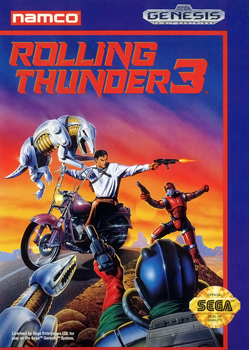
The Sega Genesis (Mega Drive in the rest of the world), received a port of the game that included cut scenes and additional levels that featured new weapons and bosses. It was apparently successful enough to warrant Namco producing a third, Genesis exclusive game, Rolling Thunder 3, released only in North America in 1993. Gameplay-wise, it took a bit of a step back, once again only being single player, where part 2 was 2-players. But on the other hand, they greatly expanded the weapons format. Where the first and second games only made use of pistols and temporary machine-gun upgrades, in Rolling Thunder 3, you can choose one of 9 different "special weapons" before each stage begins, and you get two separate fire buttons, one for your regular pistol, and one for the special weapon. The special weapons, once out of ammo, can't be used for the rest of the game, thus maintain the strategic element of gameplay. Another way the game differs, is that the levels now have no time-limit: instead, if you take too long, a sniper will eventually come out and try to kill you. Story-wise, the game seems to be a companion piece to Rolling Thunder 2, where while our heroes Leila and Albatross are busy fighting the main Geldra forces in that game, in RT3, a new hero, special agent "Jay", is chasing after Geldra's "Number Two" in command, another green-faced mother-fucker named "Dread". In an era when the Super Nintendo tended to get most of the cool third party published exclusive games, Rolling Thunder 2 and 3 were an exception to the rule.


Albatross, Leila Blitz, and................Jay. Just Jay.


All in all, while I'm not as experienced with the sequels, I need to play them more, because the original Rolling Thunder will always have a special place in my gaming heart. If you've never heard of or never had a chance to play these games, find a way to do so (however that may be), because there are fun times to be had, guaranteed. And give my old pal "Maboo" a kick in the balls for me while you're at it.


Thursday, January 30, 2014

My Favorite Video Games

As a follow up to my last article, which covered my top favorite video game companies, now I'm going to discuss a much harder list to really pin down: my favorite video games of all time. The top five or six are pretty easy. It's everything from then on that starts to get a little messy, as different games have been higher on that list at different times, some rising, some falling, and "what really deserves to make it in over what else" of course becomes an issue. Following similar criteria to my favorite developer list, my top favorite games of all time have to be games that I not only enjoyed the most when originally playing them, but also games that are virtually "timeless" to me, games that I can come back to and still enjoy at almost any time. So with that in mind, I'm going to say the first five to maybe seven games are covered. The rest, it still gets messy, but seeing as how I'm going to try to limit myself to no more than ten or so tops, it's gonna have to work itself out somehow.

Also, given the number of games and the nature of my writing, I'm going to be challenging myself to TRY to keep my comments on each game as short as I can manage. I can and most likely will cover many or perhaps even all of these games more in depth in their own articles someday, so we'll see how I do. And away we go!


Absolute Perfection.


1. Super Mario Bros. 3
    Publisher: Nintendo
    Year: 1988 (1990 in NA)

So if you've been following Retro Revelations for a decent length of time, you already know that my favorite game of all time is, hands down, Super Mario Bros. 3. It was the first game (after a brief fling with SMB1) that I fell head-over-heels in love with, it was my first true gaming obsession, and it was a game that, no matter how many other games I got as a kid, even after I got my Game Boy later on, I would still come back to it. I would still play it through every once in awhile, and not surprisingly, still have a blast whether it was my 20th playthrough or my 100th. As for why I love it, it's hard to sum up in just one paragraph. But if I had to try, I would say that it is, simply put, gaming perfection. There is not a single true flaw I could care to point out about this game, it was Nintendo taking their Mario formula, and NES gaming in general, and honing it to it's absolute peak. The graphics are timeless, the music is still some of the catchiest in history, the gameplay is turn-on-a-dime perfect, the enemies, the worlds, the cool power ups, the imagination and inventiveness. Many of these elements found their way into future Mario games, but in this man's opinion, never did all of those things coalesce into one beautiful, flawless package of greatness the way SMB3 did.

To me, it is the greatest video game ever made.


Arguably the coolest lineup of bosses ever assembled.

2. Mega Man 2
    Publisher: Capcom
    Year: 1988 (1989 in NA)


Only one game, in my mind, comes even remotely close to the perfection of SMB3, and that is Capcom's classic Mega Man 2. In the long franchise of Mega Man, even though they gave Mega Man more powers and abilities, even though the games got bigger, and the graphics got better, etc., Capcom never QUITE hit it out of the park with any other single entry in the "Blue Bomber's" games, than with this one. This game lacks the useful slide feature that is introduced in it's follow-up Mega Man 3, or the charge shot "Mega Buster" ability that debuts in Mega Man 4. It lacks the cool robo-dog pal Rush, instead having generic proto-type platform items. And as mentioned already, it's not as long as games from MM3 onward would become, only having one final Wily's Castle area.

But, in spite all of that, this game is as close to perfect as Capcom probably ever got with any game, with maybe one major exception that I'll get to later. Mega Man 2 just has "it". Again, it's somewhat hard to quantify in so few words what makes it so amazing. Again, the graphics are timeless, the music is one of the most rockin' video game soundtracks of all time, the gameplay is tight and easy to get into, the bosses and stages are awesome, Wily's Castle has some of the coolest moments in the entire series. And to top it all off, it has one of the single coolest ending/credits sequences of any game ever. I will always remember, one of the first times I ever beat the game, getting up and dancing around the living room to that awesome theme song that plays as the credits roll.


Something so amazing, that a pink cream-puff could be such an awesome game icon.

3. Kirby's Adventure
    Publisher: Nintendo
    Year: 1993

This game is one of the primary reasons why I was, as a poor kid growing up, so lucky to still have a system in the NES that got a healthy dose of new games for it at least through 1993, and still continued to see releases until late 1994. Only just getting my own NES in late 1990, not getting a Game Boy until Christmas 1993, and not getting a hand-me-down SNES from a cousin of mine until Christmas 1995, you could say as a kid gamer I was a bit behind the curve. But lucky for me, even though the SNES debuted in North America in 1991, old grandpa NES got some of it's coolest games between the years of 1991 and 1993, which means I still had cool new games to rent (and on the rare occasion when I was really lucky, own). Kirby's Adventure was one of those games, and while I would not say it reaches the pure, complete level of perfection that Super Mario Bros. 3 does, or that Mega Man 2 just about does, it still comes pretty damn close. Graphically speaking, Kirby's Adventure was one game that really impressed, and pushed that old NES hardware to it's utter limits, in an era when arcades, SNES and Genesis were wowing everyone. Taking place in Dreamland, the game is just so chock-full of color, vibrance and imagination, with a sweet soundtrack to boot, that it's hard not to like it.

But the REAL selling point, the real thing that got me hooked and blew my pre-teen self away, is the power up system. Similar to Mega Man, where he beats a boss and then gains a version of their attack, with Kirby they took that to a whole new level, where now within any given level, or even section of a level, Kirby runs into a plethora of enemies, and if he swallows them instead of spitting them out as stars, he gains their power. And the real kicker is, in this NES classic, Kirby has a grand total of 25 different powers available to him, outside of his own natural sucking, sliding and floating abilities. And especially for an old 8-bit game, that is an absurd amount of power ups. That one feature alone kept Kirby fresh and fun, even if you've played it 100 times.


When it comes to role playing games, this one is King.

4. Final Fantasy IV (II in NA)
    Publisher: Squaresoft
    Year: 1991

As mentioned in the previous article, the first rpg I ever really played, outside of perhaps Sorcerian on PC, was Final Fantasy 1 on NES. I enjoyed that game immensely, even through it's archaic spell-buying system and insane level grinding. But when I finally got around to playing Final Fantasy "II" on SNES, it was a whole different experience. I could liken it somewhat, to first seeing and playing Super Mario Bros., and then later getting to experience Super Mario Bros. 3. I originally got exposed to "FFII" when I spent the night at a friend's house, and one of HIS friends stayed up late playing this awesome rpg. I was mesmerized, and sometime later, once I had my own SNES, I managed to finally borrow the game, and was thoroughly engrossed during my entire playthrough. I honestly love FFI, and IV, V, and VI on SNES. They are some of my favorite rpgs of all time, along with other SNES hits like Chrono Trigger, Mystic Quest, and Breath of Fire.

But why FFIV ("II") is my favorite of all time, is just.....I don't know. Again, it's kind of "perfect". One of the most amazing soundtracks in gaming history, truly epic that helps tell the game's story, and a story that is interesting, thrilling and compelling. All a challenge for a video game, especially an old video game, to accomplish. The cast of characters is second to none, some of the coolest and most colorful of any rpg ever crafted, and the game's sense of pacing and how the story unfolds, it's just really special. I clearly remember during my first play-through, there were a few times when I was legitimately like "YEAH", fist pumping in the air type of stuff, I was that into it. And it's another game where the ending and closing credits sequences totally feel worthwhile after having strived to beat the game. Many would argue that there are "better" rpgs, even in the Final Fantasy series. But to me, the SNES era was the franchise at it's peak, and FFIV was the apex of that peak. Final Fantasy V and VI are both great games. But IV is timeless.


This stage has one of the coolest tunes in game history.

5. Super Castlevania IV
    Publisher: Konami
    Year: 1991

As also mentioned in the previous article, while I dearly love the Castlevania series (though not ALL of the later entries, and the new direction it's taken sucks complete donkey balls), I didn't actually, for whatever crazy reasons, PLAY a Castlevania game until CV4 on SNES, after I had gotten my SNES at the end of '95. But once I did play it, I was totally sold, because it had everything I would have loved as a kid, and everything that made me wish I HAD played it before I was 14 years old. Monsters galore, many derived from mythology and classic monster movies. Great, dark, gothic backdrops, fun whip-slinging, monster smashing action. It's probably no coincidence that thus far, all of my top favorite games also happen to have amazing soundtracks, and CV4 is no different. The graphics, for their time in 1991, were groundbreaking, making a lot of very impressive early use of the SNES hardware, with loads of detail, and cool special effects such as a stage where the background is cylindrical and constantly spinning.

This game also introduced several cool and very useful features, not all of which were included in later entries. The most important of which was the ability to whip in eight directions, as opposed to most other classic CV games where you can only attack straight ahead of you. I love many other entries in this legendary series, but this one will always and forever be my favorite.


Mortal enemies. Awesome enemies.

6. Super Metroid (Metroid III)
    Publisher: Nintendo
    Year: 1994

In all honesty, Super Castlevania IV and Super Metroid are almost interchangeable as "Number 5" on my list. I like them both a hell of a lot, and it's rough to put one over the other. But regardless, Super Metroid is yet another game I didn't get to experience until likely sometime in 1996, two years after it's release. But that didn't stop me from once again being "wowed" and amazed. I had played the original Metroid briefly, and watched it be played at a friend's house when I was younger, but similar to Castlevania, for some reason I never rented it myself in my childhood. So in many ways, Super Metroid was also my first real Metroid experience, and I was again hooked once I started playing it. From that awesome, creepy opening sequence aboard the attacked space station, to those tense opening areas exploring the surface of the planet Zebes.

The game exudes a dark, brooding mood, and translates the feelings of isolation and survival incredibly well. And of course the main hook of the game, the true fun of the game, comes with it's open sense of exploration. An action game at heart, with a deeper and more-sophisticated-than-usual-for-it's-genre subtext, Super Metroid also established many gaming conventions that would be liberally "borrowed" by other games for years to come. And it has to be said, Samus Aran is one of the coolest game heroes of all time.


The original "black and white" version, to me, is still the best.


7. The Legend of Zelda: Link's Awakening
    Publisher: Nintendo
    Year: 1993

I'm not 100% certain that this is the first Zelda game I ever played. I know that I played the first two, at least a bit, and I am certain that I did at some point rent Zelda II (a very hard but very underrated game). But when I got my Game Boy for Christmas 1993, Link's Awakening was one of the games I got with it, and thus it was, again, my first REAL full-blown Zelda experience. And again, like the two previous entries on this list, it was the game that made me fall in love with it's larger franchise, a game that I became totally engrossed in. Playing on that clunky old gray Game Boy, with an even clunkier "Light Boy" attachment so I could actually see the damn screen, would probably seriously test my adult level of patience. But I was a real trooper as a kid when it came to shit like that, and I really didn't care, so long as I was having fun, which where this game is concerned, I surely was.

Why is this my favorite Zelda? That's a good question, because I do really like Zelda II, despite it's balls-hardness, and I also absolutely adore Twilight Princess for the Gamecube, my favorite 3D Zelda. In fact Twilight Princess at one point occupied this spot on my list, and in some ways, still deserves it. But upon further reflection, and upon recently going back and playing this again on my Super Game Boy (one of the coolest inventions of all time), I had to settled upon the simple truth that while I absolutely love Twilight Princess, there is something about Link's Awakening that I enjoy that much more. It certainly helps that at one point in the game you get to walk around with a Chain Chomp from Super Mario Bros. 3. Also, I can't praise this enough: a feather item that gives you MANUAL JUMPING. Praise the Goddesses.


Famous last words: "HAH!"


8. Actraiser
   Publisher: Enix
   Year: 1990 (1991 in NA)

Yet another game I was treated to after finally getting my own SNES, Actraiser is a very unique title indeed. One part world building "Sim City" type game, one part badass action side-scroller, it features a seamless blend of disparate genres that hadn't really been tried before, and hasn't really been done since. This was another game that I initially borrowed from a friend, but eventually wound up owning, and it was yet another game that I was totally enamored with upon playing it. Yet ANOTHER game with an absolutely amazing soundtrack, this one in particular being very epic and symphonic (to the best of the SNES sound chip's abilities). And yet another very early SNES game that featured absolutely breathtaking, gorgeous sprite-based graphics. It didn't really "push the hardware" in ways like Super Castlevania IV did, but at the same time there were few other games to come along on SNES or Sega Genesis that really could match up to this game's level of detail and aesthetic. The action sequences are very tight and fun to play, and the world building is addictive in it's own right, accompanied by, to me, the coolest (and most "gets-stuck-in-your-head" catchy) tune in the game. They honestly could have made an entire game that was just the world-building part of Actraiser, but on a grander and expanded scale, and it would have been awesome. Yet, it is that perfect marriage of "sim" and action gameplay that makes Actraiser the unique and (yup I'm gonna say it again) timeless experience that it is.


So strange, yet so awesome.

9.  Pikmin
     Publisher: Nintendo
     Year: 2001

The first 3D game on my list (since I replaced Twilight Princess with Link's Awakening), it should be said that I never personally owned the console this was released on, the Gamecube. I intended to buy one eventually, but I wasn't quite as into gaming during that GC/PS2 era. At first because of a lack of funds, and later just a lack of commitment to the idea, by the time I was finally ready to get myself a Gamecube when Twilight Princess was going to come out in late 2006, the Wii was already going to be coming out, and so I just waited and (after waiting til February before I finally got one) got the Gamecube games that I liked for the Wii, which is totally backwards compatible. But, there were a few Gamecube games I really did enjoy, all of which I played on my friend Harold's system. Pikmin was one of those, a game we rented together but I wound up playing, even staying up most of a night to try and beat it at his house.

It's a very odd and quirky little game, but it has a distinct charm and unique personality, not to mention very addictive gameplay, which sees you control a tiny alien Captain Olimar, and use strange little plant creatures which he named Pikmin, to help him find the missing parts of his crashed spaceship. I was hooked from the first level, and this is one of the few games in my adult life that I got so engrossed in that I tried to beat it in one sitting. The unique "strategy lite" type gameplay, where you explore natural settings and direct up to 100 Pikmin at a time to fight monsters or collect treasure or parts for you, is really a blast, and I have never played any other game quite like it. In certain respects, it's sequel Pikmin 2 is a superior game, with no set-number-of-days time limit, and a heavier focus on treasure collecting, but because I fell in love with Pikmin 1 first, and had such a great time with it, it deserves this spot on my list.


"HADOKEN!"


10. Street Fighter II
      Publisher: Capcom
      Year: 1991

The question of what game to include in this final spot, was and is a tough one. There are many games that deserve to be included, which now wind up as "honorable mentions" (because I don't want the list to go on too long), such as but not limited to: Mighty Final Fight, Star Fox 64, Mario Kart 64, Zelda: Twilight Princess, Castlevania: Symphony of the Night, Adventure Island II, etc. All of those games are totally worthy of a "#10" spot on this list, but the reason Street Fighter II gets the nod over any others, while it was a tough call, is rather simple. It comes down to the fact that, while I love all of these other games, and have at various points in my life spent a lot of time playing them, Street Fighter II is the only game out of all of them I can genuinely say, at one point in my childhood, was an obsession of mine.

I explained in the last article how I rarely ever got to play it, because I didn't have a Super Nintendo and my grandmother rarely ever gave me quarters to play it in the arcades. So to me, it was somewhat of a "Holy Grail", it was a sacred thing that I obsessed over, perhaps directly BECAUSE I only got fleeting tastes of it, and was never (till much later in life) truly allowed to get my fill. It was the one game, out of all the games that I fell totally in love with at some point, that I didn't get plenty of time to sit down and really explore and enjoy. So because it was somewhat of a "forbidden fruit", or at least hard as hell for me to ever get to actually play, it just made me want it that much more.

Don't get me wrong, when I DID get to play it, I certainly loved what I experienced, and to this day, it remains, even in the midst of so many other greats, my favorite fighting game of all time. That fact alone merits it's inclusion in this list. But that isn't just it. Street Fighter II, in it's own way, is as "perfect" a game as Mega Man 2 is. It is the other game I mentioned earlier, the only other game Capcom ever made that was really just a total package. Mighty Final Fight on NES is close, the only thing holding it back being missing one of the levels of the arcade game, and not having 2-players. But Street Fighter II, it shares many elements with Mega Man 2, timeless graphics, a great soundtrack, a truly unique and colorful cast of great characters, and gameplay so good that almost every fighter after it tried to emulate it's success.

Street Fighter II, whether we're talking about the original version, the "Championship Edition" or the "Hyper Fighting/Turbo" edition, is just a true classic in every sense of the word, and in my mind, I don't think any fighting game is ever going to really match that perfect combination of elements that made it great.


So there you have it. There are a lot of other games I could mention, but I've already written enough. Even my "limited comments" (for most of them), while successful, turned into some rather hefty material. What can I say? When it comes to stuff I love, I guess I just love talking about it, and I can't help but go into detail and talk at length. It just kind of flows out, and that just shows my passion for these subjects. I realize that it might seem kind of odd that my #1 favorite game of all time got possibly the least said about it on this list, but that's okay. It would honestly take an entire dedicated article to explain all the reasons why that game is so awesome and why I love it so much. And trust me, at some point I probably will. For now, I hope you enjoy the list, and don't hesitate to share some of your own favorite games with me in the comments below!

Till next time, Cheers, and Happy Reading!