Showing posts with label Silver Screen Stories. Show all posts

Sunday, October 12, 2025

Silver Screen Stories: Night of the Demon


It's Halloween time again, and for 2025, I thought I'd talk about one of my favorite classic horror films, the 1957 British classic, "Night of the Demon". It's a lesser known movie, but in this man's opinion one of the best horror films ever made, of any era. It also happens to be one hell of a "supernatural drama", or "psychological thriller", in an era when the latter especially, was not very common. 


The U.S. poster.


It was also released in 1958 in the United States, under the title "Curse of the Demon". However, it was shortened for some stupid reason, by roughly 14 minutes, and while it's still a good movie, the U.S. audience was definitely cheated, as some of the cut scenes help round out the story and make things make more sense. I first saw it, most likely, in the late 2000s, once I started regularly renting movies from Netflix (back when it was for renting DVDs, and nothing more). I can't honestly remember if I saw the "Curse" or "Night" version first, but either way, I loved it from the start. It's definitely not your average 50s monster movie (though I adore those with a burning passion).  


Stonehenge has nothing to really do with the plot, but it's still a cool visual.


The film stars Dana Andrews, a great and incredibly underrated (and not very well known) dramatic actor. One of his best films, was a little known suspense/drama called "Zero Hour", which just so happens to be the movie that the 1980 comedy hit "Airplane" copied, some scenes note for note. But "Night of the Demon" is another of his bet roles, because he brings a gravity and soberness to the character, and the story, that really grounds the movie, and makes it feel like serious business. Andrews plays Dr. John Holden, a prominent psychologist, who also specializes in "debunking" supposedly supernatural and psychic phenomena. He arrives in England to give a lecture on just such a thing, helping to debunk a supposedly "magick" cult, when he discovers that his colleague, Professor Harrington, has met with a mysterious death.


A parchment of runes.


The film begins with an opening scene showing Harrington, frantically trying to meet with one Julian Karswell, a rich eccentric who is an alleged "sorcerer", with many local followers. It seems Karswell arranged for the Professor, who was publicly criticizing him and his cult, to receive a supposedly "cursed" parchment of runes, like the one seen above. And the Professor had come to believe, for whatever reasons, that the curse was real, and he begged Karswell to revoke it. However, since the parchment had already flown into a fireplace, seemingly of its own accord, and burned to ashes, Karswell simply states he'll "do what he can", after the Professor promises to publicly recant. Of course, the mysterious Mr. Karswell knows something we the audience don't, as while making his way home, relieved, poor Professor Harrington finds himself accosted by what seem like supernatural forces, and he dies.


Dr. Julian Karswell, the central figure in the tale.


 While Dr. Holden's international colleagues seem to think there might be something to the "supernatural" elements surrounding Harrington's demise, Holden himself remains ever the staunch skeptic, refusing to believe there is any such thing. He insists that there must be a rational explanation for these events, and proceeds to the British Museum Reading Room, to do further research for his upcoming presentation on Karswell. He happens, by supposed chance, to run into Karswell himself while there, where the man appeals to him, to drop his expose, and even offers to allow Holden to come to his mansion, to check out a rare book on magick that seems to be missing from the Museum Library. What Holden doesn't see, however, is that when Karswell "accidentally" knocks over some papers, when returning them to Holden, he had slipped in, you guessed it, another sinister parchment...


The brave leading lady.


Dr. Holden, while attending Professor Harrington's funeral, meets his niece, Joanna Harrington, whom he had previously encountered, though he didn't know it, on his airplane trip to the UK. She is trying to discover what truly happened to her uncle, whom she was very fond of. She has his private diary, which details his final days, in which it seems that certain strange events, caused him to shift from being a total skeptic like Holden, to being a firm believer that something was amiss, and his life was in danger. He had definitely come to respect and fear what he believed was Karswell's very real power. 

Joanna wants to meet Karswell, to see if she can learn anything, so they go together, Holden having been formally invited. When they arrive, Karswell and his mother and servants are holding his annual Halloween party, for the local children. Karswell himself is dressed up somewhat like a clown, performing innocent magic tricks for the kids, while his mother serves them home made ice cream. But when walking and talking alone with Holden later, Karswell shows his "darker" side. As a demonstration of his supposed power, he claims credit for a sudden strong and seemingly unnatural wind that rises, forcing them into the mansion. When Holden still refuses to believe that Karswell has any kind of "magick", and refuses to cancel his lecture and expose, Karswell, deadly serious, informs Holden that he will die in precisely three days. 


This film oozes atmosphere and mood.


Now this movie was directed by one Jacques Tourneur, a French filmmaker who had made quite a career for himself in Hollywood, throughout the '30s, '40s and '50s. He was known for a wide variety of genres, from serious dramas, to romances, to westerns, noir crime and even war films. But most importantly in relation to this film, in the early 40s, he directed three consecutive horror movies for RKO, and producer Val Lewton. Those films were 1942's "Cat People", and 1943's "I Walked With a Zombie" and "The Leopard Man". In all three cases, though most especially in "Cat People", Tourneur makes liberal use of shadows and dark rooms, dark streets and spooky atmosphere. He also plays with the audience, making them wonder if there is indeed something "more", something supernatural, at work. 

And he brings all of those tools and tricks back for Demon, though in my opinion, he outdoes those flicks, classics though they are. For pretty much the entire film, you are along for the ride with ultra-skeptical Dr. Holden, who believes that all instances of "the paranormal" are explainable, and therefor hogwash. Yet as the story unfolds, much like his unfortunate colleague Professor Harrington before him, even he, and through him the audience, begins to question. 

After their visit to the Karswell estate, while talking alone back in Holden's room, a piece of parchment he had no idea was hidden among his notes, seemingly flew (with no noticeable breeze) of its own accord, directly for the fireplace. Though unlike the Professor, Holden was spared by the timely intervention of a metal fireplace screen, which stops the parchment from burning, and allows him to recover it, unbeknownst to Dr. Karswell. But from this instance onward, as time gets ever close to his presentation, he starts experiencing a variety of things, always feeling cold, hearing strange noises, his vision blurring at times, or thinking that he's starting to hallucinate, etc. It doesn't stop his skepticism cold, but it does make him begin to wonder. 


Hallucination, or something more? 


And I feel that is a big part of what sets this apart from many other classic horror films, many of which some would label "campy" or "schlocky". From beginning to end, it takes itself, and its subject matter, seriously. It presents you with both facets of the story, that of clinical, skeptical science, and the possibility of actual "magick" and paranormal activity. The film itself doesn't seem to "side" with either point of view, not completely, instead opting to merely present you with plenty from both "sides", and focuses on telling you a good story. 

Karswell, for his part, played brilliantly by the great Niall MacGinnis, makes the movie. Dana Andrews and Peggy Cummins are fantastic as our believable and sympathetic heroes, but no story is truly great, without a great antagonist, and Karswell is definitely that. MacGinnis revels in the role, playing the arrogant and self-assured "sorcerer" to the hilt, while still not going over the top at any point. Which makes him all the more chilling, because he doesn't really come off as delusional, and he isn't your stereotpically "mustache twirling villain". No, he seems to know exactly what he's talking about, and exactly what he's doing. He seems to know how things will unfold, and seems confidence he's going to win, calmly, and chillingly confident, throughout. 

The movie leaves it somewhat to the viewers imagination, as to whether the "supernatural" things in the story are truly that, or just some kind of advanced hypnosis or hallucination. To that end, the studio made one interjection that Tourneur didn't agree with: they wanted the titular "demon" to be seen. And so while Tourneur himself had intended to keep it even more ambiguous, by only showing simply shadows, lighting and the occasional distortion or wind or smoke, the film does in fact show us a physical demon, hunting people down and seemingly attacking them. To be fair, the demon looks pretty damn good for what was surely not a big budget movie, and I also don't believe it being shown dampens or lessens what Tourneur was going for. Though I can also see why he would have wanted to show much less. 


Hey, how are ya?


Ultimately, while showing the demon could have been "cheesy" and detracted from the suspension of disbelief, it doesn't. It still works, in that it could very well be an honest-to-God "fire demon", materializing in a cloud of smoke, to smite Karswell's intended victims. Or it could just be some powerful post-hypnotic suggestion on Karswell's part, infecting their minds, and it's just coincidence that they happen to die horribly while having these horrible visions. Me, personally, I'm a spiritual kind of guy (though not at all religious), plus I've had a fascination with monsters and the supernatural since I was a kid. So I, naturally, lean towards the demon being real. But that said, I also like the attempt at ambiguity the film goes for. I like that it still leaves it up to the viewer to decide whether it was all real, or imagined. In a way, that makes it spookier and more mysterious, than if the film itself simply told you precisely what was what. 

I personally think that Jacques Tourneur is one of the most underrated, and talented, filmmakers of all time. Not exactly one of my personal top favorites, but I've also either liked, or at least appreciated, everything I've thus far seen of his. He was absolutely a master, and that isn't anywhere better on display, than in "Night of the Demon". I won't spoil the later events, or climax of the film for you, because if you've already seen it, then you know. And if you haven't, then by golly, do yourself a huge favor this Halloween season, and make sure you go find it, and WATCH it! You'll thank me.  

So I hope you enjoyed this piece, I hope you go enjoy the film, and above all, may you all have a very Happy Halloween!


Wednesday, August 30, 2023

Silver Screen Stories: Captain Sindbad


I'm back again, to talk about another of the significant things from my childhood. That being, the Arabian legend of Captain Sinbad, Sailor of the Seven Seas! I've talked before about my abiding love for one of my top favorite films of all time, The 7th Voyage of Sinbad, as well as how I discovered the other Ray Harryhausen Sinbad films of the 70s, thanks to (pre-Joe Bob) TNT's Monstervision. But now I'm going to get into what was probably the first Sinbad film I saw as a kid, and the influence of the character in my young life, in general. 


The first major Sinbad film.


Arguably the best Sinbad film.


Now it's entirely possible that I saw something like 1947's Sinbad the Sailor, starring Douglas Fairbanks Jr., or even 7th Voyage itself, on TV as a youngin' in the 80s. It's also very possible, even probable, that I saw some old cartoon played on TV, like the old ComiColor cartoon Sinbad the Sailor, or the classic Popeye Sinbad cartoon. The last is especially notable, both for featuring fantastic animation and effects (thanks to Fleischer Studios), but also for the fact that Sinbad (Bluto) is portrayed as a villain! 


Iwerks greatness.


Fleischer greatness.


Either way, while I cannot clearly recall in what form I first encountered the legendary Sinbad as a small child, I most inarguably did encounter him. He was enough of a cultural character, "out there in the ether", so to speak, and he must've left enough of an impression on kid me, that I was inspired to name my first childhood pet after him. At freshly six years old, I got my first dog, a mid-sized, white and fluffy "Cockerspaniel/Terrier mix", whom I decided should be named after Sinbad the Sailor. I even clearly remember that there was a little girl who lived behind us (I don't remember her name...maybe Sarah?), who I would talk to or play with now and then, who I introduced the dog to, and she asked about his name "Is it because he's a sin, and he's bad?". And I was like "No! He's like Sinbad the Sailor!" She clearly didn't know who Sinbad even was, but I sure as hell did!


My childhood dog, Sinbad.


Getting back around to the point, as it pertains to the first Sinbad film I ever saw growing up, because it's how I vaguely seem to remember it, let us just say for the sake of this article that it likely was the titular film of this piece: 1963's Captain Sindbad. First thing's first, let me say that I have no idea why this film put a "d" into Sinbad's name. It's entirely possible that in some versions of the old stories, his name had an extra "d". But this is the only piece of entertainment that I actively know of, where it is spelled this way. Perhaps they did it to be different, and have it stand out more? Who knows.


Cool poster art for the film.


Another cool poster.


Captain Sindbad was a King Brothers production, a smaller outfit who had mostly been known for crime and western films, but who had also been responsible for bringing the Toho kaiju film Rodan to the west, as well as trying their own hand at a giant monster feature in 1961, Gorgo. "Sindbad" is well directed, as always, by Byron Haskin, a director I have a fair amount of affinity for, thanks to classics like Treasure Island, The War of the Worlds, Robinson Crusoe on Mars, and of course this gem. It features a wonderful cast, led by Guy Williams (of Zorro and Lost in Space fame) as Sinbad, Heidi Bruhl as Princess Jana, and and Mexican actor Pedro Armandariz (known for his roles in John Wayne westerns Fort Apache and The 3 Godfathers) in a wonderful turn as the pompous and maniacal villain, El Kerim. 

Another great role, and probably my favorite character in the story, is the goofy court wizard Galgo, played by British character actor Abraham Sofaer. Production took place at Bavaria Studios, in Western Germany, which was home to a wide variety of films, such as the likes of The Great Escape, The Sound of Music, Willy Wonka and the Chocolate Factory, Enemy Mine, and The Neverending Story. 


Dashing leading man, Guy Williams.


Captain Sinbad's international crew.


The setup for Sindbad is simple enough, but bearing all the trademarks of a classic fantasy tale. The aging king of the middle eastern land of Baristan, is seemingly too old or too ill to rule, and thus manipulated by the classic "evil vizier", it is instead the wicked and cruel El Kerim who rules the kingdom in his stead. He is a military dictator, seemingly making war to consolidate power, and he intends to marry the princess Jana, to make his rule permanent. Along with all of this, he intends to capture and/or destroy the great Captain Sindbad, a hero of the people who is also Jana's beloved. Both to eliminate Sindbad's threat as a rival, as well as the threat he might pose to leading the people in revolt. 

To this end, though Princes Jana convinces the awesome (and hilarious) wizard Galgo to change her into a "firebird", so that she can deliver a message of warning to Sindbad and his crew of El Kerim's plans. But Kerim himself orders Galgo, whom he holds power over via a magic ring, to transform some of his guards into giant Rok birds, to drop boulders on their ship, seemingly eliminating his threat. 


Princess Jana and the wizard Galgo.


The evil El Kerim.


Naturally, most of the crew survives, including our beloved hero, the good Captain. Being rescued by some fishermen at sea, Sindbad sets out to try and rescue the princess, aided by some of his closest crewmen who manage to find him in Baristan. Plans go awry, however, when he discovers, much to his dismay, that Kerim quite literally has no heart. It has somehow been removed by black magic, and protected in some far off and dangerous tower, so long as it is kept safe, he is seemingly immortal and unharmable. At the very least to conventional things like swords or spears.

In the due course of events, with a mind to spoilers, Sindbad and Co. manage to learn of the heart and the tower, thanks to Galgo, and they set out to destroy it. The final act of the film is a race against time, as having refused to marry El Kerim, he has ordered Princess Jana to be executed. Because he's a real prick like that. 


The Monster from the Pit.


The Hand of Doom.


As far as how this film measures up to other Sinbad movies, I would personally say pretty well. The original 1947 Sinbad the Sailor, with Fairbanks Jr. in the titular role, is a good movie, and a fun adventure, but it barely has any of the more fantastical and fantasy elements that make, in this man's opinion, a Sinbad story great. And while Sindbad lacks, sadly, the amazing stop-motion magic of Ray Harryhausen (or one of his proteges), like 7th Voyage, Golden Voyage, and Eye of the Tiger enjoy, otherwise it is, for the most part, every bit as lush and lavish a production. The acting is on point, the story is very solid, it features some great sets and costumes. And most importantly, to a young boy, it has its share of magic and monster battles! Not stop-motion, of course, and it would have been great if they could have afforded it. But the special effects that are on display, are not shabby whatsoever. 

The effects for Galgo's magic, as well as those of the invisible monster Sindbad is forced to fight in the arena, are quite strong for the 60s, for a film that most assuredly didn't have a big budget. The giant mechanical hand which guards the heart in the tower, is also a very impressive feat of design and animatronics, for the time. Even the great Hydra-like beast the men face in the swamp, while it doesn't move the best, still aesthetically LOOKS fantastic. All told, even without stop-motion model wizardry, this movie is a testament to the strength (and superiority over CGI) of practical effects. 


My favorite Sinbad.


On a final note, where it concerns my favorite Sinbad depiction, and where Guy Williams ranks? I have stated in its own article, that Kerwin Matthews from The 7th Voyage of Sinbad is, without question, my top favorite Sinbad of all time. The dude was just the total package, and had it all. I think as far as Williams is concerned, I would almost be willing to say he is tied for my 2nd favorite Sinbad, though I think I have to still give the edge to Patrick Wayne from 1977's Sinbad and the Eye of the Tiger. Guy Williams is a great leading man, and portrays the legendary sailor very well. But there is just something about Wayne, he has a presence, and his acting was actually quite strong. He was an actor who, in my humble estimation, should have been a much bigger star. Then again, I feel the same way about Kerwin Matthews. So ultimately, I guess I'd say Williams is probably my 3rd favorite Sindbad, but that's still pretty great! 


                                                                     *****************


If you've never seen any Sinbad films, ever, I would highly suggest you give this one a whirl. In fact, I'll do you one better, and list out what I think are films, in order of "MUST SEE", the Sinbad adventures I think you should all watch. And make sure you do, because they're excellent!

1. The 7th Voyage of Sinbad (1957)

2. Sinbad and the Eye of the Tiger (1977)

3. Captain Sindbad (1963)

4. The Golden Voyage of Sinbad (1974)

5. Sinbad the Sailor (1947)

And as a fun bonus, you simply MUST watch the 1936 animated Fleischer masterpiece, Popeye the Sailor Meets Sinbad the Sailor! It can pretty easily be found online for a free watch. Cheers! 


Tuesday, August 24, 2021

The Black Cauldron: Disney's Forgotten Masterpiece


Walt Disney was, inarguably, one of the single most influential figures not only in film animation history, but film history period. He was a visionary, an innovator, and a driven workaholic, which at times made him difficult to work with (or for), but it also pushed his animation teams to expand and evolve an artform which the man himself, loved dearly. It can, and should, rightly be said, that without Walt Disney, modern animation as we know it would not be the same. It might not even exist, as we know it today. 

I will most certainly have to dedicate an article to the man himself someday, as along with the likes of Jim Henson, Ray Harryhausen, and many others, he is one of my personal heroes. But it goes without saying that when he and his company risked everything in the late 1930s, taking a massive risk in producing the first ever feature-length animated film, he was creating one of the single most important works of cinema in history. When Snow White and the Seven Dwarfs released in 1937, no one, certainly not Walt himself, knew whether it would succeed or fail. If it had failed, his company very well could have been done for good, and full-length animated movies might not be a thing today. But because it was a massive critical and box office success, not only was Disney's future assured, but he paved the way for seemingly countless animated movies to come. 


The Master.


From Disney themselves, with a dip in the 40s due to World War II,  the world received a steady flow of high-class, high quality features, a mix of original tales, and now infamous adaptations of classic stories. Most film and animation historians would agree, that the "Golden Age" of Disney animated theatrical films, lasted from 1937, until probably into the 1960s, before Walt's death in late 1966. Among those "golden" classics, beyond the masterpiece that was Snow White, were Pinocchio, Bambi, Fantasia, Alice in Wonderland, Peter Pan, Sleeping Beauty, and The Sword in The Stone. And in all honesty, while Disney's 60s output was still fantastic, for a variety of reasons, the overall quality of art and animation itself, seemed to start gradually changing (and arguably dipping) after Beauty's release in 1959. From Snow White to Sleeping Beauty, there was a premium by the studio, put on having these animated classics be as technically advanced and beautiful as possible. But starting with 1961's One Hundred and One Dalmatians, there was a very noticeable shift in the look of their movies. 

It would not be fair, nor correct, to say that the art or animation became POOR. Not by a long stretch. But comparing Beauty to Dalmatians, there is, however, a stark contrast in style. The biggest factor, as I understand it, was a major shift in animation technology, as while in the previous 16 films, Disney animators had applied ink to each individual cells (or frames) of animation by hand, with Dalmatians they began using Xerox methods to copy drawings to cells instead. This saved them a lot of time, and subsequently a lot of production cost. Apparently Beauty had been so expensive to make, that if they hadn't come up with the Xerox method, they would not have been able to afford to keep making animated films.

So it IS accurate to state that this was a literally cheaper method of animation, though it would still be unfair to state that the animation was now "cheap". It was, however, as previously stated, notably different. The films from Dalmatian onward tended to have a "grainier" look to them, I find. And most noticeable, the films started employing, for whatever reason, very visible black outlines around characters and objects. The background art also, for the most part, started being less "picturesque", and more stylized, less realistic. 


Black outlines, simpler drawings and backgrounds.


That is not to say, by any means, that the art or animation didn't still have great moments and great beauty. But it would also be dishonest and disingenuous for even the most ardent Disney fan, to not acknowledge that there was a definite drop off, from the 50s to the 60s. 1967's The Jungle Book, was the final animated feature in production before Walt died. Two more features, 1970's The Aristocats and 1973's Robin Hood, would be produced before their animation department essentially took a hiatus. For what it's worth, both Cats and Hood, are still great movies in their own right. Deservedly remembered as classics. But it is also undeniable, again, that the overall quality continued to erode. Most people, of course, are keenly aware of the so-called "Disney Renaissance", which began with 1989's The Little Mermaid, and lasted until, more or less, the early 2000s (before traditionally animated theatrical features sadly faded away in the United States). That era saw a major resurgence in more elaborate and more expensive art and animation. No more black lines, no more "lesser" looking animation or scenery.

But in-BETWEEN that Golden/Silver era, and the 90s "Renaissance", was a whole other era of Disney animation. An era less talked about, less known about, and in some circles, much less highly regarded. Unfairly so, I might interject. And it is that era, and more specifically one film in particular from that era, that I'm here to talk about. 


The Rescuers.


For the purpose of convenience, if we're going to refer to the 1937-1959, pre-Xerox period of Disney animated films as the "Golden Age", and thus let's call the following 1961-1973 period the "Silver Age", then it only stands to reason, continuing to follow that comic book convention, that we refer to the period I'm here to talk about, as the "Bronze Age". First and foremost, it bears pointing out that there was what I consider one "In-Between" film, a leftover from the "Silver Age", that was released in early 1977, The Many Adventures of Winnie the Pooh. This is a splendid film, one of their stronger works in fact. But it is also an anthology release, with a bit of new material made to connect three previously released Winnie the Pooh short films, into one "cohesive" story. The film that I consider to be the true start of the so-called Disney "Bronze Age", also released just a few months later, in the summer of 1977, was film seen above, The Rescuers. 

While it absolutely still had some involvement (in some cases brought out of retirement), of some of the original "Nine Old Men" of Disney's animators, Rescuers also was significant for employing many new animators, among them and most influential on this particular project, Gary Goldman and most especially Don Bluth. Those names are, of course, important, because a couple years after the release of Rescuers, dissatisfied with how then-current Disney did things on the animated front, they along with many other animators, walked out and formed their own studio. Bluth films would go on to dominate much of the 1980s, not to mention shaping the animation landscape, but we're getting a bit ahead of ourselves. As far as Rescuers itself goes, while it clearly still made prominent use of "Silver Age" trademarks like black outlines and simpler backgrounds, it was also, I think, quite a bit more stylized and experimental in certain ways, compared to those earlier movies. Looking at Rescuers, and Don Bluth's later directed films (he only animated here), I think his influence is quite clear, and the film was all the better for it. 


The future?


One thing that Bluth was most passionate about, beyond wanting a return to the higher standards of art and animation practices of those early "Golden Age" days, was, in a way at least, to "treat animation more seriously". Meaning, at least earlier in his career, Don Bluth firmly believed that not only should "cartoon movies" not be made strictly with children in mind, but that (much like Jim Henson believed), children could not only handle more somewhat darker and more serious fare, but that they would even like it! On that token, I think that Walt Disney himself must have had similar feelings once upon a time, as when you look at the early feature-length output in that "Golden" era, the likes of Snow White, Pinocchio, Bambi, Fantasia, Alice, etc., those were all actually rather dark in their own way, and at times quite somber and serious in tone. The Rescuers, I feel, hearkened back to this kind of tone, as it is definitely a darker and more somber film than the company's several previous outings. 

Bluth, Goldman and company walked out during the production of Disney's next "Bronze Age" picture, which was The Fox and The Hound, a story aimed at children, but also dealing with many harsh and sobering facts of life, and nature. I don't think that Bluth had any issue with the content of Fox, but rather, he strongly disliked Disney's then-current method of doing things, how they went about producing animation. His group would eventually themselves produce the masterpiece you see above, The Secret of NIMH, a decidedly "anti-Disney" style of animated film. It was dark, it had many "scary" moments for children, it had zero song-and-dance scenes, and it tackled some pretty serious, fairly heavy and "grown up" subject matter. Yet it was a modest success, and on a personal note, one of my very favorite childhood films (and still to this day remains one of my top favorite animated films of all time). Ironically, the next project that Disney would tackle after Fox, would be far more like NIMH, far more Bluth-esque and "anti-Disney", than I think anyone would have ever expected. 


The Source.


The Heroes.


All the way back in 1973, the year of the last true "Silver Age" release, in fact, Disney was chasing after the rights to a series of fantasy novels by author Lloyd Alexander, called "The Chronicles of Prydain". Full of stories and characters heavily steeped in Welsh culture and Celtic mythology, these were epic tales of sword and sorcery, seemingly right up Disney's alley. But after taking most of the decade trying to develop the story into a "workable idea" for a feature film, and then after the animator walk-out during production on Fox and Hound, the movie that would come to be known as The Black Cauldron was pushed back to a 1984 release. Many new faces would be working on this epic project, one of whom was named Tim Burton, who had previously done some animation work on Fox and a little flick known as Tron. While his tenure on the production of Cauldron wasn't long, he did do some conceptual character art for the film.

Now it needs to be acknowledged up front, after all of my prattling about animation history, where it concerns Cauldron as a film, that it is widely, and I would personally add QUITE unfairly, considered by many film buffs to be "the film that almost killed Disney". It's also considered by many, again unjustly, to be one of the "worst films Disney ever made". The first claim, I'm sorry to say, is at least PARTIALLY true, but we'll get into that in a moment. The latter, however, I would most strongly argue, could not be any further from the actual truth. The production of Cauldron was a rough and somewhat infamously difficult one. Not so much because of the animators or production crew themselves, but more because of the tumultuous times that Disney as a company was going through. In the early 80s, the Walt Disney Company had, in just a few years, not one, not two, but three different CEOs. It was a time of major uncertainty for the company, and especially its animation division, which was seen at the time as not nearly as profitable as it once was. And to top it all off, with Michael Eisner coming on board in 1984, he brought with him one Jeffrey Katzenberg, who was put in charge of Disney's film production. 


Fearful omens...


The production of Cauldron had a lot of issues before Katzenberg came on board, with various names either being removed or voluntarily removing themselves. There were also various "cooks in the kitchen" over time, and thus some serious conflict in just what the tone and direction of the film should be. But ultimately, it was Katzenberg, one man, who I think had the most detrimental impact on the movie's possibility for success. After seeing the final print, and feeling it was "too scary for children" etc., he personally edited a whopping 12 minutes from the movie. And it was already finished when he did this, mind you. It was pushed back from its December 1984 release date, all the way to summer of 1985. And while perhaps nothing major was cut in his editing rampage, it still had an adverse effect on the final product, especially the climax. 

All that said, I want to be perfectly clear about something. The Black Cauldron, as a movie, is NOT a "bad" film. Not even remotely close. In point of fact, while I'll elaborate more in a bit, I personally consider it one of the best animated features Disney has ever produced, and yes that really is saying something. It is hardly a "perfect" picture. Fans of the books would swiftly point out that while it draws its material from the first two books in the Prydain series, that it is not especially accurate to them, instead telling its own story "inspired by", really. Disney fans would also, somewhat rightly, point out that Cauldron absolutely is the "red-headed step-child" of their animated feature catalogue. As stated before, a very a-typical, in many ways "anti-Disney" Disney film. But none of that, in this man's estimation, makes it a "BAD" movie, at all.


Eilonwy and her magic Orb.


The story the movie tells, in a nutshell, is that the land of Prydain has been besieged by war, from the forces of the powerful and mysterious Horned King. He seeks an ancient artifact known as the Black Cauldron, so that he might use it to raise an army of undead called the "Cauldron Born", soldiers who cannot be killed, to finally conquer the kingdom. The enchanter, Dallben, who is responsible among other things for the care of a special pig, Hen Wen, who can produce visions, fears that the Horned King seeks his pig, to use it in finding the Cauldron. Also in Dallben's care, is his assistant, a farm boy named Taran who dreams of being a great and heroic warrior. The old man charges Taran with hiding with Hen Wen in the forest, until he comes for them, hoping that will keep her from the Horned King's clutches. But his dragons find the pig anyway, when Taran was day-dreaming carelessly, and take her away. It is then up to Taran, with new friends he makes along the way, to try and get Hen Wen back before the worst is realized. 

I have heard it said that this film, among its other perceived faults, has a "weak story" compared to other Disney classics. A claim that I find to be laughable, considering that, even though it deviates from its source material (as many Disney films do anyway), Cauldron's plot is actually, while straight-forward, pretty unique. You don't often run across stories about undead wizards seeking undead armies, and prophetic pigs and mystic cauldrons. I have also seen it said that this film, unlike many other Disney classics, has "weak characters", which I also find to be rather dubious. Quite frankly, I would contend that The Black Cauldron has stronger and more interesting characters that many of Disney's highly praised masterpieces. Taran himself is a bit of a cliched "well meaning bungler who must grow up and realize his potential" type of hero, yes, but he's still a charming and relatable character. Eilonwy, while indeed an initially kidnapped princess, is hardly a mere "damsel in distress", rather being portrayed as fairly equal to Taran in the story. The goofy bard Fflewddur Fflam, whose lute always seems to bust a string whenever he's being less than honest, is good comic relief, as well as a wizened adult voice to help temper the youthful heroes. The fairy Doli, is an a-typically grumpy and stern, but likeable ally. And last but not least, Gurgi the...creature, is an all at once cowardly wretch of a sneak thief, but also a lovable (and apparently stinky) loyal friend. I actually think of all the characters, Gurgi undergoes the most growth throughout the story. 


The Big Bad.

Fearsome Foe.

The "loyal" minion.


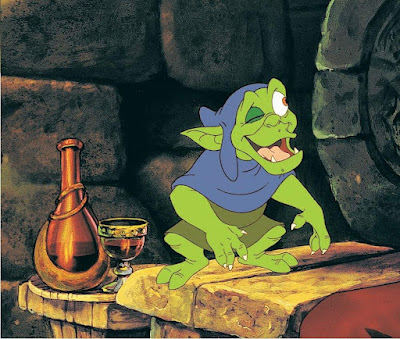
Of course no hero can be great, without a great villain, and Black Cauldron provides no exception. I would say, hands down, that the Horned King is the most fearsome, and certainly scariest baddie of the Disney lot. Having never read the books, I have to trust the internet when it tells me that, apparently, The Horned King is not any one direct character from the source material, but rather something of a mishmash of villains. Or if you prefer, more of an original Disney creation, in a very real sense, and in THAT light, I think one of their best. It doesn't get much more intimidating than a dude who is basically an undead, skeletal wraith himself. And voice actor John Hurt, who had previously voiced the heroic Aragorn in the 1978 Lord of the Rings film, does a marvelously sinister job, making the Horned One sound rather otherworldly. And no great villain is complete without a memorable minion, to which the king has Creeper, a pint-sized goblin, who seemingly lives to serve, yet also seems like he'd bolt if only he thought he could get away with it. 

The point being, that the movie is full of memorable and charming characters, including the likes of the jovial Fairy King Eidelleg, as well as the sinister yet self-serving three witch sisters straight out of Shakespearean myth, Orddu, Orgoch and Orwen. Not to mention Hen Wen the pig herself, who, while she has no lines, beyond her prophetic abilities, is quite emotive and endearing.


The Witches.


The Bard.


Gurgi the Great.


I did not, thanks to Disney's own idiotic lack of foresight, get to see this film as a child, and I really wish I had been able to. I SHOULD have been able to, and I'm certain I would have adored it, just as I adored other "dark" 80s kids movies like The Dark Crystal, The Secret of NIMH, and The Land Before Time. The reason I didn't get to, is because the film bombed at the box office, in large part I feel, due to Disney's own mismanagement and mis-marketing of it. But also due to some kind of public perception at the time that it was "too dark for a Disney movie". Which is sad, because OTHER "dark" kids or family films did well in theaters, in the 80s. But worse, because of this, and I suppose not yet understanding just how big of business home video could be yet, Disney decided to NOT release the movie on VHS at any point in the 80s, in fact not releasing it on home video at all until 1998. It also was never shown on television, on The Disney Channel, which meant that if you were like me, and didn't get to see it when it was out in 1985, then you were shit out of luck. I literally had to wait until I was around 16, perhaps nearly 17 years old, before I could finally watch this movie.

And it's funny, because at the time it finally released so I could rent it, I really didn't have much idea at all about its apparently "infamous" stature, that it was "the film that almost killed Disney", etc. To elaborate on that a bit, this movie at its time of release, was the single most expensive animated movie ever produced. And if you ask me, it shows, as it is a massive step up from that (still great) "Silver Age" fare, or even from The Rescuers or The Fox and The Hound, in the visual department. The animation in this movie is top notch, and the artwork in general is downright gorgeous. Its one of the best looking animated films ever produced, flat out. It was also the first time Disney used CGI in one of their animated features, though I'm sure the long production time didn't help the inflated budget. Either way, it probably wound up costing way more than it should have, and even though they already had their next animated movie in somewhat concurrent production, this movie losing money like it did, "put the future of Disney's animated division in serious doubt". It isn't that this movie literally would have killed Disney the company. I'm sure they would have soldiered on with live action flicks, their theme parks, The Disney Channel, etc. But I suppose it's possible that they could have been REALLY stupid in overreacting to Cauldron's U.S. box office, and decided to not release The Great Mouse Detective  the following year. 

For what it's worth, Cauldron did well in certain other markets, such as France, where it apparently did good business. It was mainly the United Stated/North American market that for whatever dumb reasons, didn't go see it in droves. And again, the thing is, I don't believe that Cauldron failed because it was "dark". Not simply on that fact alone. Don Bluth went on to have MASSIVE success with "darker", more serious animated fare, such as An American Tale and The Land Before Time, within the same time frame, from the same audiences. So either Americans really were holding Disney itself to a silly double-standard, or I don't know...maybe Disney really did mismanage the film's release. What I do know, is that I hardly think the content of the movie itself, can truly be blamed for its lack of monetary success. And while not AS much so, Disney's following 80s movies, Mouse Detective and Oliver & Company, had similarly darker tones, but found at least moderate success themselves. 


The Cauldron in Question.

Creepy dudes.


I would hardly go so far as to try and argue that this film doesn't have flaws. In fact with the nature of the production, and the 12 minute hack-job, it was inevitable that it would have some. However, I would argue that the movie does not have any GLARING flaws, and I do feel fairly justified in considering Cauldron to be, in spite of the production, one of Disney's strongest works. I believe it really deserves a second chance by audiences, and a more sincere reconsideration on its merits as a movie. Because it really is a great piece of work, beautiful to look at, interesting story, compelling and likable characters, scary bad guy, dark and creepy atmosphere but genuinely funny moments of levity. It has very solid writing, good acting, with voices by veteran character actors like Freddie Jones, Nigel Hawthorne, John Hurt, and Phil Fondacaro (not to mention narration by the great John Huston). A very nice score by Elmer Bernstein. And in spite of the stupid cuts, good flow, as the story really doesn't drag at any point.

This film really doesn't come up sorely lacking in any area. And I think if more people gave it a genuinely fair shake, public opinion of it would improve dramatically. This film suffers mostly from what I fully consider to be a poor reputation, dating all the way back to 1985, its financial failure, and Disney's stupid decision not to release it on VHS. If they had done just that one thing, I earnestly believe that it would have become a hit on home video (as many movies that didn't initially do well in theaters did), and people would consider it a cult classic. What's more, as an aside, while I like The Lion King, and love Aladdin, overall I like the "Bronze Age" output more than the revered "Renaissance" output that followed it. Rescuers, Fox & Hound, Black Cauldron, Mouse Detective, and Oliver & Company, that's a pretty damn strong lineup if you ask me.


Magic swords are pretty much always awesome.

The most poignant moment in the movie.


For me personally, to tell the truth, when I did finally first get to see this in my teens, for whatever silly reasons, I seem to vaguely recall not being that into it. I couldn't tell you why, now, though I can say that I did  the same thing on initial viewings at that age of several OTHER movies I would go on to absolutely love. But when I gave it another chance myself, years later, in my 20s, I did fall in love with it. My reasons for liking it so much, and coming to regard it so highly, I suppose you could say are varied. For one thing, I'm huge into mythology and folklore in general, especially Celtic stuff. I grew up a massive monster nut, as many of you know, and usually gravitated towards anything that had monsters, or magic, and cool adventures in general. And this movie has all of that. So it definitely appeals to the kid in me, who somehow magically hasn't fully died over my crappy adult lifetime. 

But it also has things that appeal to the cerebral adult in me. Such as the relationship between Taran and Eilonwy. I love the fact that she isn't a helpless or airheaded damsel. In fact when he first meets her, she is showing initiative, finding her way out of her captor's dungeon. If it weren't for her, Taran might not have escaped himself. I'm less a sucker for the stereotypical "strong, independent female" (though I do like such characters a lot, when done RIGHT), than I am a total sucker for the kind of relationship between a hero and heroin, that is totally equal, as in they need each other, have to rely on each other, and wind up saving each other. Which Taran and Eilonwy definitely do. In fact, of the four main heroes of the story, all of them get their moments to shine, their times to be brave, and to matter. You don't always get that with stories, let alone movies. And while it's major *SPOILERS*, as the picture above hints, possibly the strongest moment in the entire film, is when Taran is going to sacrifice himself to the Cauldron to stop the Cauldron Born, but previously cowardly Gurgi stops him, insisting that Taran matters more, and opting to himself jump to his doom instead. Naturally, in the end they get Gurgi back, but it is still a super poignant, tear-jerking kind of moment. *END SPOILERS*

So as I often end these pieces by saying, if you have never seen this movie, or haven't seen it in a long time, do me a favor, do yourself a favor...hell, do the MOVIE a favor, and give it a first/second/whatever chance. It really is a great, super underrated work, and I really do believe, in its own way, a bit of a masterpiece. The Black Cauldron is a very good movie, at the least, and I truly feel that it deserves to be recognized as such, after all this time. 


Saturday, November 30, 2019

Silver Screen Stories: The 7th Voyage of Sinbad


Growing up as a child in the 80s and early 90s, the legendary figure of Sinbad the Sailor, was something of a hero of mine. I don't remember at what age I first saw a Sinbad film, but it must have been young enough, because when I was freshly 6 years old, I got my first dog, a fluffy white terrier mix that I named Sinbad. Clearly, the character was in my kindergarten age consciousness enough, that I chose that name, and was aware who the mythical sailor was.

I'm going to venture a guess, that the first Sinbad movie I ever saw, was not one of Ray Harryhausen's masterpieces. Instead, it was probably a film that I'll get to in a few moments. To start with, of course, the stories of Sinbad, for the unfamiliar, originated as late entries into the infamous "1001 Arabian Nights" story collection. The same collection that characters such as Aladdin, and Ali Baba came from. If you actually look at the old stories, much like actually looking at the stories of Greek heroes like Jason, Heracles or Perseus, you'll see a character who looks far less virtuous and heroic than what we know and think of in modern media. Let's just say that I'm glad I didn't read his stories as a kid, for I likely wouldn't have been nearly as big a fan of him.


Animation innovator Ub Iwerks' take on the character.


Fellow innovator Max Fleischer's unique, villainous take.


The first two depictions of Sinbad on film, were actually cartoons. The first, produced by Ub Iwerks studio after he had (temporarily) parted ways with Walt Disney, was a 1935 theatrical short, which featured the typical "Disney-like" whimsy that Iwerks brought to his productions. A year later, Disney's primary competitor on the theatrical short front, Fleischer Studios, led by brothers Max and Dave Fleischer, released their own, more unique take on the character. Max Fleischer had been an innovator on the animation scene, pioneering advanced techniques like Multi-Plane and Rotoscoping. With his biggest success of the time, predating his great Superman cartoons, Popeye (along with Betty Boop and others), he was giving Disney a run for his money. And when he saw that Disney was preparing a feature-length animated film, something risky and unheard of at the time, he saw that his own dream of an animated feature was possible.

So he took his top star, Popeye the Sailor, and set him up against his rival, Bluto, playing the part of a more vain, villainous take on Sinbad the Sailor. A duel, if you will, of which great sailor was better. The 1936 Popeye the Sailor Meets Sinbad the Sailor, was a double-reel cartoon, clocking in at about sixteen and a half minutes. Fleischer would continue to use Popeye in other short films, where he would continue to experiment and up the ante, in stories based on Ali Baba and Aladdin, working his way towards his 1939 feature release, Gulliver's Travels. Of the three extended Popeye "specials", however, the original Sinbad one was and remains the most popular. Personally, what stands out in the Sinbad Popeye cartoon, aside from the usual humor, was Bluto's great turn as a boastful, bully Sinbad, and his island of various animals and monsters. The one thing the two very different Sinbad cartoons had in common, was the giant mythical monster bird known as Roc, said to be big enough to carry off elephants in its claws. The Roc featured in one or more of the original Sinbad stories, and would be important in a certain future film.


The first live action Sinbad.


Sinbad would first see representation in a live action film, in the more comical 1942 Arabian Nights, from Universal Studios. There, he was played by Shemp Howard of Three Stooges fame, of all people, and was more of a minor character. His first, true debut to feature movies, was in the 1947 RKO film, appropriately titled Sinbad the Sailor. Starring dashing Douglas Fairbanks Jr. in the titular role, with Maureen O'Hara as the beautiful Shireen, this story is much tamer than the later Sinbad adventures. The plot focuses on Sinbad learning of the treasures of Alexander the Great, and his adventures trying to find them. There is little to no real magic or supernatural happenings in this film, which makes it lesser in my eyes (and many other fans', most likely). But it's still a solid film for what it is, and Fairbanks makes a good Sinbad. A few years later, in 1955, RKO released another movie entitled Son of Sinbad, which featured western cowboy star Dale Robertson in the role of the legend's alleged son. It too featured no real magic or epicness. I wouldn't see either movie until my adult years anyway, which is just as well.


Now THAT'S what I'm talkin' about!


While it came it several years later than the movie we're here today to discuss, the first Sinbad movie I probably saw as a child, on TV, was 1963's Captain Sindbad. I'm not entirely sure about the alternate spelling of the name, perhaps they just wanted to be different. But all the same, THIS was the kind of Sinbad tale the character deserved. While it lacks, and seriously could have benefited from stop-motion magic like Harryhausen's, this MGM production is still packed with all of the magic, and wonder, and adventure you could want in such a fantasy feature. Starring Guy Williams as "Sindbad", the tale includes threats such as an arena battle with an invisible monster, a deadly Hydra, and a magically guarded tower. I think this film deserves its own article someday, but for now, it's enough to say that it is likely this that left the impression on me as a child, and inspired me to name my dog after the hero.


The cover of my VHS copy.


As I've explained in previous articles, my love of both Godzilla and Harryhausen films, really both exploded thanks to our finally getting a VCR player around 1989/90 or so. Just as Godzilla vs. The Sea Monster was likely the first of his films that I got to own, The 7th Voyage of Sinbad was definitely the first (and only) Sinbad movie I owned in my childhood. I would get to see Captain Sindbad again on TV somewhere around this time, and I would see Harryhausen's two other Sinbad greats (The Golden Voyage and Eye of the Tiger), along with his others epics like Jason and the Argonauts and Clash of the Titans, thanks to my childhood obsession, TNT's MonsterVision.

But while I love all of those movies dearly, both in equals parts because of childhood nostalgia, but also because it's a truly great and wonderful film, 7th Voyage to this day is still my favorite Sinbad film, and live action fantasy film in general.


The film's two starring heroes.


Ray Harryhausen had, up until this film, pretty much exclusively done science fiction movies, including standouts The Beast From 20,000 Fathoms and Earth vs. The Flying Saucers. He started teaming with producer Charles H. Schneer on the 1955 monster film It Came From Beneath the Sea, and they began regularly teaming from then on. So it was Schneer who helped bring about this first true fantasy epic Sinbad tale to the screen. Nathan Juran, who had worked with the pair on their previous project 20 Million Miles to Earth, was hired to direct, while composer Bernard Herrman, who had done great work with Alfred Hitchcock, and would go on to score other Harryhausen films like Mysterious Island and Jason and the Argonauts, would bring the action to life with fantastic music.

To play the titular hero, they cast actor Kerwin Matthews, in his first starring role. They cast the young Kathryn Grant as Princess Parisa, Sinbad's love, and Torin Thatcher, in a marvelous turn as the mysterious magician Sokurah. As the Genie of the magic lamp, they cast child actor Richard Eyer, who had previously starred in the only other film to feature the great Robbie the Robot (of Forbidden Planet fame), 1957's The Invisible Boy. All told, the cast, the music, the production, the locals and sets, and of course Ray's stop-motions magic, were all on point. The film released in 1958, becoming a financial success that would not only boost Ray Harryhausen's career, but also help lead to something of a surge in fantasy films.


Sinbad, and tiny Parisa.


The core of the plot, sees Captain Sinbad and his crew, caught in a storm, which has blown them far off course. They are trying to reach Baghdad with the Princess Parisa on time for their wedding, which will also help avert a war with her country of Chandra. The storm blows them off the shore of mysterious Colossa Island, where they disembark to gather food and fresh water. Unfortunately for them, they run afoul of a giant Cyclops, who is chasing an enigmatic magician called Sokurah, for he has stolen from them the prized and powerful magic lamp. He uses the lamp to create a barrier between Sinbad's men and the Cyclops, to aid both their and his own escape, but the Cyclops has other ideas, hurling a great boulder over the barrier, capsizing their rowboat, and causing Sokurah to drop the lamp into the sea, which the Cyclops then retrieves.

Beside himself with grief, the sorcerer is obsessed with getting that lamp back, as the genie's power is immense. To that end, he offers Sinbad a bag full of precious gems, worth a fortune, stating there is many times that treasure hidden by the Cyclops back on his island. But Sinbad refuses to turn the ship around, knowing they are already running late for he and Parisa's wedding. The wedding is set to take place, but Sokurah, unable to convince the Caliph of Baghdad to grant him an expedition back to his island, casts dark magic to make Parisa shrink to the size of a living doll. This causes her blustering father to declare war on Baghdad, and Sinbad manages to convince the exiled magician to stay and help them return Parisa to her rightful state, not knowing it was Sokurah who has caused it.


The monstrous bird, Roc.


Naturally, the last ingredient for the potion to cure her, happens to be the shell of a Roc egg, which can only be found, you guessed it, on Sokurah's island of Colossa. With Sinbad's old crew mostly refusing to go back to that accursed place, Sinbad is forced to recruit criminals from Baghdad's prison, offering them freedom in return for making the voyage. Many agree to go, but as the voyage nears its destination, they try to mutiny, only failing because of a nearby island, whose demons' wails drive men mad, and drive their ships to smash on jagged rocks. Sinbad and company are freed to save the ship, and within little time, they are back on Colossa, gigantic crossbow in tow, to help them fend off any Cyclops.


The genie, Barani.


Not to give away too much of the plot, you could probably guess that when Sinbad's dwindling crew manage to secure a piece of Roc's eggshell, that bastard Sokurah snatches Parisa, in a bid to force Sinbad to come to his hidden castle and give him his precious lamp. Before this, however, Parisa had braved to venture inside the lamp itself, meeting the genie, who looks like a little boy. He is a slave to the lamp, though there is a prophecy inscribed which states he could possibly be freed some day. Parisa promises to try and free him, if he'll teach her the words to summon his aid, which she in turn taught to Sinbad. It is thus with the Genie's help, that Sinbad finds Sokurah's castle, and rushes to the final confrontation.

One thing that stands out about this film, to people who follow mythology and folklore, is that Harryhausen took some liberties with a couple of the film's primary monsters, namely the Roc bird and the Cyclops. He chose to give the Roc two heads, both the hatchling they run across and the angry parent, perhaps to make it more imposing. Though if you ask me, a ginormous bird with one head would be pretty terrifying. And for the Cyclops, he altered their Greek myth form, of essentially just being gigantic one-eyed people, to instead being more inhuman, satyr-like beings with cloven hooves, and a horn crowning their heads. Departure or not, I love his version of the Cyclops, and I think it is one of the single most iconic movie monsters of all time.


One of Ray's gorgeous concept drawings.


From concept to reality.


Additionally, while not AS iconic in most fans' minds as the infamous skeleton fight in Jason and the Argonauts, which came five years later, 7th Voyage features a duel with a single animated skeleton warrior, seen above, which would serve as Ray's prototype for the later, more ambitious scene. Still, nothing like this fight between Sinbad and the Skeleton had ever really been done before, and Kerwin Matthews had to train with a fencing master, to the point of getting down dance-like timing, to be able to act as if he were fighting an opponent who was not truly there. This was, of course, decades before such things would be attempted with the aid of computer graphics. Not only did Matthews have to get all of his movements precisely correct, but Ray had to match the skeleton's movements up precisely as well. The final product, is one of the coolest scenes in movie history, which still looks great and stands up to this day.


That sly devil, Sokurah.


To me, as a child, I was absolutely entranced by this movie, just as much in '89/'90 as I'm sure kids/people were when it originally released in 1958. That's not only a testament to how good Harryhausen's special effects were, but also a testament to how good the movie in general is. Trust me, I have seen some movies with cool stop-motion effects, which as MOVIES go, are garbage. But to my mind, everything about 7th Voyage stands out. The pacing and cinematography are on point, the casting and acting are great, and the story itself, while simple and fairy-tale-like, is also just really entertaining. And it needs to be said that Bernard Herrman's magical score fits the mood of every scene perfectly. From the very opening of the Columbia logo, the main theme of the film kicks in and really grabs you, holding on throughout. Scenes such as the magic snake dance in Baghdad, feature such wonderfully imaginative and fitting musical flourishes and refrains, and the score never feels off or out of place. Like a good movie score should, it helps tell the story as much as the visuals and acting do.


Perhaps the most iconic scene of the film.


Of course, while I loved the entire film and watched it a ton as a kid, at that age, the part that naturally stood out the most to me, "monster kid" that I was, were the monsters themselves. And the climactic battle between a Cyclops and Sokurah's protective dragon, was the main event! I liked, and still like, the Cyclops. But even as a child, I've always had a thing for dragons, which perhaps led to my love of dinosaurs, and Godzilla, etc. One of my favorite childhood films, even though it was goofy, was the original Pete's Dragon, with me of course wishing I had a dragon friend like him. So it probably goes without saying then, that I rooted for the dragon in this fight.

Within the next couple of years of my young life, as TNT started their marathons, and other stations played late-night monster movies as well, as I said before, I was able to see Captain Sindbad again, and The Golden Voyage of Sinbad, and Sinbad and the Tiger's Eye. But while I think those are all excellent films, and I love them all a lot, to my mind, The 7th Voyage of Sinbad is still the best of the lot. As awesome as Tom Baker and Margaret Whiting are as Koura and Zenobia, or even Pedro Armenderiz as the vile El Kharim in "Sindbad", to me Torin Thatcher as Sokurah is the perfect villain. He may not even be as purely evil as those others, but his obsession with power and specifically with owning the magic lamp, push him to deliciously dastardly ends.


The Princess saving the day.


Or, for example, while the other Sinbad movies feature some genuinely gorgeous, and even cool leading ladies, for my money, Princess Parisa rocks. Not only was she beautiful, but she wasn't your typical damsel in distress. When she is shrunken to tiny size, and her whole world is ruined and her father flies off into a warmongering rage, she doesn't freak out or cry, she keeps her cool and even comforts a mourning Sinbad. And twice during the tale, it is she, using her size to their advantage, who displays great courage and resourcefulness, saving Sinbad and his crew from a cage, and later braving the magical unknown to try talking to the Genie of the lamp. She is also incredibly honorable, as even though they could use the Genie's magic late in the story, she remains steadfast in her promise to try and free him instead.

For that matter, as much as I love ALL of Harryhausen's monsters, especially the ones from the Sinbad films, none of them are AS classy or as classic to me, as the Roc, and the Cyclops, and the Dragon. And while I think that all of those Sinbad actors, from Douglas Fairbanks Jr. in the 40s, to Guy Williams, John Phillip Law, and Patrick Wayne (son of John Wayne), are good and they all owned the role in their own way, they ALL made good Sinbads. I would still argue that Kerwin Matthews was the best in the role, and at the very least, he's my personal favorite Sinbad, and always will be.


Ray and his babies.


While in many ways, the later two Harryhausen Sinbad epics, both of which feature a Doctor Who (Golden has Tom Baker and Tiger has Patrick Troughton), are even more elaborate and epic films with arguably superior effects work, 7th Voyage still stands above them as the most charming, whimsical, and complete of Ray's unofficial "Sinbad Trilogy". And while a majority of film fans and historians seem to agree that Jason and the Argonauts is Ray's greatest work, and I myself call 1981's Clash of the Titans, sadly his final feature film, to be his magnum opus, his masterpiece. I would still ultimately say that to ME, for my money, in my heart of hearts, 7th Voyage is his best overall film. And again, at the very least, it is MY personal favorite Harryhausen movie.

It actually stands the test of time in my Top 5 Favorite Films ever, which have fluctuated in position a bit, even since I wrote that article talking about them. For one thing, Jim Henson's The Dark Crystal arguably belongs in my Top 5, instead of merely Top 10. If you were to ask me right now, while the movies themselves remain the same, the position for my Top 10 favorites of all time, would look more like this:


1. The Hobbit (1977)

2. The Dark Crystal (1982)

3.
The 7th Voyage of Sinbad (1958)

4. Young Frankenstein (1974)
 
5. Big Trouble in Little China (1985)

6. Godzilla vs. Monster Zero (1965)

7. Ghostbusters (1984)

8. Throw Mama From the Train (1987)

9. The Goonies (1985)

10. The 'Burbs (1989)


But 7th Voyage has, and will continue no matter what, to remain in my personal Top 5, even over a Godzilla film, for the rest of my life.


As I always seem to say, if you've never seen this film, or ANY Harryhausen movie for that matter, then please, do yourself, your kids, your pets, everyone a favor, and watch The 7th Voyage of Sinbad. It is, in a word, delightful. And if the word "wholesome" should ever be attached to any fantasy/adventure epic, this would be it as well. It is, I'm not afraid or ashamed to state, at least as far as I'm concerned, the best (live action at least) fantasy film ever crafted.


THE master of movie magic and special effects, 1920-2013.