Tuesday, September 28, 2021

Godzilla Chronicles: Godzilla vs. Megalon


On the heels of the previous Godzilla Tag-Team match, 1972's Godzilla vs. Gigan, Toho gifted the world yet another crazy Tag-Team affair! But this time, instead of teaming with my boy Anguirus, the Big G would be seen joining forces with...Ultraman? Not quite, but close enough! And while as you can see in the poster above, the oddball Gigan is back for more action, instead of teaming up with the awesome King Ghidorah, he instead mixes his might with another monster, equally as bizarre as he! In what is quite probably the second weirdest entry of the Showa series outside of Godzilla vs. The Smog Monster, I'm about to tell you of one of the most bizarre films of my childhood. Buckle up...


Jet Jaguar


The True OG, Ultraman


Perhaps the weirdest thing about Godzilla vs. Megalon, is that aforementioned robot side-kick! The singular personality of Jet Jaguar was born out of a contest held by Toho in 1972. The contest winner would have their design featured in an upcoming Toho production! The winner was a school-boy, who came up with the very Ultraman-inspired "Red Arone", which was later reworked by Toho into what we would come to know as Jet Jaguar. Supposedly, when shown the reworked design, the kid who created "Red Arone" was quite unhappy, as it didn't resemble his creation as closely as he would have liked. But just the same, it must have been cool to be a kid, having SOME version of a character you made up yourself, featured in a movie!

Speaking of Ultraman, it was Godzilla's own special effects wizard creator, Eiji Tsuburaya, who kicked off the Tokusatsu (or "Special Filming", meaning special effects based) "Giant Robo-Man" craze, in the mid-60s. Beginning with the very X-Files-like show Ultra Q, which featured something of a paranormal investigation team, dealing with various weird creatures, aliens and monsters, in 1966, the concept later evolved into a second show which debuted later in the year, Ultraman. Ultraman featured a dedicated team of anti-monster fighters who protect the Earth (or rather, Japan) from supernatural threats. Shin Hayata, prominent member of this "Science Patrol", unbeknownst to his teammates, had fused with an alien being, and when things were too tough for the Patrol to handle, he would transform into the gigantic, robot-looking warrior known as Ultraman, to defeat the monsters. Ultraman proved to be so popular with kids, that several other VERY similar shows were created in the late 60s and early 70s, including Giant Robo, Mirrorman, and Toho's own Zone Fighter, which featured several appearances by Godzilla himself! 


Mirrorman


Zone Fighter, teaming with Godzilla.


Ironically, Toho's Zone Fighter show was produced within the same time frame as Godzilla vs. Megalon, and would debut not long after the movie itself, also in 1973. The show is considered "canon" to the Showa Era movies, and not only featured appearances by Godzilla, but villain monsters like Gigan and King Ghidorah as well! If Toho had any long-term plans for Jet Jaguar, they certainly never came to pass, unfortunately. 


Jet Jaguar's creator, Goro, and his friend Hiroshi.


Little brother Rokuro, and his weird-ass fish thing.


In the film's story, scientist and inventor Goro Ibuki, has created a sophisticated android, apparently just for fun, called Jet Jaguar. WHY Jet Jaguar? Well, that is a mystery the movie leaves unexplained. One day, when Goro, his hip friend Hiroshi Jinkawa, and little brother (whom he seems to be raising on his own) Rokuro Ibuki, are enjoying a seemingly peaceful day at a local lake. As you can see above, Rokuro was playing out on the water, with what looks like a very odd "mother fish and children" floating water-bike of some kind. No doubt another invention of Goro. And while it looks goofy as hell on the surface, I'll fully admit that seeing it as a kid, I actually thought it was pretty cool, and wanted one. Though to be perfectly fair, seeing it in action, it does seem RATHER slow moving, so maybe that wouldn't be so much fun after all? 

The boys' idyllic day at the lake is abruptly interrupted, and ruined, by a giant fissure that opens, draining the entire lake into the deep underground. After saving his kid brother with a towing line, Goro and Company, left stunned by the demise of their favorite lake, make for home. But upon coming home, they are attacked by mysterious assailants, who have broken into their very odd, cube-shaped science hut. The bad guys make a get-away, but return soon enough, as they're after the amazing Jet Jaguar! It seems they are agents of a lost, now underground civilization, the remnant of essentially ancient Atlantis, called "Seatopia". Seatopia has been suffering lately, due to earthquakes caused by the surface-dwellers' idiotic nuclear experiments. And now, they want revenge! 


An average day, down in Seatopia.


Seatopia's fashionably 70s leader, Emperor Antonio.


Surprisingly, it would seem that Seatopia's retaliation for the destruction of their own home, is going to come in the form of, believe it or not...a giant monster! In this particular case, a gigantic beetle-thing whom they worship as a god, called Megalon. Their plan seems to be, to get control of Goro Ibuki's miraculous Jet Jaguar, who they will in turn use to guide Megalon, as he hops and glides and bombs his way to the utter destruction of the surface world! Or at least Tokyo.

The problem is, those damn surface dwellers seem more clever than anticipated. After a thwarted attempt to dump poor Goro and Rokuro down the fissure in a big metal cargo box, they double back, and that blasted inventor manages to cook up a supersonic device which allows him to retake control of Jet Jaguar! He sends Jet on a mission to Monster Island, to enlist the aid of Godzilla, which forces Seatopia's Emperor Antonio to call on his own aid, this time from those deep space bastards of Space Hunter Nebula M, the very same giant cockroach aliens from the previous film, Godzilla vs. Gigan. The roaches promise to send Gigan to help, setting up the Tag-Team rematch between Godzilla and Gigan that I mentioned early in this very same article! 


New partner, same bad attitude!


As an aside, it seems that this movie was made rather hastily, after a previously planned Godzilla project had been canned at the last minute. It seems that director Jun Fukuda was left to basically write the script, based on a rough story outline, by himself, and the production took place over three weeks. Not that Gigan before it was some elaborate masterpiece, but it's a shame, as usual, that Toho, especially in the 70s, was being so cheap when it came to their Godzilla films. Because it would have been interesting, and preferable, to see what Megalon could have been, with more time, and more budget. Then again, what I just said applies to the vast majority of "genre" (science fiction, fantasy, horror, etc.) films from yesteryear, most of which were (and this applied to TV shows as well) constrained by smaller budgets and less time than they should have been given. Such fare was considered "low brow" back then, and thus it was very rare for shows, or films of such nature, to be given the kind of treatment they deserved. 


Fearsome Godzilla


Cute Godzilla


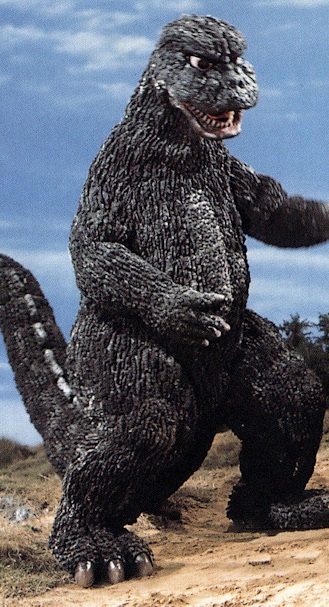
As a SIDE-side note, it must be said that the suit featured in this movie, dubbed "MegaroGoji", is a major contrast to the suit used in multiple prior Godzilla films. Where as the suit which had been used from Destroy All Monsters, all the way up through Godzilla vs. Gigan (in another cheap move, Toho was REALLY getting their mileage out of these suits in the 70s), was featured arguably the most fearsome, and certainly most angry looking face of the bunch, this new suit was quite the opposite. The "MegaroGoji" suit, which would be featured in the Zone Fighter show, as well as ultimately the final three Godzilla films of the Showa Era (including this one of course), features a decidedly softer, friendlier look. In fact, many fans consider it to look somewhat "dog-like", and is arguably the cutest looking Godzilla. Toho really wanted to drive home the fact that Godzilla was now firmly a good guy, and humanity's friend and guardian, no longer the city-trampling terror. This suit was said to be slapped together faster than any other suit in the series, but in all fairness, it looks pretty damn good if that's the case. 


My VHS cover.


Alternate VHS cover


My own experience with Godzilla vs. Megalon, comes from that period of my childhood, around 1989/90, when we finally first got a VCR in our household. As I've related in the past, I'm pretty certain that the first Godzilla movie I ever came to own on tape as a kid, was Godzilla vs. the Sea Monster. But other early inclusions in my collection, were Godzilla: King of the Monsters, Godzilla vs. Monster Zero, and the bizarre classic we're here talking about today. On an interesting side-note, if you look above to the top picture of the cover of my own VHS copy of this film, you'll see that it features rather bland, and rather odd artwork. In point of fact, that image of Godzilla, is taken from the first film in the Hesei Era series (the only one I that knew existed until I got later into my teens), The Return of Godzilla. I'm going to guess that art was used, as perhaps they figured that was the version of Godzilla that U.S. audiences might be most recently familiar with, as the American version of the film, Godzilla 1985, was I'm sure a popular rental of the time. I know I rented it pretty early into our VCR ownership. As for the bottom image? I've actually never seen that art before I did research on this piece, but while it's kinda goofy looking, I think kid me would have preferred that cover. 

 As for what kid me actually thought of this film? Put bluntly, I'd have to imagine, of the growing number of Godzilla (and related Toho) films that I came to own, or see thanks to TNT's MonsterVision, that Megalon was not one of my favorites. But that isn't to say that I disliked it, by any means. In fact, I loved pretty much any Godzilla or monster movie in general, as a kid. ANYTHING Godzilla-related was my bag back then, meaning even if it wasn't a favorite, I still loved it. A slight exception would be poor All Monsters Attack, which I saw on TV as "Godzilla's Revenge", a movie that I hardly HATED, but didn't love either. Mainly due to the fact that most of the monster footage was taken from other movies. But as for Megalon himself? I suppose I probably felt he was a pretty cool monster. The idea of Jet Jaguar, and a little boy who gets to live with his cool inventor brother, and have cool gadgets to play with, and NOT be bossed around, I'm sure held a lot of appeal. And of course this movie was actually my own personal first experience of the monster Gigan, along with the Godzilla: Monster of Monsters NES game, as I would not come to see Gigan's debut movie until a few years later, on TV. 


Those damn bullies!


As an adult, all these long years later, my opinion of the film is that it was obviously rushed. Like Gigan before it, Megalon suffers from too-short a production cycle, and a similarly cheap over-use of stock footage of city destruction and other such scenes, used from various previous Godzilla movies. Neither movie is BAD, by any means, at least not in my view, or likely the view of most fellow die-hard Godzilla fans. But it is, again, a damn shame that these productions were treated as they were, because these films deserved to be much more than they got to be. In the end, I think stacked up next to each other, even ignoring the fact that Gigan has my beloved Anguirus in it, as well as King Ghidorah, I think Gigan still comes out on top over Megalon. Megalon is, I'm sorry to say, one of the weakest of the Showa Era, and certainly of that tail-end 70s period. 

However, as a movie, it's also still a lot of fun. It is quite possibly the overall goofiest of the bunch, though it has very stiff competition from Son of Godzilla in that regard. But with the colorful Jet Jaguar, the goofy kid-brother, the cheese-ball Seatopian villains, and incredibly weird nature of Megalon himself, there's a strong argument to be made. Megalon, as a monster, while surely gigantic and fearsome in his destructive capacity, also has moments of acting, even just left on his own, spectacularly goofball. On the one hand, the dude's got metal "hands" that come together to form a drill, which he can use to bore under the ground. He also can shoot deadly electric beams from his rhino-beetle-like horn, and he can spit what seem to be highly destructive organic bombs from his mouth to boot. On the other hand, Megalon seems to like hopping across the land in a hilarious fashion, and at one point, left without the guidance of Jet Jaguar, he even busts out some "fancy gliding" dance moves for no apparent reason whatsoever! 


The Slide


Of course, THE single goofiest moment of the film, and the thing that is most infamous about this movie, is "The Slide". Known, thanks in large part to Mystery Science Theater 3000 (one of my favorite shows of all time), even to people who don't know Godzilla movies at all, let alone the exact movie it's from, this incident has become something of a Godzilla-meme unto itself. Which is both hilarious, but also a bit unfortunate. Hilarious because it IS such a genuinely ridiculous moment, and is entertaining in its own right. But unfortunate, at least in this man's view, because it is one of the single cheesiest moments in what is already (somewhat unfairly) a Godzilla series that is known by the mainstream public as being "cheesy" to begin with. It's unfortunate, I suppose I would say, that when many people who don't know or love Godzilla films as I do, think of Godzilla, they might likely associate that name most closely with a cornball image like this one. 

The move in question, comes late in the film, at the climax of the great Tag-Team battle between Godzilla & Jet Jaguar vs. Megalon and Gigan. By this point, Gigan has already had enough, and has flown off back out into space, leaving poor old Megalon all on his own. Jet Jaguar holds Megalon up, pinning his arms back, and Godzilla, backing up enough to build up some steam, proceeds to tail slide a RATHER long way, to give ol' Mega a "kangaroo kick" from hell. And he does this not once, but twice! Megalon is left so utterly defeated and humiliated, that he burrows back into the earth, and those dastardly Seatopians give the hell up for good. For what it's worth, while this is inarguably an incredibly cheesy moment, I WOULD argue that Godzilla using his own death breath to fly (backwards) in Godzilla vs. The Smog Monster, is still more ridiculous than this. 


The US poster.


The German poster...


As another aside, if you look above, you'll see a couple of the international promotional posters for this film. In the American one, taking a book right out of the promo art for the 1976 remake of King Kong, Godzilla and Megalon are depicted as fighting, in the United States, on TOP of the World Trade Center buildings. As if the sheer bulk and weight of monsters that large, wouldn't absolutely crush those buildings in the first place! And speaking of King Kong...below it is the poster for the movie in Germany. It's a bit too long and convoluted a story to fully get into, but let's just say that Germany had a long history with false advertising, when it came to promoting Godzilla (and related) movies. The general idea here, being, that somehow Jet Jaguar is actually just King Kong...turned into a robot? 


Pals.


Just hangin' with the boys.


 As with pretty much any of the original Showa series of Godzilla and related monster movies, I would honestly recommend watching this one. Not as a first or even second choice. But it's still worth seeing, and it's a fun, and perhaps unintentionally funny, ride. I'd say it's the most "70s" of the bunch", in its own way, right down to the incredibly catch Jet Jaguar theme song at the end.

I don't generally like to think of Godzilla films as something to laugh at, and it genuinely bothers me, I'll admit, that so many people do view them that way. That isn't to say that I don't recognize and even treasure the goofier, and admittedly funny moments that the series can provide. I just dislike the notion that the films' "cheesy" effects, and just the movies as a whole in general, are "bad", and something to be sneered at, or only viewed/enjoyed ironically, as in "so bad it's good, let's watch them and laugh at them" kind of fare. 

It isn't that I take Godzilla SO seriously, but I do think, viewed through the right lens and taken in the proper frame of mind, that most of these movies, have a lot more substance, and a lot more to offer, than merely laughs. These films, and especially the "Big G" himself, are very dear to my heart, and they are 100% a connection with that inner kid in me who, in spite of everything I've been through in life so far, has refused to become totally cynical and dead inside. I suppose you could say, that Godzilla is a connection to that inner child, and thus, what still remains, in the face of a VERY cynical world, of my innocence, and sense of wonder. 


                                                                ********************* 


So go watch yourself some Godzilla flicks, including this one! And I'll be back next month, with a brand new Halloween piece for all you boys and ghouls! In the meantime, stay dialed to the various Retro Revelations social media, for "Halloween Countdown" goodness.


****************************


Here is the full list of Godzilla Chronicles articles:


1. The Beginning

2. Gojira (aka Godzilla: King of the Monsters)

3. Godzilla Raids Again

4. King Kong vs. Godzilla

5. Mothra vs. Godzilla

6. Ghidorah, The Three-Headed Monster

7. Invasion of the Astro Monster (aka Godzilla vs. Monster Zero)

8. Godzilla vs. the Sea Monster

9. Son of Godzilla

10. Destroy All Monsters

11. All Monsters Attack

12. Godzilla vs. The Smog Monster

13. Godzilla vs. Gigan

14. Godzilla vs. Megalon

15. Godzilla vs. Mechagodzilla

16. Terror of Mechagodzilla


Tuesday, August 24, 2021

The Black Cauldron: Disney's Forgotten Masterpiece


Walt Disney was, inarguably, one of the single most influential figures not only in film animation history, but film history period. He was a visionary, an innovator, and a driven workaholic, which at times made him difficult to work with (or for), but it also pushed his animation teams to expand and evolve an artform which the man himself, loved dearly. It can, and should, rightly be said, that without Walt Disney, modern animation as we know it would not be the same. It might not even exist, as we know it today. 

I will most certainly have to dedicate an article to the man himself someday, as along with the likes of Jim Henson, Ray Harryhausen, and many others, he is one of my personal heroes. But it goes without saying that when he and his company risked everything in the late 1930s, taking a massive risk in producing the first ever feature-length animated film, he was creating one of the single most important works of cinema in history. When Snow White and the Seven Dwarfs released in 1937, no one, certainly not Walt himself, knew whether it would succeed or fail. If it had failed, his company very well could have been done for good, and full-length animated movies might not be a thing today. But because it was a massive critical and box office success, not only was Disney's future assured, but he paved the way for seemingly countless animated movies to come. 


The Master.


From Disney themselves, with a dip in the 40s due to World War II,  the world received a steady flow of high-class, high quality features, a mix of original tales, and now infamous adaptations of classic stories. Most film and animation historians would agree, that the "Golden Age" of Disney animated theatrical films, lasted from 1937, until probably into the 1960s, before Walt's death in late 1966. Among those "golden" classics, beyond the masterpiece that was Snow White, were Pinocchio, Bambi, Fantasia, Alice in Wonderland, Peter Pan, Sleeping Beauty, and The Sword in The Stone. And in all honesty, while Disney's 60s output was still fantastic, for a variety of reasons, the overall quality of art and animation itself, seemed to start gradually changing (and arguably dipping) after Beauty's release in 1959. From Snow White to Sleeping Beauty, there was a premium by the studio, put on having these animated classics be as technically advanced and beautiful as possible. But starting with 1961's One Hundred and One Dalmatians, there was a very noticeable shift in the look of their movies. 

It would not be fair, nor correct, to say that the art or animation became POOR. Not by a long stretch. But comparing Beauty to Dalmatians, there is, however, a stark contrast in style. The biggest factor, as I understand it, was a major shift in animation technology, as while in the previous 16 films, Disney animators had applied ink to each individual cells (or frames) of animation by hand, with Dalmatians they began using Xerox methods to copy drawings to cells instead. This saved them a lot of time, and subsequently a lot of production cost. Apparently Beauty had been so expensive to make, that if they hadn't come up with the Xerox method, they would not have been able to afford to keep making animated films.

So it IS accurate to state that this was a literally cheaper method of animation, though it would still be unfair to state that the animation was now "cheap". It was, however, as previously stated, notably different. The films from Dalmatian onward tended to have a "grainier" look to them, I find. And most noticeable, the films started employing, for whatever reason, very visible black outlines around characters and objects. The background art also, for the most part, started being less "picturesque", and more stylized, less realistic. 


Black outlines, simpler drawings and backgrounds.


That is not to say, by any means, that the art or animation didn't still have great moments and great beauty. But it would also be dishonest and disingenuous for even the most ardent Disney fan, to not acknowledge that there was a definite drop off, from the 50s to the 60s. 1967's The Jungle Book, was the final animated feature in production before Walt died. Two more features, 1970's The Aristocats and 1973's Robin Hood, would be produced before their animation department essentially took a hiatus. For what it's worth, both Cats and Hood, are still great movies in their own right. Deservedly remembered as classics. But it is also undeniable, again, that the overall quality continued to erode. Most people, of course, are keenly aware of the so-called "Disney Renaissance", which began with 1989's The Little Mermaid, and lasted until, more or less, the early 2000s (before traditionally animated theatrical features sadly faded away in the United States). That era saw a major resurgence in more elaborate and more expensive art and animation. No more black lines, no more "lesser" looking animation or scenery.

But in-BETWEEN that Golden/Silver era, and the 90s "Renaissance", was a whole other era of Disney animation. An era less talked about, less known about, and in some circles, much less highly regarded. Unfairly so, I might interject. And it is that era, and more specifically one film in particular from that era, that I'm here to talk about. 


The Rescuers.


For the purpose of convenience, if we're going to refer to the 1937-1959, pre-Xerox period of Disney animated films as the "Golden Age", and thus let's call the following 1961-1973 period the "Silver Age", then it only stands to reason, continuing to follow that comic book convention, that we refer to the period I'm here to talk about, as the "Bronze Age". First and foremost, it bears pointing out that there was what I consider one "In-Between" film, a leftover from the "Silver Age", that was released in early 1977, The Many Adventures of Winnie the Pooh. This is a splendid film, one of their stronger works in fact. But it is also an anthology release, with a bit of new material made to connect three previously released Winnie the Pooh short films, into one "cohesive" story. The film that I consider to be the true start of the so-called Disney "Bronze Age", also released just a few months later, in the summer of 1977, was film seen above, The Rescuers

While it absolutely still had some involvement (in some cases brought out of retirement), of some of the original "Nine Old Men" of Disney's animators, Rescuers also was significant for employing many new animators, among them and most influential on this particular project, Gary Goldman and most especially Don Bluth. Those names are, of course, important, because a couple years after the release of Rescuers, dissatisfied with how then-current Disney did things on the animated front, they along with many other animators, walked out and formed their own studio. Bluth films would go on to dominate much of the 1980s, not to mention shaping the animation landscape, but we're getting a bit ahead of ourselves. As far as Rescuers itself goes, while it clearly still made prominent use of "Silver Age" trademarks like black outlines and simpler backgrounds, it was also, I think, quite a bit more stylized and experimental in certain ways, compared to those earlier movies. Looking at Rescuers, and Don Bluth's later directed films (he only animated here), I think his influence is quite clear, and the film was all the better for it. 


The future?


One thing that Bluth was most passionate about, beyond wanting a return to the higher standards of art and animation practices of those early "Golden Age" days, was, in a way at least, to "treat animation more seriously". Meaning, at least earlier in his career, Don Bluth firmly believed that not only should "cartoon movies" not be made strictly with children in mind, but that (much like Jim Henson believed), children could not only handle more somewhat darker and more serious fare, but that they would even like it! On that token, I think that Walt Disney himself must have had similar feelings once upon a time, as when you look at the early feature-length output in that "Golden" era, the likes of Snow White, Pinocchio, Bambi, Fantasia, Alice, etc., those were all actually rather dark in their own way, and at times quite somber and serious in tone. The Rescuers, I feel, hearkened back to this kind of tone, as it is definitely a darker and more somber film than the company's several previous outings. 

Bluth, Goldman and company walked out during the production of Disney's next "Bronze Age" picture, which was The Fox and The Hound, a story aimed at children, but also dealing with many harsh and sobering facts of life, and nature. I don't think that Bluth had any issue with the content of Fox, but rather, he strongly disliked Disney's then-current method of doing things, how they went about producing animation. His group would eventually themselves produce the masterpiece you see above, The Secret of NIMH, a decidedly "anti-Disney" style of animated film. It was dark, it had many "scary" moments for children, it had zero song-and-dance scenes, and it tackled some pretty serious, fairly heavy and "grown up" subject matter. Yet it was a modest success, and on a personal note, one of my very favorite childhood films (and still to this day remains one of my top favorite animated films of all time). Ironically, the next project that Disney would tackle after Fox, would be far more like NIMH, far more Bluth-esque and "anti-Disney", than I think anyone would have ever expected. 


The Source.


The Heroes.


All the way back in 1973, the year of the last true "Silver Age" release, in fact, Disney was chasing after the rights to a series of fantasy novels by author Lloyd Alexander, called "The Chronicles of Prydain". Full of stories and characters heavily steeped in Welsh culture and Celtic mythology, these were epic tales of sword and sorcery, seemingly right up Disney's alley. But after taking most of the decade trying to develop the story into a "workable idea" for a feature film, and then after the animator walk-out during production on Fox and Hound, the movie that would come to be known as The Black Cauldron was pushed back to a 1984 release. Many new faces would be working on this epic project, one of whom was named Tim Burton, who had previously done some animation work on Fox and a little flick known as Tron. While his tenure on the production of Cauldron wasn't long, he did do some conceptual character art for the film.

Now it needs to be acknowledged up front, after all of my prattling about animation history, where it concerns Cauldron as a film, that it is widely, and I would personally add QUITE unfairly, considered by many film buffs to be "the film that almost killed Disney". It's also considered by many, again unjustly, to be one of the "worst films Disney ever made". The first claim, I'm sorry to say, is at least PARTIALLY true, but we'll get into that in a moment. The latter, however, I would most strongly argue, could not be any further from the actual truth. The production of Cauldron was a rough and somewhat infamously difficult one. Not so much because of the animators or production crew themselves, but more because of the tumultuous times that Disney as a company was going through. In the early 80s, the Walt Disney Company had, in just a few years, not one, not two, but three different CEOs. It was a time of major uncertainty for the company, and especially its animation division, which was seen at the time as not nearly as profitable as it once was. And to top it all off, with Michael Eisner coming on board in 1984, he brought with him one Jeffrey Katzenberg, who was put in charge of Disney's film production. 


Fearful omens...


The production of Cauldron had a lot of issues before Katzenberg came on board, with various names either being removed or voluntarily removing themselves. There were also various "cooks in the kitchen" over time, and thus some serious conflict in just what the tone and direction of the film should be. But ultimately, it was Katzenberg, one man, who I think had the most detrimental impact on the movie's possibility for success. After seeing the final print, and feeling it was "too scary for children" etc., he personally edited a whopping 12 minutes from the movie. And it was already finished when he did this, mind you. It was pushed back from its December 1984 release date, all the way to summer of 1985. And while perhaps nothing major was cut in his editing rampage, it still had an adverse effect on the final product, especially the climax. 

All that said, I want to be perfectly clear about something. The Black Cauldron, as a movie, is NOT a "bad" film. Not even remotely close. In point of fact, while I'll elaborate more in a bit, I personally consider it one of the best animated features Disney has ever produced, and yes that really is saying something. It is hardly a "perfect" picture. Fans of the books would swiftly point out that while it draws its material from the first two books in the Prydain series, that it is not especially accurate to them, instead telling its own story "inspired by", really. Disney fans would also, somewhat rightly, point out that Cauldron absolutely is the "red-headed step-child" of their animated feature catalogue. As stated before, a very a-typical, in many ways "anti-Disney" Disney film. But none of that, in this man's estimation, makes it a "BAD" movie, at all.


Eilonwy and her magic Orb.


The story the movie tells, in a nutshell, is that the land of Prydain has been besieged by war, from the forces of the powerful and mysterious Horned King. He seeks an ancient artifact known as the Black Cauldron, so that he might use it to raise an army of undead called the "Cauldron Born", soldiers who cannot be killed, to finally conquer the kingdom. The enchanter, Dallben, who is responsible among other things for the care of a special pig, Hen Wen, who can produce visions, fears that the Horned King seeks his pig, to use it in finding the Cauldron. Also in Dallben's care, is his assistant, a farm boy named Taran who dreams of being a great and heroic warrior. The old man charges Taran with hiding with Hen Wen in the forest, until he comes for them, hoping that will keep her from the Horned King's clutches. But his dragons find the pig anyway, when Taran was day-dreaming carelessly, and take her away. It is then up to Taran, with new friends he makes along the way, to try and get Hen Wen back before the worst is realized. 

I have heard it said that this film, among its other perceived faults, has a "weak story" compared to other Disney classics. A claim that I find to be laughable, considering that, even though it deviates from its source material (as many Disney films do anyway), Cauldron's plot is actually, while straight-forward, pretty unique. You don't often run across stories about undead wizards seeking undead armies, and prophetic pigs and mystic cauldrons. I have also seen it said that this film, unlike many other Disney classics, has "weak characters", which I also find to be rather dubious. Quite frankly, I would contend that The Black Cauldron has stronger and more interesting characters that many of Disney's highly praised masterpieces. Taran himself is a bit of a cliched "well meaning bungler who must grow up and realize his potential" type of hero, yes, but he's still a charming and relatable character. Eilonwy, while indeed an initially kidnapped princess, is hardly a mere "damsel in distress", rather being portrayed as fairly equal to Taran in the story. The goofy bard Fflewddur Fflam, whose lute always seems to bust a string whenever he's being less than honest, is good comic relief, as well as a wizened adult voice to help temper the youthful heroes. The fairy Doli, is an a-typically grumpy and stern, but likeable ally. And last but not least, Gurgi the...creature, is an all at once cowardly wretch of a sneak thief, but also a lovable (and apparently stinky) loyal friend. I actually think of all the characters, Gurgi undergoes the most growth throughout the story. 


The Big Bad.

Fearsome Foe.

The "loyal" minion.


Of course no hero can be great, without a great villain, and Black Cauldron provides no exception. I would say, hands down, that the Horned King is the most fearsome, and certainly scariest baddie of the Disney lot. Having never read the books, I have to trust the internet when it tells me that, apparently, The Horned King is not any one direct character from the source material, but rather something of a mishmash of villains. Or if you prefer, more of an original Disney creation, in a very real sense, and in THAT light, I think one of their best. It doesn't get much more intimidating than a dude who is basically an undead, skeletal wraith himself. And voice actor John Hurt, who had previously voiced the heroic Aragorn in the 1978 Lord of the Rings film, does a marvelously sinister job, making the Horned One sound rather otherworldly. And no great villain is complete without a memorable minion, to which the king has Creeper, a pint-sized goblin, who seemingly lives to serve, yet also seems like he'd bolt if only he thought he could get away with it. 

The point being, that the movie is full of memorable and charming characters, including the likes of the jovial Fairy King Eidelleg, as well as the sinister yet self-serving three witch sisters straight out of Shakespearean myth, Orddu, Orgoch and Orwen. Not to mention Hen Wen the pig herself, who, while she has no lines, beyond her prophetic abilities, is quite emotive and endearing.


The Witches.


The Bard.


Gurgi the Great.


I did not, thanks to Disney's own idiotic lack of foresight, get to see this film as a child, and I really wish I had been able to. I SHOULD have been able to, and I'm certain I would have adored it, just as I adored other "dark" 80s kids movies like The Dark Crystal, The Secret of NIMH, and The Land Before Time. The reason I didn't get to, is because the film bombed at the box office, in large part I feel, due to Disney's own mismanagement and mis-marketing of it. But also due to some kind of public perception at the time that it was "too dark for a Disney movie". Which is sad, because OTHER "dark" kids or family films did well in theaters, in the 80s. But worse, because of this, and I suppose not yet understanding just how big of business home video could be yet, Disney decided to NOT release the movie on VHS at any point in the 80s, in fact not releasing it on home video at all until 1998. It also was never shown on television, on The Disney Channel, which meant that if you were like me, and didn't get to see it when it was out in 1985, then you were shit out of luck. I literally had to wait until I was around 16, perhaps nearly 17 years old, before I could finally watch this movie.

And it's funny, because at the time it finally released so I could rent it, I really didn't have much idea at all about its apparently "infamous" stature, that it was "the film that almost killed Disney", etc. To elaborate on that a bit, this movie at its time of release, was the single most expensive animated movie ever produced. And if you ask me, it shows, as it is a massive step up from that (still great) "Silver Age" fare, or even from The Rescuers or The Fox and The Hound, in the visual department. The animation in this movie is top notch, and the artwork in general is downright gorgeous. Its one of the best looking animated films ever produced, flat out. It was also the first time Disney used CGI in one of their animated features, though I'm sure the long production time didn't help the inflated budget. Either way, it probably wound up costing way more than it should have, and even though they already had their next animated movie in somewhat concurrent production, this movie losing money like it did, "put the future of Disney's animated division in serious doubt". It isn't that this movie literally would have killed Disney the company. I'm sure they would have soldiered on with live action flicks, their theme parks, The Disney Channel, etc. But I suppose it's possible that they could have been REALLY stupid in overreacting to Cauldron's U.S. box office, and decided to not release The Great Mouse Detective  the following year. 

For what it's worth, Cauldron did well in certain other markets, such as France, where it apparently did good business. It was mainly the United Stated/North American market that for whatever dumb reasons, didn't go see it in droves. And again, the thing is, I don't believe that Cauldron failed because it was "dark". Not simply on that fact alone. Don Bluth went on to have MASSIVE success with "darker", more serious animated fare, such as An American Tale and The Land Before Time, within the same time frame, from the same audiences. So either Americans really were holding Disney itself to a silly double-standard, or I don't know...maybe Disney really did mismanage the film's release. What I do know, is that I hardly think the content of the movie itself, can truly be blamed for its lack of monetary success. And while not AS much so, Disney's following 80s movies, Mouse Detective and Oliver & Company, had similarly darker tones, but found at least moderate success themselves. 


The Cauldron in Question.

Creepy dudes.


I would hardly go so far as to try and argue that this film doesn't have flaws. In fact with the nature of the production, and the 12 minute hack-job, it was inevitable that it would have some. However, I would argue that the movie does not have any GLARING flaws, and I do feel fairly justified in considering Cauldron to be, in spite of the production, one of Disney's strongest works. I believe it really deserves a second chance by audiences, and a more sincere reconsideration on its merits as a movie. Because it really is a great piece of work, beautiful to look at, interesting story, compelling and likable characters, scary bad guy, dark and creepy atmosphere but genuinely funny moments of levity. It has very solid writing, good acting, with voices by veteran character actors like Freddie Jones, Nigel Hawthorne, John Hurt, and Phil Fondacaro (not to mention narration by the great John Huston). A very nice score by Elmer Bernstein. And in spite of the stupid cuts, good flow, as the story really doesn't drag at any point.

This film really doesn't come up sorely lacking in any area. And I think if more people gave it a genuinely fair shake, public opinion of it would improve dramatically. This film suffers mostly from what I fully consider to be a poor reputation, dating all the way back to 1985, its financial failure, and Disney's stupid decision not to release it on VHS. If they had done just that one thing, I earnestly believe that it would have become a hit on home video (as many movies that didn't initially do well in theaters did), and people would consider it a cult classic. What's more, as an aside, while I like The Lion King, and love Aladdin, overall I like the "Bronze Age" output more than the revered "Renaissance" output that followed it. Rescuers, Fox & Hound, Black Cauldron, Mouse Detective, and Oliver & Company, that's a pretty damn strong lineup if you ask me.


Magic swords are pretty much always awesome.

The most poignant moment in the movie.


For me personally, to tell the truth, when I did finally first get to see this in my teens, for whatever silly reasons, I seem to vaguely recall not being that into it. I couldn't tell you why, now, though I can say that I did  the same thing on initial viewings at that age of several OTHER movies I would go on to absolutely love. But when I gave it another chance myself, years later, in my 20s, I did fall in love with it. My reasons for liking it so much, and coming to regard it so highly, I suppose you could say are varied. For one thing, I'm huge into mythology and folklore in general, especially Celtic stuff. I grew up a massive monster nut, as many of you know, and usually gravitated towards anything that had monsters, or magic, and cool adventures in general. And this movie has all of that. So it definitely appeals to the kid in me, who somehow magically hasn't fully died over my crappy adult lifetime. 

But it also has things that appeal to the cerebral adult in me. Such as the relationship between Taran and Eilonwy. I love the fact that she isn't a helpless or airheaded damsel. In fact when he first meets her, she is showing initiative, finding her way out of her captor's dungeon. If it weren't for her, Taran might not have escaped himself. I'm less a sucker for the stereotypical "strong, independent female" (though I do like such characters a lot, when done RIGHT), than I am a total sucker for the kind of relationship between a hero and heroin, that is totally equal, as in they need each other, have to rely on each other, and wind up saving each other. Which Taran and Eilonwy definitely do. In fact, of the four main heroes of the story, all of them get their moments to shine, their times to be brave, and to matter. You don't always get that with stories, let alone movies. And while it's major *SPOILERS*, as the picture above hints, possibly the strongest moment in the entire film, is when Taran is going to sacrifice himself to the Cauldron to stop the Cauldron Born, but previously cowardly Gurgi stops him, insisting that Taran matters more, and opting to himself jump to his doom instead. Naturally, in the end they get Gurgi back, but it is still a super poignant, tear-jerking kind of moment. *END SPOILERS*

So as I often end these pieces by saying, if you have never seen this movie, or haven't seen it in a long time, do me a favor, do yourself a favor...hell, do the MOVIE a favor, and give it a first/second/whatever chance. It really is a great, super underrated work, and I really do believe, in its own way, a bit of a masterpiece. The Black Cauldron is a very good movie, at the least, and I truly feel that it deserves to be recognized as such, after all this time. 


Monday, May 31, 2021

Godzilla Chronicles: Godzilla vs. Gigan


We have now reached the 13th entry in this fantastic little side series! In the last Chronicle, we kicked off the 1970s, with THE weirdest, but also one of the best Godzilla films, Godzilla vs. Hedorah, aka Godzilla vs. The Smog Monster! Well buckle up, because while nothing can QUITE match that film, the weirdness of the 70s never lets up....


MAN, that diet has really worked wonders...


When I first encountered this film as part of TNT's MonsterVision, specifically as one of their "Godzilla Bash" marathons, it was called Godzilla on Monster Island. Which was apparently the US title it was given when it got brought over. An odd thing, too, because while yes, Godzilla DOES appear on Monster Island (first introduced in Destroy All Monsters), that title makes it sound as if it's the focus of the story, which of course it isn't. The proper title, which I suppose is a major spoiler for the new monster in the mix, is Godzilla vs. Gigan

My thoughts/feelings on this movie upon first seeing it then, at age 12 or 13 in the mid 90s, besides of course being excited just to SEE more Godzilla films, was kind of mixed. On the one hand, it had King Ghidorah back, who always makes a great villain, and a new addition I'd actually already seen in Gigan, due to having already owned the following movie in the series, Godzilla vs. Megalon, on VHS tape. It ALSO had Anguirus, who would go on to become my 2nd favorite Toho Daikaiju behind Godzilla himself, but I'll get more into that a bit later. 

On the OTHER hand, it also had a weird ass plot, and even from my more limited experience (not having been able to see films like Ghidorah the Three-Headed Monster and Destroy All Monsters yet), I could still tell, at least to a point, that this movie made some liberal use of stock footage from older movies. However, considering that the story basically sets up a big monster tag-team match, I'm sure that my overall experience was enjoyment.


Dental hygiene is very important!


Speaking of the plot, here it is in a nutshell. This dude, Gengo Kotaka, is a manga artist. He's trying to sell his (admittedly goofy) new kaiju creations, like Mamagon the monster of strict mothers, to manga outlets. Having no luck, he instead finds himself drawing interest from another, unexpected group. The fine folks at World Children's Land, a new theme-park dedicated to "World Peace", and featuring the wonderful Godzilla Tower you can see above, claim to like his work, and want him to do designs for their park. But of course, along the way, he begins to suspect that there's more to his new employers than is readily apparent. 

He bumps into a strange girl, running away from building security, and recovers a tape reel that she drops in her haste. Later encountering the girl, named Machiko Shima, again, and her goofy hippy friend Shosaku, they try to "stick him up" to get the tape back, with what turns out to be just a foil-wrapped corn on the cob, but he believes it to be a gun and faints. They take him back to (I'm assuming) Shosaku's apartment, and explain the truth to him: that Machiko's brother Takashi Shima, is an engineer who works for World Children's Land, but disappeared several days before. 

This ultimately leads the trio, joined by Gengo's somewhat bossy (yet martial arts bad ass) girlfriend Tomoko, to run afoul of the WCL people, as they begin to learn too much of a developing and diabolical plot. Naturally, as became common for many of these late Showa Era Godzilla movies, the nogoodnicks are ACTUALLY aliens from outer space, this time some kind of giant cockroaches to be precise, and the Earth is just the place to be it seems, so like every OTHER no good alien in the galaxy, they want it for themselves! 


The rumble of the century!


The aliens' dastardly plan, leads us to the thing we REALLY care about, which is the monster fights! Their big plan, is to use "Action Plan Tapes", to guide two awful space monsters to Earth, to wreck human civilization, so that the Roach Folks can take over. Since Invasion of the Astro Monster, every Alien-Come-Lately seems to just copy Planet X's idea, to control monsters to defeat and conquer Earth. Super lazy, right? Well this time, in addition to arguably Godzilla's most fearsome foe, King Ghidorah, returning in what would be his last Showa appearance (outside of a couple Zone Fighter TV episodes), this movie introduces us to another new monster, Gigan! 

While not AS interesting or unique as Hedorah the Smog Monster, Gigan is still one of the more unique Godzilla enemies. He's basically a freaky alien cyborg...thing. As you can see above, he's got metal hook things for hands and feet, and a deadly SAW-BLADE in his belly! He also had fins on his back, which allow him to fly. So already, the alien tag-team has some major advantage over our Earth Boys, because they BOTH have deadly weapons, and BOTH can fly! 


They've got the G-Man on the ropes!


As for the fight itself, well, referring back to the stock footage comment from earlier, Toho around this time was having some financial trouble (the entire Japanese film industry was), and so they got cheap with their Godzilla flicks, more-so than ever. For one thing, they use quite a bit of stock footage from Ghidorah and Destroy, for "monsters destroying cities" and other various scenes. Secondly, after the special effects bonanza that was Destroy, Toho changed how they filmed the Godzilla movies. Before, they would have two main film units, one to film the monster scenes, and one to film the human footage. In the 70s, they now only had one production unit to film both, and less people working on the special effects. So Ghidorah, for example, in this film is less active, less head-movement, flying, etc, because there was less crew to operate all his parts. 

Outside of that fact, the battle between the two teams is actually still fairly cool. Naturally, Godzilla's side is a bit undermanned, because poor Anguirus lacks any kind of beams or weapons, outside of the his spikes. But Godzilla's power, and Anguirus' fearlessness and determination, make up the difference, and stock footage aside, it's still a hell of a show! 


The DREAM Team!


Never tell Anguirus he can't hang with the Big Boys!


And speaking of Anguirus, I feel the need to take some time to really elucidate just why I love and appreciate him so damn much. Originally appearing as Godzilla's first monster foe all the way back in 1955's Godzilla Raids Again, Anguirus has always been the underdog. He walks on all-fours, he has no beam or major weapon attacks. He's smaller than many other monsters. And I think for me, that's part of why I love him. What Anguirus lacks in size or raw power, he makes up for in spades with a ton of heart. He's got spunk, and I like that in a monster! 

 His back IS covered with a shell of razor sharp protective spikes, and he has claws, teeth, and some horns he doesn't make nearly enough use of. He has major appearances in only three Showa films, Raids, Destroy, and this film. Rodan got four appearances, Mothra also got four. King Ghidorah as a VILLAIN even got four. I think that Anguirus was perfectly deserving, and wish he would have gotten one more movie. Technically, he does have cameo appearances (one of which purely stock footage), in two following 70s films, but I don't count those. 


How can you not love this face?


But in spite of his lack of spotlight, I still grew to love this spiky brawler. In large part because of seeing this movie, actually. I owned Raids before I saw this, but in that he's Godzilla's enemy, who eventually gets trashed, because Godzilla is the fuckin' man. But in Gigan, he gets a spotlight as not only Godzilla's friend, but even something of Godzilla's EQUAL. And I like that. He's Godzilla's "Little Buddy", the Gilligan to Godzilla's Skipper, if you will. Though not as goofy and inept. 

In all seriousness though, in the world of giant monsters, I think Anguirus does genuinely get passed over a lot, and is highly underappreciated. He didn't even get a single, not even cameo appearance in the entire Hesei (80s and 90s) series! And I strongly feel that he deserves more love and respect. He's a great monster, the small dog in the fight who doesn't know he's small, and what he lacks in "Wow Factor", he makes up for with moxy, and frankly, meanness! I mean the dude bit Ghidorah's NECK and hung the hell on when his foe flew into the air, in Destroy All Monsters (a scene that gets re-used in this, by the way)! He also gets a cool move in Gigan, where he is thrown spikes first at his enemy! 

 All in all, Angy (as his friends call him), is one rough and tumble monster. He's a loyal friend, and (in his later appearances) a staunch defender of the Earth from all bastard alien monsters! What's not to love? If Godzilla didn't hold a permanent nostalgic place in my heart as THE man, Anguirus would honestly be my pick for favorite monster, no joke. If Godzilla is the King of the Monsters, then Anguirus is the Prince!


Some incredible fan art of this tag match for the ages!


In the grand scale of things, I would not put Godzilla vs. Gigan on my personal Top 5 Godzilla Films list. But it will always have a special place in my heart, purely for the fact that it gives Anguirus such a spotlight, and gives life to the relationship between he and Godzilla, as best pals, not mortal enemies. It wouldn't be one of my top recommendations to see for people who haven't seen any classic Godzilla movies. But it IS a worthwhile watch, stock-footage and all, because it's a fun brawl, at the end of the day. In my view, the 70s, with a couple exceptions, generally was a weaker period for Showa Godzilla than the 60s were, which was the franchise's height. But it still produced some worthwhile Godzilla moments, and this is one of them. In fact, if it wasn't FOR the stock-footage overuse, I would call it one of the strongest. 


****************************


Here is the full list of Godzilla Chronicles articles:


1. The Beginning

2. Gojira (aka Godzilla: King of the Monsters)

3. Godzilla Raids Again

4. King Kong vs. Godzilla

5. Mothra vs. Godzilla

6. Ghidorah, The Three-Headed Monster

7. Invasion of the Astro Monster (aka Godzilla vs. Monster Zero)

8. Godzilla vs. the Sea Monster

9. Son of Godzilla

10. Destroy All Monsters

11. All Monsters Attack

12. Godzilla vs. The Smog Monster

13. Godzilla vs. Gigan

14. Godzilla vs. Megalon

15. Godzilla vs. Mechagodzilla

16. Terror of Mechagodzilla