Wednesday, April 17, 2013

Forgotten Gems: Kid Klown


Welcome back to another look into gaming's obscure, but awesome, past. Today's exhibit? A little known NES gem entitled "Kid Klown in Night Mayor World". Developed and published by Japanese studio Kemco, the company that brought such NES classics as Spy vs. Spy, Deja Vu, Shadowgate, and the Bugs Bunny games, this title, like certain others (Super Mario Bros. 2, Yo Noid!), started out as somewhat of a different beast. Originally titled "Mickey Mouse III: Yume Fuusen" (Mickey Mouse III: Balloon Dreams),  it was essentially the same game, only part of a Mickey Mouse series of games. In fact, this game was called "Mickey Mouse III" in Japan because they had done this before, with what Americans know as Bugs Bunny's Crazy Castle. Crazy Castle originally featured Roger Rabbit in Japan, but they later made a version with Mickey Mouse after losing the rights, along with the Bugs Bunny version for the states. The Game Boy versions of Crazy Castle 1 and 2 are known as Mickey Mouse I and Mickey Mouse II in Japan, hence this game was somehow the third in that series. Confused yet? Well that's okay, because Kemco would continue the series as Bugs Bunny's Crazy Castle in the states, until Crazy Castle 5 for the Game Boy Advance, which wound up starring Woody Woodpecker. For those counting along at home, that makes 4 different characters from 3 different animation studios (Disney, Warner Bros., and Universal) that Kemco had to license from. But hey, the series DID see a total of 10 releases (at least in Japan, one of which was made into a Real Ghostbusters game in NA and a Garfield game in Europe, if you can grasp that), so I suppose ultimately it paid off right?


Mouse? Clown? Fun game either way.


ANYWAYS, disregarding the somewhat messy (but intriguing) history of the series that the original Japanese version originated from, what WE here in the U.S.of A got, was a peculiar, but fun, game called Kid Klown. The original Mickey game was released in Japan in 1992. Our version with the righteous Klown dude (first name Kid), arrived in April 1993, what happened to be a very good year for the NES (Kirby's Adventure anyone?). So, focusing on OUR version here today, the setting sees a family of clowns traveling with their circus, when they run across a mysterious magician named Night Mayor. I want to take a moment, first off, to comment on the fact that the pun-name NIGHT MAYOR is, in my humble opinion, fucking fantastic. It's just the right amount of cheese to tickle my "Man That's Awesome" bone. So, as you might surmise given his name (and his nefarious mustache), Night Mayor is up to no good, and he asks Kid to help him open a magical treasure vault. Kid, having been warned NEVER to talk to strange and creepy magicians out on the highway at night by his wise and loving parents, basically tells Mr. Mayor to "piss off". So, in a fit of indignation, said bad fellow uses his wicked magic to kidnap the Klown family, and challenges Kid to follow and find them, if he ever wants to see them again. And thus it's off to the races we go!


NEVER trust people with top hats on rainy nights!


If you hadn't noticed by now, I'll reveal the silly pun. Night Mayor = Nightmare! Get it? Awesome right? Indeed. Moving on!


Different name, same great balloon taste!


So as far as the game proper is concerned, here's the scoop. You've got yourself six major areas (plus the opening level), each one having a different theme. I can definitely see how in the Mickey version, you were traveling through some kind of magical dream world. But it fits with a kooky game where you play a balloon-wielding clown fighting a guy named Night Mayor as well! The thing that stands out about this game the most, of course, is in fact said balloons. The graphics are solid (in fact there's some very inventive sprite effects at points), and the soundtrack is cheery if not unremarkable. But where the game enters the "kicks ass" arena, is in the gameplay. Why it kicks is, is because Kemco really did a number on inventing balloon mechanics the player can employ. In no particular order, you can use these inflated bags of fun as: weapons, a means of floating for longer jumps, a platform to bounce off of performing high jumps, a shield from certain enemy attacks, etc. Talk about versatile. And it doesn't end there. You can aim balloon fire directly overhead, as well as choosing to toss short-range balloons, or hold the B button down to throw them further. And of course you can even drop the balloons straight down, as a weapon or a platform to jump to higher places, or you can even just hold it out in front of you like a shield. If you ask me, that's pretty damn ingenious, especially for the 8-bit era, not to mention the fact that I don't think I've ever really seen a similar set up in any other game I've ever played. So Kemco deserves major kudos for really taking the Mario "run and jump" platforming standard, but making it their own.


Some of the cheeriest, most harmless looking, most devious levels you'll ever face in gaming.

The other area that this game really stands out, for anyone who has ever played it, is that while on the surface it seems very much like an "easy kids' game", it also packs some serious punch in the difficulty department in a few areas once you get deeper in. The different areas include a charming forest, a crazy toy factory, a giant beanstalk land complete with an evil Cyclops giant at the end, a land of snow and ice, a stage made up of living (and dangerous) candies and pastries, and finally Night Mayor's gigantic castle. The game really does ramp it up the further you get, as well. I just recently played through it again myself, and god damn, there are some parts that'll make you cuss out the game like nobodies business. For instance, in Stage 3, the beanstalk stage, you have to climb vertically, but are bombarded while doing so by swarms of enemies that include among other annoyances, evil clouds that shit lightning all over you. Then you've got Stage 4, with it's slippery ice, but worse yet, snow drifts that you actually get stuck in, which makes getting across super fun, while being attacked by enemies. and then of course, there's Castle Night Mayor, which takes the SMB1 concept of having a maze-like castle with plenty of wrong ways to go, and cranks it up to 11, by having doors that make you fight previous bosses, doors that take you right back to the beginning of an area you just got through, or even all the way back to the beginning of the castle. And unlike Bowser's final castle in that hallowed NES standard, Night Mayor is more of a dick, so his castle is bigger, with plenty of genuinely fucked up moments, most especially the final area, which is a room of doors which, you guessed it, all but one lead you to other areas, including the very damn beginning of the level. So have fun choosing the wrong door several times (unless of course you CHEAT and use the internet).


Cute, innocent looking, but oh so evil.


All in all, this game is well worth playing in my expert opinion. It controls well, is fun to play thanks to the inventive balloon mechanics, has a lot of replay value in spite of a few throw-your-controller moments, and the game just honestly exudes fun. From the gameplay, to the level design, right down to the carnival-like minigame between stages that allows you to throw balloons at targets to gain back health, 1up, etc. Plus, as I've already mentioned, the bad guy's name is NIGHT MAYOR, and that right there should be worth the price of admission. The game actually turned into a series, but the SNES and PS1 entries, for instance, were weird "always moving" games that saw Kid on a rolling ball, rolling and dodging through levels. None of them showed the same cool gameplay mechanics or sense of fun-ness the original had, so in my personal view they're really not all that worth checking out.

But do yourself a favor, and get your hands on a cart of the NES original if you can, or find "other" means to play it if you have to, but play it. Or else the Night Mayor will give you.......unpleasant dreams!

Friday, April 5, 2013

Silver Screen Stories: The 27th Day

You just don't see awesome hand drawn movie art like this anymore....


Much like the countless classic video games that most people have likely never heard of, so too exist countless classic movies, many of which are truly great, that people aren't but should be made aware of. So naturally I'll be taking it upon myself to turn you all onto those over time as well. One such movie is a fairly obscure number called "The 27th Day". One of many classic films that I unfortunately never saw growing up and knew nothing about until well into my adulthood, I had the distinct pleasure of learning about this little gem through the wonders of Turner Classic Movies (THE best channel on television). While I tend to get enjoyment out of most classic horror, fantasy or science fiction movies, there are some that rise above the cliches and tropes of their genres, and genuinely surprise you with depth and substance.


Ominous title. Misleading (but awesome) movie poster. What's going on here?


Released in 1957 (a VERY popular year for sci fi films), "The 27th Day" was the creation of one John Mantley, most famous for his work with the classic television show "Gunsmoke", who wrote both the original story it was based on, as well as the screenplay adaptation. It was produced, in a rare instance back in those days, by a woman, Helen Ainsworth, an actress who also acted as an agent and produced several films, and it was directed by William Asher. The movie stars Gene Barry (from the 1953 War of the Worlds), Valerie French and Arnold Moss. 

In a nutshell, the story starts with 5 citizens of the world, an American reporter (Barry), an English woman (French), a Chinese peasant, a German physicist, and a Russian solider, being suddenly taken from their daily lives and placed aboard an alien spacecraft. There they are met by a mysterious stranger (Moss), who refers to himself only as "The Alien", who proceeds to present them with a fantastic story, and an even more fantastic and unbelievable opportunity. "The Alien" represents a race whose planet's sun is soon to go nova, and thus they must find a new world to inhabit very soon. They have chosen Earth, but their strict moral code does not allow them to simply move in and kill the humans, so instead they have devised a plan. They will give each of the 5 citizens a box, that only their brainwaves can open, and in each box is contained 3 small capsules, which individually have enough power to wipe out every human life within a 3000 mile radius. The catch is, that while they fully expect, given what they've seen of human history, that the humans will use the capsules to destroy each other, thus leaving the Earth open for new tenants, the humans also have the choice to NOT use such power, in which case after 27 days the capsules will become inert and useless, forcing the Aliens to find someplace else to move to.


"All the power in the world. What would you do with it?"


Sufficed to say, not exactly the setup that the movie poster implies, is it? Alien Invasion movies were big hits in the 1950s, so the studio (in this case Columbia Pictures) obviously thought they'd make more money promoting it as such. Kind of like "The Day the Earth Stood Still", I assume. While this film had a very small budget (the flying saucer clip is taken right out of "Earth vs. The Flying Saucers"), it makes up for it in good plot, good acting, and a nice sense of human drama. The 5 humans are of course set back in their home countries, with 27 days to play out whether or not humanity will use these weapons of destruction. Not to spoil too much, but the women in this story turn out to make the right decision before anyone, as Evelyn (the Englishwoman) throws her box in the English Channel immediately upon arrival back to Earth, and Su Tan (the Chinese peasant girl) chooses to kill herself instead of allowing anyone to get their hands on her capsules. That of course leaves the three men still in possession of theirs, and thus the movie goes. The film is surprising, again for it's time (considering McCarthyist bullshit of the day, the Cold War, etc.), in that it depicts the Russian and Chinese characters as having just as much moral fiber and humanity as thier "Western" counterparts, with Su Tan dramatically taking her own life to avert destruction, and Communist Russian soldier Ivan Godofsky bravely refusing to tell his superiors about the weapon.

To make matters worse, "The Alien" soon announces to the entire world not only that the capsules exist and what they can do, but even points out exactly who has them. Godofsky's superiors torture him and eventually get him to open his box, while the American Johnathan Clark and the German scientist Klaus Bechner are persuaded to work with the American government to try and prevent the Russians' inevitable attack. So the story goes, and while I don't want to spoil the ending, I will just say that all in all it's a very compelling and brilliantly executed film.

I would highly suggest anyone to watch it, whether they're a fan of classic science fiction or not. It's a great movie, and one of the rare ones that is not only entertaining but makes you think. So if you can, find a way to watch it, and enjoy!

Friday, March 29, 2013

Forgotten Gems: TumblePop


Back again for another round of forgotten gaming classics. This time, we take a look at another fairly obscure arcade game that was mentioned last time around, that being 1991's TumblePop. TumblePop was made by Japanese developer/publisher Data East, who were one of the kings of the arcade's heyday. Data East was responsible for such early arcade hits as Burger Time, Astro Fighter, Karate Champ, and Ring King. They also made later hits such as Karnov, Two Crude Dudes, Bad Dudes vs. Dragon Ninja, Heavy Barrel, Captain America and the Avengers, Kid Niki, Breakthru, Bloody Wolf, and the Magical Drop series. They were also a big name in the late 80s/early 90s home console market, producing such hits as Joe & Mac, Congo's Caper, and High Seas Havoc. And of course, I'd be remiss if I didn't mention their infamous (but decent) Street Fighter II ripoff, Fighter's History, which became a short-lived series of it's own.


"It SUCKS, while it CUTS!"


Unlike the last entry, Avenging Spirit, TumblePop was more of your traditional arcade fare: light on story, big on high scores and just outright fun. The basic premise of the game is that you play a pair of "Ghost Buster" type characters, who use (get this) vacuum cleaner type gizmos to suck up ghosts, demons, aliens and other monsters. A concept that would, in some form, pop up again years later in Nintendo's own Luigi's Mansion. Once you suck up enemies, you can blast them back OUT of the vacuum thingy to use as projectiles against other enemies. And therein lies the core gameplay mechanic, and basic fun of Tumble Pop.


"I'll have the Calamari, Bob."


Similar to the Taito classic Bubble Bobble, when enemies are destroyed, they often leave behind goodies for you to collect, such as coins, etc. In fact, the game seems largely inspired by earlier hits like Bubble Bobble as well as Capcom's Buster Bros, and the game takes the same classic arcade approach of the action being limited to little "Screens", instead of the kinds of sprawling levels seen in the later side-scroller genre. Like those earlier games, it also features two player simultaneous co-op gameplay, which just adds to the pandemonium. Along with goodies from enemies, you also collect occasional letters that, as you can see in the picture above, eventually spell out "Tumbepop", and when you get the full word, you are whisked off to a timed bonus stage where you can get even MORE high-score ensuring goodies, as well as extra lives.


"Alright Mister, FREEZE!"


The game plays out over 10 different areas, representing (mostly) real places on earth, such as New York, Moscow, Japan, Egypt, Australia, etc. In the final two areas (SPOILERS) the game sees you travel to Outer Space and finally The Moon. Each area features it's own themed monsters, as well as typically one big boss fight at the end. And as you have seen in these pictures, there are some crazy bosses, like a giant octopus, a killer snowman, a giant clown robot, a flaming dragon, an enormous genie, etc. And if that weren't enough, if you failed to defeat all the monsters in a given time, a Dracula-type dude will wander on screen and if he catches you, you lose a life. Major bummer. Totally bogus! But I digress.


"What the hell happened? Now we're colorless AND adorable!?"


As mentioned in the previous article, as coincidental Fate would have it, unfortunately the only platform that TumblePop was ever ported to, like Avenging Spirit before it, was the original Game Boy, in 1992. Again, awesome for Game Boy owners, too bad for anybody else. As again, this would have made an amazing NES game, or even SNES or Genesis game. I certainly would have loved to have rented or maybe even owned it on NES as a kid. The one big difference between the two however, in my personal experience, was that I actually got to PLAY the arcade version of TumblePop as it was long a mainstay of the local area skating rink. As a matter of fact, as a call back to an even earlier article, remember that buddy of mine Harold, whose favorite game EVER is M.C. Kids? Yup, well TumblePop was pretty much his favorite arcade game too. And wouldn't you know it (unlike his modern taste in games), BOTH of these classics were actually fun! Damn you Harold!!


I guess it's true what they say...being on game box art really DOES make you gain weight!


It should be mentioned that the Game Boy version of TumbePop differed slightly, in that it featured a "World Map" of sorts, where you could even exit areas if they were too hard and come back later, as well as an on-map Shop where you could use coins collected to buy upgrades. Pretty nifty all around. And, again like Avenging Spirit, the Game Boy version of TumblePop, as luck would have it, is available for download on the 3DS eShop. I would highly suggest giving both games a whirl, as they're well worth it.

Well, that about wraps it up folks! Another fun game, faded from memory, but now resurrected through the power of....well, my bodacious writing! Go find yourself a copy of TumblePop, and suck away! 


Thursday, March 21, 2013

Forgotten Gems: Avenging Spirit


When it comes to classic/retro gaming, most people would probably be amazed at just how many truly great, obscure classics there are out there that they've not only never played, but likely never even heard of. And so, as part of my ongoing Retro Ministry, I intend to reacquaint folks with some of these forgotten gems over time. As comes with the territory, these entries will not be about the bigger, more popular games that a lot more people know about. No, instead, these will strictly be focused on games that are rare, but awesome.


Right off the bat you can see that this game screams "Awesome".


First up, we're going to look at a little number called "Avenging Spirit", or as it was known in Japan, "Phantasm". Avenging Spirit was originally an arcade game by Jaleco, who also brought you such classics as Astyanax, the Bases Loaded series, and the Rushing Beat series. With Avenging Spirit, however, you had a game that was a bit ahead of it's time and rather unique in it's approach. It was, at it's core, another action/platformer type of game, similar to Mario, Mega Man or Contra. But where AS really stood out, was also the "gimmick" that made it incredibly fun. The plot can be summarized as follows: You're a dude who was walking his girlfriend home one night, when you are ambushed by villainous agents, who kidnap your girlfriend, and shoot you down, leaving you for dead. You come back as a ghost, and your girlfriend's father, a research scientist specializing in spectral phenomenon, wants you to try and get his daughter back, as she's being held for random to ensure her father's aid in nefarious plans.


Words can't do justice to how cool this game really is.


So that's the basic setup. You play as a ghost, and while you have the awesome ability to possess enemies to use their powers, the catch is that if the body you're inhabiting dies, you have a limited amount of time to possess another body, otherwise your energy will dissipate, you'll pass on to the "Other Side", and your mission to save your girlfriend will have failed. So while you get this bad ass ability to basically play as a wide assortment of various characters with all sorts of weapons and powers, you're also challenged by your spectral limitations. And when I say you can possess enemies, literally, you can take over and play as pretty much every enemy type in the game, except for the bosses. Naturally.  As you can see above, you get an energy bar for your ghost, which goes down every time you leave a possessed body, as well as a life-bar for the enemies you possess at the bottom of the screen. Different enemy types also give you varying speed, strength, jumping power, etc., in addition to their unique weapon. Of those enemy types, as mentioned, for a game from 1991, you get a pretty healthy selection to choose from. They include, as seen above, nefarious 1930s mobsters complete with pistols, and feisty Amazon women who look suspiciously like classic Wonder Woman, who use their raw power to punch waves of force at you.  You can also play Rambo-esque commandos with machine guns, ninjas who are very agile and throw stars, goofy wizards with magic wands, a baseball player complete with a bat, a robot, an invisible man, and even a fire breathing DRAGON (probably the coolest thing you can play in the whole game).


 See, you can play a DRAGON, and he even has good fashion sense!


You have to use these awesome abilities to make your way through six stages, all while smashing the shit out of enemies, and possessing some at your leisure to accomplish this. Each stage has a boss, of course, and naturally, especially considering it's an arcade game and wants our quarters, they aren't easy. You are also tasked with collecting 3 keys in stages 2, 5 and 6 (random I know), which are used at the end of the game to rescue your girlfriend, as if beating the game wasn't enough. And just to really stick it to you, if you DON'T get all the keys in those stages, you'll actually be unable to rescue her at all, and even though you can still beat the boss and defeat the bad guys, you'll actually get a bad ending (SPOILERS). So trust me, you wanna get those damn keys!


Lookin' pretty neat in 8-bit.

The game was also ported a year later in 1992 to the Nintendo Game Boy. Having played both versions, with obvious "downgrades" to graphics and such, the game holds up remarkably well, and I honestly can't see too much different in the port. The Game Boy version seems to retain most of the enemies, all the stages and bosses, and plays basically the same (if not actually a little bit tighter than the arcade original). Sadly, Avenging Spirit was ONLY ported to the Game Boy and nothing else, which is too bad, because looking at that screenshot above, I could really see it having been great on NES in full color, not to mention being a no-brainier for the 16-bit Super NES. It's actually a similarly odd case to another obscure arcade gem, Tumble Pop by Data East (which I'll cover later), that was also ONLY ported to the Game Boy. Damn Game Boy got all the luck. And while I did have a Game Boy as a kid, I didn't get one until, I do believe the Christmas of 1993, and I never actually heard of this game until I was an adult. I just think it would have made a great NES game, and I would have had a higher likelihood of perhaps seeing at my local rental store and actually getting to play it as a kid. I only lament this, mind you, because while I love this game as a kid, you know how much more open and enthusiastic about everything you were as a child....I absolutely would have been nuts about this game back then.


Talk about misleading covers.....I bet this pic alone cost many kids being able to play this gem.


 Then again, there's a very long list of games I never got to play or even heard of as a kid that I wouldn't discover until my teens at least, when internet was more prevalent. Real damn shame, that. BUT, all things considered, the Game Boy version that we did get is a great port of the game, and is actually available for download on the Nintendo 3DS eShop. You can also apparently get a version of the arcade original for iPhone, though personally, I just simply couldn't see playing old school side-scrollers with those fake touch-screen "buttons" they try to get away with. Me, I need a real controller in my hands! Of course there are "other" means to find and play the arcade version if you wish, and considering that's how I got to play it, I'll just say that if you know what I'm talking about and can, by all means enjoy! You'll be glad you did.


Friday, March 15, 2013

Childhood Memories: Captain N


So, sticking to the theme of DiC Nintendo-based cartoon series, I might as well hit on the non-Mario member of the group. That would be a little series called "Captain N: The Game Master". The show's origins actually date back to the magazine Nintendo Power, as a comic created by editor Randy Studdard, and the original Nintendo Power incarnation was quite a bit different. In that incarnation, the character was called "Captain Nintendo", and he fought against a rogue Nintendo computer called Mother Brain, and he had the ability to bring life to Nintendo game characters temporarily, to help him do battle. Nintendo liked this idea, and used the core concept to shop around another cartoon series. And as such, Captain N the cartoon was produced by DiC, who had already handled their Mario cartoons. In it's more well known cartoon incarnation, Captain N took a different, and arguably cooler form (though to be fair, the original concept was pretty neat).

Saturday Morning Awesomeness


Debuting on September 9th, 1989 on NBC, "Captain N: The Game Master" starred the character Kevin Keene, a California teenager who was obsessed with Nintendo games. As shown in the opening credits, while playing a game (Punch Out in this case), Kevin's television turns into a portal, which sucks him and his dog Duke into "Videoland", a world where games from the Nintendo Entertainment System make up a network of independent but connected worlds. The central hub of Videoland, known as the "Palace of Power", is under attack by the villain from Metroid, Mother Brain, and her minions (made up of enemies from many other games, as well as Metroid itself), and the ruler, Princess Lana, is the one who sent for a hero to help tip the scales in an endless war. Kevin is ported into this strange land, and finds himself surrounded by heroes from many of his favorite video games, such as Mega Man, Kid Icarus, and Simon Belmont from Castlevania. He also finds that peripherals from his NES have become empowered weapons, such as a Light Gun that fires real laser shots, and an NES controller whose buttons allow him incredible feats, like the "Start" button allowing him to temporarily "pause" everything around him, or pressing directions on the "D-Pad" to make him jump very high or "slide" out of the way of harm.


Da Bad Guys

The show operated from that basic premise, with Princess Lana and the heroes, led by Kevin, known as "Captain N", against the evil Mother Brain, and her armies, including her main henchmen King Hippo from Punch Out and the Eggplant Wizard from Kid Icarus. Another semi-regular henchmen of sorts, was Dr. Wily from the Mega Man series, who provided various robot villains for Mother Brain to throw at the heroes in typically inane schemes. In a given episode, Mother Brain would usually either attack one of the video game worlds, or use one of the worlds to lure the heroes into some kind of trap.


The Original Mega Man........Robot Masters?


The list of NES games whose worlds were visited or represented was rather extensive. Such games included Donkey Kong, Mega Man, Castlevania, Kid Icarus, The Legend of Zelda, The Adventures of Bayou Billy, Dragon Quest, Tetris, Faxanadu, etc.  And as such, many of those game's enemies or even heroes would show up in the episodes. For example, major villains made appearances such as Count Dracula, Donkey Kong, the Dragonlord from Dragon Quest (at the time known as Dragon Warrior in the U.S.), the villain Malkil from Wizards & Warriors, Medusa from Kid Icarus, and even Ganon from The Legend of Zelda. As far as heroes, many big names show up to help the heroes, such as Bayou Billy, Doctor Light (here called Wright, which it was officially mistranslated as in one or more of the earliest Mega Man games in North America), Pero from Puss n Boots, Robin Hood, and even Link and Princess Zelda. The only major Nintendo franchise of the time that had come out by 1989/90 not represented at all, was obviously Super Mario Bros., because it had it's own show(s). On a cool side note, the two episodes that feature Link and Zelda have the same voice actors as from the Zelda episodes from the Super Mario Bros. Super Show (and the same for Ganon as well).


A Meeting of the Heroes

Much like the Super Mario Bros. Super Show, Captain N also features a lot of actual sound effects and even versions of music from the games themselves. The one major exception, and a stupid one at that, was Mega Man, as Capcom (the company that makes it), while allowing the characters, for some dumbass reason didn't allow them to use official sounds or music from the Mega Man games (which is a goddamn shame). But otherwise, the games were well represented. While there were some weird things, such as (if you look at the picture a ways up) how goofy the artists made Elecman (Robot Master from Mega Man) look, as a video game fan growing up, Captain N was a wonderful show, and a great compliment to the Mario shows. In the second season a couple of new heroes were introduced, one being Princess Lana's brother Lyle, who didn't feel like much of a hero and had left the palace to go live in Tetrisland, and the main one was Game Boy, literally a sentient Game Boy console sent to help the heroes by Lana's father King Charles, who had been abducted and exiled to the "Mirror Zone" by Mother Brain before the show's storyline began.

To the Rescue!


The show lasted for 3 seasons, the second of which was paired with "The Adventures of Super Mario Bros 3", and the third season paired with the "Super Mario World" cartoon. The first two seasons were very strong, in my humble opinion, with great stories and game appearances, but much like the Mario World cartoon, the third season of Captain N also just felt sup-par. Not BAD, by any means, still entertaining. But it definitely felt like a decline, which was really too bad. Part of this was due to NBC cutting the budget for the Saturday morning lineup, as their corporate stiffs were trying to move away from cartoons (because they suck). Because of that, the animation was lesser quality, and they even had several episodes that left out Simon Belmont and Mega Man, simply because they didn't want to pay Konami and Capcom (the game publishers) royalties. That, ladies and gentlemen, is the kind of corporate bullshit that can and does ruin great stuff like this.


She sure is...

 Outside of the cartoon itself, Valiant Comics also put out several Captain N comic books as part of their "Nintendo Comic System" series. The comics were very close to the cartoon, with a few major exceptions. One being that Princess Lana had a bit more of an active role, using a magical Power Staff that she didn't actually use (but was featured with in promotional art) in the show, so she more actively fought in battles instead of just directing the heroes (or sometimes having to be rescued) in the cartoon. The other, bigger change, was (again to avoid royalties) the fact that the comics didn't feature any "third party" (meaning not made by Nintendo) characters, so Simon Belmont and Mega Man were absent. Instead, the comic did feature a couple of stories based on Metroid, in which the hero Samus Aran showed up to help fight her nemesis Mother Brain. These were cool appearances, as Samus for whatever reason had not been featured in the cartoon (even though the heroes had to go to "Metroid" a couple of times). I do believe this might have also been the first example of Samus actually talking and showing more of a character, which in these comics was more of a semi-ruthless (but still "heart of gold") bounty hunter, who happened to have the hots for Kevin. In general, the Captain N comics, similar to the Zelda comics, had a slightly darker, certainly less comical tone than the cartoons did, and honestly featured some great writing and stories. I'll have to write an entry dedicated completely to those "Nintendo Comic System" comics, because they were awesome.

From a personal perspective Captain N, along with the Mario cartoons, was a huge part of my childhood. As much as I loved video games, and my NES in particular, it was just mind blowing to have a cartoon about a guy who got to go and be a hero IN these video game worlds. There are certain things I've heard some people nitpick about, such as Mega Man being green, or Simon Belmont being a self-absorbed goof (though to be fair, he still has his bad ass moments). But really, I didn't care about that shit as a kid, and still really don't, because to me, it was just quality entertainment. My biggest cartoon "crush" in my later (almost adolescence) childhood in the early 90s, was of course the X-Men, but Captain N was absolutely right up there with it. It's a very good show, with tons of nostalgia, genuinely funny moments, and a few surprisingly cool stories "for a kid's cartoon" to boot. For anyone who is a fan of Nintendo, video games, or cartoons, I'd highly suggest checking it out. The first two seasons are on DVD, while the third can be found bundled with the Super Mario World cartoon. Hunt 'em down, and enjoy!


Friday, February 15, 2013

Childhood Memories: A Few Marios More


So last time, we looked at the classic late 80s gem known as "The Super Mario Bros. Super Show". It had it all, Captain Lou Albano, Mario and the gang, witty humor, live segments with special guest stars, stories that spoofed popular media, and even special Friday "The Legend of Zelda" episodes. Sadly, that greatness only lasted for one season, or more accurately 65 episodes. It was re-played on various networks for years, so it got plenty of exposure, and it was good enough that many people still remember it fondly today. That wasn't the end of animated Mario on American network television, however. He saw a continued life in the form of two further cartoon series, the first of which as you can see above, was called "The Adventures of Super Mario Bros. 3".

Still produced by DiC Entertainment, it was originally blocked together with another Nintendo inspired show called "Captain N: The Game Master", which I won't get into here, as it certainly deserves it's own article. This new show had no live action segments, so instead in it's original form, the format would see a Captain N episode book-ended by two Super Mario Bros. 3 episodes. Part of the reason there were no longer live action Mario Bros. segments, is because for whatever reasons, Captain Lou and Danny Wells were no longer playing Mario and Luigi. Those parts were now played by Walker Boone (who had a much gruffer voice than Albano) and Tony Rosato (who managed to sound closer to his predecessor). As a matter of fact the only voice actors to carry over from the Super Show, were John Stocker as Toad and Harvey Atkin as King Bowser Koopa. The show was still largely animated by the same people, so the characters kept the same basic look, with only slight changes. Similar to the Super Show, the cartoon also extensively used sound effects directly from the Super Mario Bros. 3 game, and even variations on it's music. The catchy rap intro from the Super Show was gone, replaced by a narration over the "Doom Ship" level theme from the game, and each episode had a nice little title screen accompanied by a map from one of the game's worlds, complete with that world's theme song.


The Gang's All Here!

Now, storywise, in comparison to the Super Show, The Adventures of Super Mario Bros. 3 was slightly more cohesive, in the sense that while in the first show each episode took place in a different, made up world, in this show, most episodes took place in the "Mushroom World", as represented by Super Mario Bros. 3 itself. Fitting with SMB3, as you can see in the picture above, Bowser once again tries to conquer the Mushroom Kingdom, this time bringing along his 7 kids, the "Koopalings". In an odd twist, as it would turn out though, this show went into production before Super Mario Bros. 3 had come out in America, so the creators didn't have names for the Koopalings, and had to make up their own. As such, their names for the show were as follows: Larry was "Cheatsy", Morton was "Big Mouth", Wendy was "Kootie Pie", Iggy was "Hip", Lemmy was "Hop", Roy was "Bully", and Ludvig von Koopa was "Kooky". They stuck with this because why not, I guess, even after the game came out, so I'm sure there was certainly confusion from fans. As most Mario fans know, Nintendo of America named the Koopalings based on various musicians and entertainment personalities. The names DiC came up with, were decidedly.....less creative. But alas.


What's weirder, seeing Milli Vanilli in a cartoon, or seeing Wendy O. Koopa in a miniskirt?


Now like I said, most of the stories in this Mario 3 based cartoon took place in Mushroom World, and fitting that, there are episodes where they travel to Desert Land, Giant Land, Ice Land, etc. Each episode naturally features some kind of scheme by Bowser and his brats that the Mario Brothers have to find a way to thwart. Like the previous show, the Marios would often do this with the aid of power ups straight out of the games, and in this case that most often took the form of the Raccoon Leaf, which would transform them into Raccoon Mario and Luigi, though on the odd occasion they would also bust out the Frog Suit. Not all of the stories take place in the Mushroom World though, in fact several of them actually take place in our "real world", with Bowser and Co. trying to expand their horizons by conquering Earth instead. One episode, entitled "Reptiles in the Rose Garden" sees Bowser teleport the White House, complete with then still President Bush and his wife, to Dark Land as a present for Wendy (I mean Kootie Pie). In another such episode, called "Seven Continents for Seven Koopas" (a rip on the cheesy old musical "Seven Brides for Seven Brothers"), Bowser sends each of his kids to go and conquer one of the seven major continents of the planet. And I would be remiss if I didn't talk about the episode seen above, called "Kootie Pie Rocks", where the pop group Milli Vanilli are kidnapped by Bowser to play an exclusive concert for Kootie Pie. In a funny note, this episode originally featured actual songs by the group, but after their famous lip-syncing fiasco occurred, further re-runs of that episode (and even the DVD release), replaced their songs with generic music. But hey, you still have the absolute weirdness of Milli Vanilli in a Mario cartoon, so what are you gonna do?


Ah yes, Mario, Luigi, Princess, Yoshi, and.....WHO the fuck is that caveman?


Similar to the Super Show, "The Adventures of Super Mario Bros. 3" only lasted one season, in this case meaning 26 11 minute episodes, originally packaged with Captain N and then later as it's own separate show. Almost exactly a year later, this show would be replaced by a new packaging with brand new episodes of Captain N, simply entitled "Super Mario World". This show came out in September of 1991, almost a month after the game itself had debuted with the Super Nintendo Entertainment System in the states. Like that game (actually titled Super Mario Bros. 4 for anyone nerdy enough to care), this new show saw the plumbers hanging out in Dinosaur Land, as Bowser and his kids had migrated there to take over, apparently tired of failing to capture the Mushroom Kingdom. The show still featured Mario, Luigi and the Princess, still voiced by their Mario 3 cartoon actors, along with naturally Yoshi, popular character from the game. But in an incredibly odd decision by the production team, they decided to inhabit dinosaur island with human cave people, completely made up and not in any way featured in Super Mario World the game, of course. And with this decision, they also made the real head-scratcher to completely omit the character of Toad. Even as a kid this made zero sense to me, seeing as this heroic foursome had been established ever since the Super Show in '89, and now they decide to drop Toad, even though people are used to him and like him? But the craziest thing about the whole mess, is that John Stocker was still kept in the cast, now voicing a completely made-up cave person called "Oogtar". Because apparently, some genius at DiC thought that some caveman character with a retarded name would be better than Toad. Naturally.

To be honest, I'm speaking from bias here, as even as a kid in 1991, I never really cared much for the Super Mario World cartoon. The cavemen, Oogtar, no Toad, the storylines in general......it wasn't BAD, but it just didn't do it for me. Hell, the adjacent new episodes of Captain N weren't even anywhere near as good. And who knows, maybe that's why the show only lasted 13 episodes? It DID have a semi-catchy wannabe reggae sounding theme song. And it DID have Yoshi. For dumb continuity's sake they even maintained the same silly names for the Koopalings. But overall, I dunno, it just kind of felt to me like the whole animated Mario run went out with a bit of a whimper instead of a bang, because of this show. They eventually repackaged reruns of it in a new format show called, coinciding with the release of that game, "Super Mario All Stars". Though in another odd decision, they chose to omit Mario 3 episodes from that show, only showing Super Show and Mario World episodes instead (even though animation from the Mario 3 show was shown in the opening).


"What do you MEAN we're getting cancelled?"


All in all, my feelings about the Mario cartoons has shifted as I've gotten older. As a kid, I absolutely loved the Super Show, don't get me wrong, it was great. I even still have some VHS tapes of it (that I keep in spite of owning the whole show on DVD). But back in the early 90s, Super Mario Bros. 3 was my man-crush of a game, it was my childhood sweetheart, and to be fair it STILL is my fav. game of all time (even though it seems a hell of a lot harder to me now than it did then). So back then, I absolutely adored the Mario 3 cartoon as well, because I mean LOOK at it, it had Raccoon powers, and map screens from the game, and actual Mushroom World locations, etc. etc. But looking back on it all NOW, I honestly like the Super Show a lot better. Make no mistake, the Mario 3 cartoon is still cool. But really, the Super Show honestly did "have it all" as a show, Captain Lou and Danny Wells were the perfect Mario and Luigi, the humor and writing just seemed in general better. I guess I just came to appreciate it more as I've gotten older, and as you age, your reasons for liking things sometimes change. But all in all, I'm glad these Mario cartoons were part of my childhood, and trust me, they were a BIG part. Some of my favorite shows ever, and always a highlight whenever I could see them.

Good stuff all around, and again, if you've never seen them, I suggest checking them all out. I'd recommend the Super Show if you can only check out just one. But really, Mario 3 and even the Mario World cartoon are worth your time, so make some time.......and remember, "Do the Mario!"


Thursday, January 31, 2013

Childhood Memories: Do The Mario!

Hey, Paisanos!


Back in the 80s, during my early childhood, there were certainly a lot of cartoons that I loved. Inspector Gadget, The Smurfs, He-Man, Thundercats, Silverhawks, Garfield & Friends, Heathcliff & the Catillac Cats, The Carebears, etc. Not to mention all the classic cartoons from Disney, MGM, Warner Bros., Hanna-Barbera, etc. that they used to play regularly on TV. It's safe to say I've always loved animation, pretty much all my life. As far back as three or four years old, I've also had an avid love of video games. In fact the two earliest games I can remember seeing or "playing" were Pac-Man and Dig Dug in the arcade. As it turns out, one of the earliest cartoons that I remember watching, was an early 80s Pac-Man cartoon produced by Hanna-Barbera, something I'll surely give it's own blog at a future date. Given those two great childhood loves, it wasn't until I discovered the Nintendo Entertainment System (a bit later than most kids), and first saw Super Mario Bros. being played, that I went from love to childhood obsession. Super Mario Bros., and later especially Super Mario Bros. 3, really kicked off arguably my most passionate (of many) childhood interests. And so when I discovered there was a Super Mario Bros. based cartoon? It was automatically my new favorite cartoon of the time.


The Bros., hangin' with Sgt. Slaughter.

The Super Mario Bros. Super Show first debuted on Monday, September 4th, 1989. It was developed and produced by animation company DiC, who were also responsible for other great 80s cartoons such as Heathcliff, Inspector Gadget, and The Real Ghostbusters. The show consisted of two segments. The first was a live action segment where the voices of Mario and Luigi, played by former professional wrestler and famous wrestling manager "Captain" Lou Albano and actor Danny Wells, also portrayed the characters in front of the camera, in comedic skits usually involving some kind of celebrity guest. These guests were typically people famous at the time, such as child actor Brian Bonsall of Family Ties fame, Wheel of Fortune personality Vanna White, Los Angeles Laker Magic Johnson, disc jockey and voice actor Gary Owens, and even some of Captain Lou's old wrestling contemporaries Sgt. Slaughter and "Rowdy" Roddy Piper. These live action skits would bookend the show, opening it with the setup that would end in a cliffhanger, and then once the cartoon episode for the day had concluded, the live action skit would come back and wrap up the show. The nice thing about these skits, was the chemistry between Albano and Wells, who you could tell genuinely got along, and really put themselves in the roles. Albano would reveal in interviews years later that he and Wells were never given a full script for these scenes, but rather a general outline of what was going to happen, and then the two of them would generally just ad lib their lines, in front of a live studio audience no less. Given that fact, it makes you appreciate these purposefully-silly segments even more, as much of the ad-libbed material Albano and Wells came up with was genuinely funny and entertaining.


"Mario, we ain't in Brooklyn anymore!"

As for the cartoon itself, for a young Mario fan, it honestly couldn't have been much better. Having just released in North America in October of 1988, Super Mario Bros. 2 was still very fresh on kids' minds, and as such, it served in some ways as the biggest influence on the show. The main protagonists of the show were of course Mario and Luigi, voiced by Albano and Wells, but they were also joined, in SMB2 fashion, by Princess Toadstool and Toad, voiced by Jeanie Elias and John Stocker. The primary villain, naturally was King Bowser Koopa, voiced by Harvey Atkin, but given the influence of SMB2, he often employed enemies and bosses from that game as his lackeys, such as Mouser, Tri-Clyde, Fry Guy, Clawgrip, Shy Guys, Sniffits, Cobrats, Beezos, Flurries, Albatoss' and Bob-Ombs, etc. In fact the only enemies from SMB2 never present in the cartoon, were Hawkmouth and the game's final boss Wart. The show also utilized concepts from SMB2, such as Bowser using magic potion bottles to create doorways and escape, or the Mario Bros. picking up and hurling objects such as vegetables and blocks at enemies. The show's producers even went so far as to use mainly sound effects directly from SMB2, such as the throwing, hitting, jumping etc. for effects in the cartoon itself. However, with all of this influence from the second game, there was still plenty of influence from the original Super Mario Bros. as well, such as the heroes frequently encountering and using Fire Flowers, jumping and breaking blocks, as well as Bowser's more traditional minions being frequently mixed in with the Mario 2 baddies, such as Goombas, Koopa Troopas, and even the occasional appearance of Bloopers, Lakitu and his Spinies.


"Koopa Pack, Attack!"


The general basis of the cartoon was the same as the games, seeing Mario and his companions fight against Bowser and his forces, who are trying to conquer the Mushroom Kingdom. But in a twist on that theme, and most likely to give the writers more room to work and create variety, in the show Mario and his pals travel to different made up lands, which Bowser is inevitably also trying to conquer, where the heroes then have to thwart Bowser's evil (and often hilarious) schemes and save the day. Each episode basically had some kind of theme, and often the episodes would be homages or parodies of popular movies or fiction. For example, there were episodes based on Dracula and Frankenstein, James Bond, 20,000 Leagues Under the Sea, Hercules, Indiana Jones, Mad Max, King Arthur, Robin Hood, Jack & the Beanstalk, Sherlock Holmes, and even Godzilla (naturally one of my favorite episodes). As seen in the picture above, Bowser and Co. would often adopt outfits or personalities fitting the theme of the episode (and concurrent land they're trying to conquer), with Bowser himself adopting various guises and nicknames, such as Koopenstein, Count Koopula, Koopa Claus, Koop-zilla, and even Robo-Koopa (a parody of Robocop). Inevitably, the heroes would defeat Koopa, which would usually send him slinking off to the next episode, often with the classic line "He who Koops and runs away, lives to Koop another day!"


"Does anybody have some spare ravioli?"

Now, one thing I should point out, for those of you who may have never seen these old cartoons, is the portrayal of Mario and Luigi themselves. As established in the show, Mario and Luigi (probably taking some cues from the series prequel of sorts, simply titled Mario Bros.), are natives of Brooklyn, New York, in the real world Earth. They were plumbers who accidentally found themselves sucked down a drain and wound up in the magical Mushroom Kingdom (which is also consistent with the NA booklet for SMB1). Because they're established as being from Brooklyn, they have heavy Brooklyn accents, and this is how I grew up with Mario and Luigi, a couple of tough New Yorkers. They were even (more or less) depicted this way in the infamous (and I argue still highly entertaining for what it was) Super Mario Bros. movie. Now somewhere along the line, when Nintendo decided to give Mario a bit of voice for Super Mario 64, they hired talented voice actor Charles Martinet, who in his audition, instead of going for the gruff NY accent, decided Mario should have a more stereotypical Italian accent. As history would have it, the NA Nintendo reps loved it, and that is how Mario has sounded ever since. Now mind you, I don't MIND the way Mario sounds now, it's grown on me over time, and I've accepted that that is how Mario is seen by most folks today. BUT, the Mario I grew up with was a pint-sized tough guy plumber from the mean streets of Brooklyn, voiced by Captain Lou Albano (and later by Walker Boone, but more on that later), and that's how I'll always prefer it.


"By the power of Grayskull....."

Of course, I would be remiss if I didn't mention one other element to this show, that pretty much put something that was already perfect, over the top. In it's original 1989 run, The Super Mario Bros. Super Show was broadcast in syndication every weekday. For the Monday through Thursday episodes, the show featured a Mario cartoon. But on Fridays, it would feature a special "The Legend of Zelda" cartoon, which would still be book-ended by live Mario Bros. Plumbing segments. During the M-Th episodes, right before finally wrapping up whatever zany situation was occurring in the live skit, they would have one of the characters say something along the lines of "While we find out what happened to Mario's pajamas, watch these scenes from the next Legend of Zelda!" (I don't think they ever actually said that one, but it's still funny). The Zelda cartoon itself, was very true to the games it was based on (with Zelda 2 also having just released the year prior in 1988 in NA), utilizing music and sound effects from the show, as well as having Gannon as the primary villain, with appearances by just about every enemy from the first two Zelda games at some point. The show still had a goofy tone, of course, but it was good entertainment. Though people who are aware of it today, are likely most aware of Link's catch-phrase from the show, where every time Zelda would get pissed at him for something, or crack a joke at his expense, he would exclaim "Well excuuuuuuuuse ME, princess!" (a line, by the way, I still use on my friends from time to time). While goofy or funny in tone, these episodes still managed to also retain a nice sense of epic fantasy adventure that really fit the games, and it was cool to have basically Nintendo's two biggest franchises represented in one show.


"Well Excuuuuuuuuse ME!"

The Super Mario Bros. Super Show's original run lasted from September '89 through December 1st '89, with 65 total episodes (52 Mario, 13 Zelda). To be completely honest, I'm not sure whether or not I actually caught the show when it originally aired, because it was continued in reruns until September 1991. And even beyond that, it was picked up that same month (and year) by The Family Channel, and would continue to air in some form until 1994. Regardless, it was one of my fav. cartoons of the time, and remains one of my favorite animated shows of all time. It's naturally great material for kids, but it also had really clever writing, and can easily be great entertainment for us "big kids" as well. One disappointing element of the show that was dropped upon later re-airings and in the DVD releases, is that originally, every Super Mario Bros. cartoon episode would feature actual hit songs from various eras of music, at some point in the episode to accompany the action. Some of these songs would include "Great Balls of Fire", "La Bamba", "Workin For a Livin'", "Kung Fu Fighting", and even Michael Jackson's "Beat It". But as I said, in later airings and for DVD releases, these songs were removed and replaced with stock music from the show, most likely due to royalty issues. Granted, it's more important that the show made great use of versions of actual music from the SMB1 and SMB2 games, but it was still just another cool little feature that the cartoons used real songs too.

So that about does it for one of my best childhood memories, when it comes to shows that I loved. The entire Mario episodes can be found on DVD, and the Zelda episodes are also available on their own separate DVD. Though sadly, while all 52 Mario cartoons are there, for some stupid reason not all of the live skits were included (though most are). It's a show I still think fondly of, and still get a big smile on my face when I pop in one of the DVDs from time to time. Quite frankly, it's an overused saying, but it's really true that they "just don't make shows like this anymore", because they don't. It was truly a one of a kind show, and it's really too bad that it's run only lasted one season, because more certainly would have been welcome. That doesn't mean that it didn't "live on" in a way, though, as it lasted in re-runs until 1994, but also because it would be followed up by a "successor" cartoon that at the time I loved just as much, which will be the focus of my next entry. So stay tuned cats and kittens, as there is more animated Mario goodness just around the corner!


Till then, I'll leave you with the most fitting way to end this particular topic that there is. Enjoy!


Friday, January 18, 2013

Classic Comics: Beware the Creeper


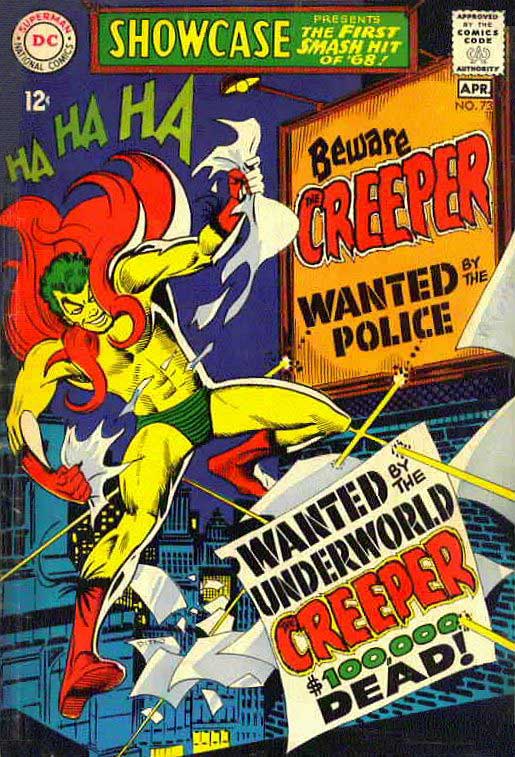
Showcase #73, first appearance of The Creeper.


"The world has more than it's share of troublemakers, tormentors and terrorists! And perhaps not enough forces of courage, strength and justice to combat them. But now -- a new force against evil is about to make it's presence felt. A unique power, embodied in a remarkable character, and dedicated to the defeat of the destroyers. A man accidentally thrust into a dynamic destiny...and who accepts the explosive challenge. For it is he who will defy those destroyers, and make them Beware the Creeper!!!"


That quote is the first thing you read in Showcase #73, "The Coming of the Creeper". It's so awesome, I just felt that I had to add it. The Creeper was one of several properties that were created at DC Comics in the late 1960s by one Steve Ditko. Ditko is one of the most well known comic book artists of all time, along with the likes of Jack Kirby and Bob Kane, among so many others. Ditko had already made a name for himself by the late 60s, first with the Charlton Comics character Captain Atom (he would later also create The Question for Charlton, both of whom would become DC characters), and later more famously as the co-creator (visual designer) of both Spider-Man and Doctor Strange for Marvel Comics. He left Marvel after a period of great success, and went to rival DC where along with The Creeper, he also created or co-created the likes of Shade the Changing Man and Hawk and Dove.


Story-wise, the Creeper wasn't all that different from many other hero characters of the time. But character-wise, he most certainly was unique. WHAM-TV show host and personality Jack Ryder, who in his first Showcase #73 appearance would offend a guest and be fired from that job, only to be hired by the studio as a kind of security investigator, wound up following an assignment to his strange fate. Getting mixed up with mob boss Angel Devilin and his thugs, he discovers the missing Dr. Vincent Yatz at a faux high society party, which is really cover for the mob to sell Dr. Yatz and his secrets back to very interested communist parties. It seems Dr. Yatz has invented such things as an "instant healing formula", as well as a "matter displacement device", things those evil communists would love to use as weapons. To sneak into the party, a costume party, Jack had to don some sort of costume for disguise, and as luck would have it, all the costume shop he stopped at had available, was one box of leftover junk. So he just threw together one of the weirdest outfits of all time out of what was there, and voila, you have the basic look of the Creeper, though it's all makeup and even a green-haired wig (as seen in the cover art above). Upon successfully sneaking into the party, however, he winds up getting himself near-fatally stabbed, and thrown into the same secret room as Dr. Yatz. Both to save Jack's life, as well as to keep his secrets out of evil hands, Dr. Yatz injects him with the fast healing formula, and sticks the small matter displacement dohickey in the wound while he's at it. The good doc gets himself shot dead for his trouble, but his legacy now lives on in the form of Jack Ryder, who would soon take on the monicker "The Creeper".


The Creeper, in his own solo-title.


That legacy turned out to be the unwitting creation of DC's newest, strangest super-hero. The healing serum seemed to give Jack permanent fast-healing ability, a power none-too-common in comics at this juncture (not to mention many years preceding the more famous Marvel character Wolverine), not to mention exponentially increasing his natural strength, stamina, agility, reflexes, and so on. The other side-effect of the good doctor's work, is that via a tiny transmitter device he would keep attached to his wrist-watch, Jack could now use the matter displacement thingy grafted into his body, to automatically switch to his Creeper form. Whereas he had originally donned random bits of costume, accompanied by a green wig and yellow makeup, these things were now permanent so long as the device was activated, meaning baddies couldn't just pull his wig off, etc. When he hit the switch, he WAS The Creeper, and he could turn back into Jack Ryder just as fast, which added another unique-for-it's-time element to the character. The final piece to the puzzle, was a conscious choice on Jack's part to start laughing maniacally and acting as "creepy" and otherworldly as possible when fighting criminals, using the element of fear to his advantage in a similar, and yet far different way to Batman. This aura of fear, combined with his "inhuman" physical abilities and fast healing, made most thugs he faced doubt that The Creeper even WAS human, but perhaps rather a ghost or something altogether different.

This served Mr. Ryder well, as he was able to mop up Angel Devilin and his gang. But in so doing, he also found himself on the wrong side of the law, as in initially escaping from the mansion where Dr. Yatz had been held, he unknowingly attacks a police officer, as he had just been fighting his way through thugs. So while he was a hero for beating the bad guys and saving the day, he was from the get-go also established a "wanted man", both by the city's criminal underground ($100,000 for his head, to be precise), as well as the police. His initial appearance in Showcase was well enough received to lead into the character getting his own solo-title, "Beware the Creeper", plotted by Steve Ditko, but also written (as his first DC assignment), by one Dennis O'Neil. Denny O'Neil would later become famous for his work on the Green Lantern/Green Arrow comic, as well as his now-classic Batman work (creating such memorable villains as Man-Bat and Ra's Al Ghul, among others).


The introduction of his most dangerous villain, Proteus.


In the first issue of "Beware the Creeper", Ryder would face off against a new threat, both to himself as well as the mob, a seeming vigilante calling himself "The Terror". He faced and defeated this threat, in what would present itself in a very detective fashioned story of "whodunnit", with Ryder trying to determine who out of several likely candidates is in fact the masked "Terror". By issue #2, readers would be introduced to his biggest and most enduring villain, a mystery man who can disguise himself as anyone he chooses (so it would seem), known only as Proteus. It seems that this mysterious Proteus turned up at some point in the recent past, and had strong-armed his way into control of the local mobs. In his very first appearance, Proteus takes the form of The Creeper, attacking the WHAM-TV production room, setting off an explosive that kills one of the crew, framing The Creeper for murder in the eyes of the public in the process. The primary focus of Jack's activities over the remaining issues (what few they were) of his first title's run, was trying to discover just who Proteus really is, as well as bringing him and the criminal underground down for good.


The final confrontation?

Sadly, "Beware the Creeper" would enjoy a run of only 6 issues. I would imagine that the sales were just not up to snuff, which very sadly has happened to a lot of great comic titles over the years (same with tv shows, etc). In the last article, about The Doom Patrol, I had to "spoil" the end of that team and their comic, for one thing because (to comic fans at least), their fate was already pretty well known, and for another, it was just something when dealing with that team and that title, that had to be discussed. However, when it comes to The Creeper, or at least his original six issue "Beware the Creeper" run (seven if you count Showcase #73), I don't really want to spoil the fun, so if you want to know the scoop on this Proteus guy, and juicy stuff like that, I'd highly encourage you to find yourself these comics and read them, as they're well worth it despite their number.

The Creeper would thankfully not be done after his title was cancelled though. In fact throughout the 70s and 80s he would go on to make numerous appearances in various titles, including The Justice League of America, Detective Comics (Batman), and many others. Some loose ends of his own title would be somewhat further explored in an "Super-Team Family" issue #2. He would, however, go on to be nothing more than a cameo type of character until the 90s, when he would eventually get his own comic for a time again. Though after the infamous mid-80s "Crisis on Infinite Earths" storyline, he was one of many characters to have their origins retconned (or in his case slightly tweaked), adding some rather silly elements to what was already a perfectly fine character. Overall, though his own comic was very short-lived, and his appearances over the years have been sporadic, he is one of many DC "second stringer" type characters that I have really come to love and appreciate in recent years.

He actually even enjoyed some minor appearances in both "The New Batman Adventures" in the 90s, as well as the early 2000s "Justice League Unlimited". His episode of Batman, entitled "Beware the Creeper", despite featuring a completely wrong origin for his powers (you'll have to watch to understand), is still a rather entertaining episode. His limited appearances in JLU, while cool, are actually just non-speaking background parts, but it was still cool that they thought to include him at all. He's certainly a character that deserves some love. So there ya go folks, go check out "Beware the Creeper", you'll be glad you did!