Thursday, October 29, 2020

Bela Lugosi: The Ultimate Dracula


The character of the vampire lord, Count Dracula, as made famous by Irish author Bram Stoker, is one of the most recognized and iconic figures in not just horror fiction, but ALL of popular fiction. There are very few people in the "developed world" today, I'd wager, who didn't at least have a general passing knowledge of who Dracula is. He's been depicted in everything from serious works of art, to toys, to comics, to cartoons and even sketch comedy. But the medium in which he became most famous, naturally, was film. 

There have been many, MANY depictions of Dracula in film, by some counts, the character has made over 200 film appearances, allegedly second only to Sherlock Holmes. But again, I would wager that more people, especially young people, know who Dracula is, than even the great detective. Narrowing it down a bit, there have been, at the LEAST, around or probably over 40 films made that center around the character of Dracula more specifically, most of them direct adaptations, of some manner or other, of Stoker's original novel. But while several of those film depictions of the Count have been quite memorable, some even iconic, there is one who, I think it's completely fair to say, stands head and shoulders above all the rest.


Lugosi in the original Broadway play.


Béla Ferenc Dezső Blaskó, otherwise known as Bela Lugosi, was born on October 20th, 1882, in Lugos Austria-Hungary, what is now known as Lugoj, Romania. Meaning that, ironically, the man who would go on to become synonymous with the character of Dracula, was originally from the same basic land that was also home to the Count's native Transylvania. Lugosi dropped out of school at age 12 (something not at all uncommon in those days), and began his acting career in the very early 1900s. After years acting in stage plays in Hungary and elsewhere, he got his first silent film role in 1917. He went on to act in several Hungarian and then German films, before finally leaving Europe for political reasons, to immigrate to the United States in 1920. After living and working in the States for many years, both as a laborer and immigrant actor, by 1931 he finally became a naturalized citizen. 

Lugosi's acting work in America started out in his native Hungarian, playing to immigrant crowds. His first English speaking role came in 1922, and for his first several English plays, he had to learn his lines phonetically, as he could not yet speak English very well. During the 20s, he also acted in several silent films, the first of which being J. Gordon Edwards' The Silent Command. But the role that would come to define his career, for better and for worse, fell into his lap in the late 20s. In the summer of 1927, he was approached to play the role of Count Dracula in a Broadway production, which would go on to be a smash hit, playing 261 times before embarking on a national tour that ended in California. 


A poster almost as iconic as the film's actor.


When Universal Pictures optioned the rights to the play and began production in 1930, as hard as it may be for many to imagine, and in spite his own lobbying for the role he felt was his, Lugosi was actually not the studio's first choice to portray the title role. After considering many other actors, in part because he lobbies hard and won them over, but also reportedly in part because he agreed to take the role for considerably less money than he could have commanded, Bela Lugosi did, however, win the role that so badly wanted to portray on the "silver screen". 


Spanish Dracula


Spanish Renfield


Spanish Van Helsing


In an unusual, but in those days not uncommon occurrence, Universal had two productions of Dracula filming at the same time. The more famous English production would film during the day, and then when they were done, the Spanish production would use the exact same sets at night. For many years, the Spanish version of the film was actually thought to be lost, though surviving prints were eventually found. It would seem that to many film historians and even some film buffs, this Spanish language film is considered "superior", mainly due to a few, in my opinion minor points. For one thing, the Spanish production apparently had the advantage of watching the English "dailies", watching their camera-work etc., and were able to try and improve upon it, such as the camera moving up the stairs to zoom in on Dracula when he first appears to Renfield. They also added a bit more "flair" in certain scenes, such as smoke rising from Dracula's coffin when he awakes, and things like that. Lastly, the Spanish film, for whatever reason, clocks in at nearly 20 minutes longer than the English version, which some feel gives the story a bit more room to breath, and a bit more time for character development. 

Personally, however, I reject the notion that the Spanish version is "superior". I absolutely recognize the longer running time, slightly more lavish special effects, and somewhat more complex camera-work. But to me, none of these things really "improve" the story itself to a significant degree. I think for what it was, especially considering it was made on a smaller budget than the English version, the Spanish film is well done, and a solid movie overall. But as far as I'm concerned, there really is no contest between the two, and I'll explain why. 


English Dracula


English Renfield


English Van Helsing


The English version has also been criticized by some critics retroactively, for being "too much like silent film". And I honestly, for the life of me, don't understand how this is a legitimate complaint. Director Todd Browning, though he left a lot of the actual filming to Director of Photography Karl Freund, was a successful director of silent films. He reportedly was never quite comfortable with sound films, and this being one of very first, it shows. But as far as I'm concerned, his silent era proclivities are not a hindrance to the movie, but rather, a strength. The film has a lot of silent moments, with hardly any music (which wasn't unusual for early sound films anyway), and a lot of long, still shots. To me, this lends to the creepy atmosphere, mood and tone of the story. The darkness, silence and stillness, lend the film, in my opinion, a much spookier and more menacing air, than the busier, more technically complex Spanish production. 

The acting in this movie, has also been described by some as basically being stage acting, which, again, I don't find any real fault in. For one thing, Bela Lugosi and Edward Van Sloan, had already played Dracula and Professor Van Helsing respectively, opposite one another hundreds of times in the play. Which, I might add, attributes itself both to their chemistry together on screen, working off of each other so very well. But it also explains, as far as I'm concerned, why they both seem so comfortable and natural in their roles. Because they had literally already played them to death. And really, I think along with what I personally consider more appropriate cinematography for the tone of the film, that the acting is really the shining strength that makes the English, not the Spanish version, the "superior" 1931 Dracula. 


Perfect in their roles.


While I have no wish to slight the acting job of the Spanish crew, to me at least, the acting in the English version of Dracula, is simply better. It's top tier, in all of the major roles, and even in some of the smaller ones. One such smaller role that really stands out, as a bit of valuable comic relief, is that of the Seward Sanitarium attendant, Martin, played Charles K. Gerrard. His thick, Cockney-esque accent, delivering humorous jabs in his interactions with the insane Renfield, are genuinely funny, and shine appropriately comedic light on the otherwise macabre nature of the man eating flies and spiders. Helen Chandler and David Manners also stand out, as the haunted Mina Seward, and her concerned, protective lover John Harker. 

But the three characters who truly steal the show, and carry the film, are appropriately the three biggest roles. First off, it should be mentioned that Dwight Frye was an incredible character actor of his era, bringing both capable physicality, and true dramatic chops to his roles. The role of Renfield, I think, is arguably the finest of his career, and certainly the most complex of the entire film. Renfield starts off a very decent, if somewhat simple, and good-natured, well meaning real estate solicitor, who was hired by Dracula to arrange for his purchase of the decrepit Carfax Abbey in England. But after Dracula gets control of him, becomes a man quite literally possessed, a tortured soul who hates and mourns what he is made to do, and what he has become, but is also thoroughly controlled by his cravings for "smaller lives" (flies, spiders and other bugs), and his fearful loyalty to his "master". 

Frye expresses such a fantastic range of emotions as this character, from well mannered and even joyful, to outright menacing and stark raving mad. And then of course there are his periods of solemn, remorseful sadness. By comparison, Pablo Alvarez Rubio as Renfield in the Spanish version, is convincingly manic and insane. But he also comes off, at least to me, as a bit TOO over the top with his craziness. Dwight Frye's performance, even at its most manic, just comes across as more subtle and menacing. He also, to me, feels like more of a conflicted character. All around, his performance is an absolute highlight to the film.


Dracula descending.


The true "meat and potatoes" of the story, of course, is the mental chess game, and actual conflict, between the characters of Van Helsing, and Count Dracula himself. As stated before, I feel that Edward Van Sloan and Bela Lugosi were perfect for these roles, both because they had already made these roles their own on stage, but because their individual personas, acting idiosyncrasies, and even their accents, in Bela's case natural, were perfect. For his part, Van Sloan as Professor Van Helsing, is great to me, tied in my mind with Peter Cushing's portrayal of the character in the later Hammer films. He is all at once wise and very learned about supernatural and scientific matters, even a tad arrogant while also still coming off as politely humble. He is a charming and commanding presence, who garners the respect and often obedience of those he is trying to help, merely by his presence and personality. He is a self-assured, yet cautious hero, who would rather quietly observe, waiting for the right moment to strike, rather than rush in foolishly. He is a man of action, but only when the proper situation presents itself. 

Eduardo Arozamena, Van Helsing in the Spanish version, does a perfectly fine job in the role. In fact he shares some of the characteristics of the character as Van Sloan does. But at the same time, his Van Helsing also seems to bit more of a timid, even bumbling old man, at times even somewhat fearful of Dracula, something that Van Sloan's Professor never is. Whether he is faced with Renfield's madness and threats, or Dracula's brooding yet charming menace, Van Sloan's portrayal of the good doctor, never once bats an eye. Not that he isn't, perhaps, deep down fearful, but because he is confident that he knows how to deal with it.

Even in the iconic scene where they are alone together for the first time, and they both "lay their cards on the table", so to speak, and Dracula tries to mesmerize and control Van Helsing, he does now cower. He does, in fact, momentarily nearly fall under the Count's sway, so strong is the undead fiend's power, but Van Helsing's will proves to be quite strong, as he steadies himself, standing up straight and defying the vampire lord. Lugosi's Dracula expresses, more than once, genuine respect, perhaps even slight admiration for his new enemy. And because of Van Sloan's confident, wizened portrayal of the character, you can actually believe that he truly means it. His Van Helsing earned Dracula's begrudging respect, even though they fully, and openly, intend to destroy one another. 


Those haunting eyes.


As for the person we're really here to discuss, Lugosi as Count Dracula, if you've ever even seen but a small clip, or even just a picture of his performance, really speaks for itself. His exotic, charming yet sinister look, and his natural Hungarian accent, just lent themselves to the character. He isn't an immediately physically imposing figure, not someone who commands instant fright upon first seeing him. And yet, you can also immediately tell there is something more, something dangerous about this persona, and he is not someone you would want to meet alone, in the dark. By comparison, Carlos Villarías' Dracula in the Spanish version, while capably acted, both because of his general mannerisms, but also because of his quite frankly sometimes goofy looking facial expressions, comes across as a far less menacing, sometimes even comical vampire. Again, no offense to Carlos, but to all those who try to claim that the Spanish version is "superior", I don't think his portrayal holds even a small candle to Lugosi's.

Lugosi's Dracula is a monster, no doubt about it, but he is a monster who is not often given to recklessness or foolish chance. Much like his opposite, Van Helsing, he too is a very calculating mind, who plans much and risks little. Not because he is afraid, but because he is a mastermind who is always several steps ahead of most of his victims and enemies. He's a man who has had centuries to learn and hone and perfect his role as vile hunter of the living, and his mental command of the weaker-minded is pretty much unparalleled. He is still supernaturally strong, mentally powerful, and able to change his physical form, etc., just as most versions of the character are. But with Lugosi's portrayal, the characters strength lies more in his cunning, and almost sardonic charm. He's scary, but often more because of what he COULD do to you, or even make you do to yourself, than because of more graphic acts of intimidation or violence. 


Max Schreck's Count Orlok.


Christopher Lee's "Hammer" Dracula


Bela Lugosi's OG Dracula


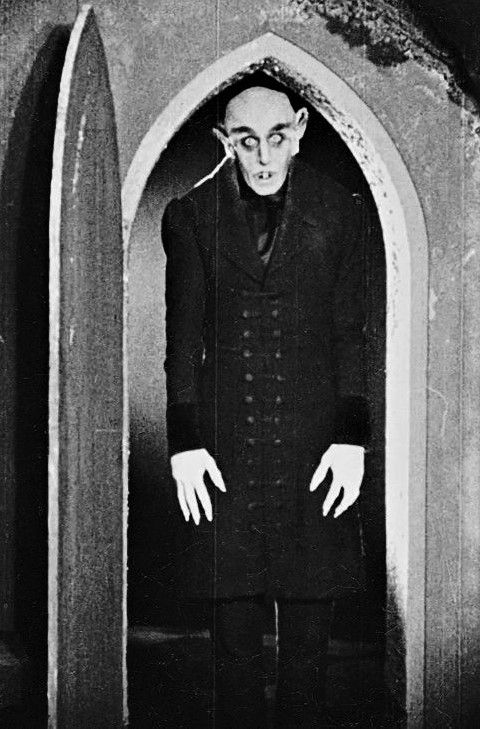
I think in the minds of most film fans and historians (often little distinction between the two), there are really three main film portrayals of Count Dracula, that are the most memorable and iconic. They are pictured above. While in the 1922 silent film Nosferatu, for legal reasons they had to rename the character Count Orlok, it is still meant to be Dracula. And in all blunt honesty, Max Schreck's incredible turn in that film, is hands down the creepiest. His character eschews any pretense at handsomeness or charm. He looks and acts like the monster he truly is, and his image and performance are no doubt the scariest, if we're talking about pure horror. 

As for Sir Christopher Lee, he played the character of Dracula probably more times, in both Hammer films and outside of that studio, than any other actor. His portrayal is unquestionably the most intimidating and certainly the most actively, visibly violent. But for all of his visual evocativeness, I must say, for all the times he played the character, Lee's Dracula also has the least "character" of the three. That definitely isn't a knock on him, as Lee was a great actor in his own right. But the combination of how he was directed, the scripts he was given (or sometimes chose to ignore), and his own personal choices in portraying the role, while his Dracula is absolutely fearsome, even "badass" as some would rightly say, you could also argue his Dracula has the least "to him", if that makes sense. If anything, he almost feels like more of an evil force, than he does a character.


That pose.


That expression.


That stare.


But for my money, as a film fan, as a horror fan, as a fan of supernatural fiction in general, Bela Lugosi is, as the title of the article states: The Ultimate Dracula. His character is the prefect mixture, of just charming enough, just intimidating enough, and just sinister enough, that he is the complete total package as far as I'm concerned. There are good reasons why it is his portrayal and very image, that is most popularly and most infamously associated with the character. He made that role his own in a way that few actors ever accomplish in their entire career. And this was, on a professional note, both a boon and a curse to him as an actor. That one iconic role achieved him a kind of "immortality" that few ever achieve. But at the same time, being so associated with that role, along with his thick Hungarian accent, also caused Lugosi to become very typecast for the rest of his film career. A fact that he, rightly, hated. He loved the character, so much so that he was buried with the original cape when he passed away, something his family thought he would have liked. But he also hated what it did to his career, a career full of many other iconic roles and great turns. But he could never quite escape The Count, much like his victims in the story. 

Regardless of that unfortunate fact, the truth is, Lugosi was a fantastic actor, a reality that shines in his immortal performance as Count Dracula. The Spanish version made by Universal may well have been more "technically sound" in certain ways. But I hardly think those extra touches make it "superior", and as as stated, I feel that acting-wise, it is most certainly the inferior film. And there have surely been a great many adaptations of the story since 1931, which have been more lavish, more expensive, more technically impressive, etc., including Francis Ford Coppola's 1992 film, which featured Gary Oldman in a very strong performance. But I do not earnestly believe, out of all the films that have come since, or perhaps ever WILL come, that any of them are as simple, pure, and darkly, hauntingly beautiful, as Todd Browning's 1931 classic. That Dracula, as far as I'm concerned, is perfect, and is one of the few films I would give "5 Stars" to. 


Bela Lugosi IS Dracula, to entire generations of people, and deservedly so. If you've never seen the movie, I implore you, this Halloween Weekend, please do yourself a favor and watch it. It is a slow, often understated burn of a film. But it is never boring, always captivating, often creepy, and if you ask me, a pure delight to take in. I'd like to wish everyone a Happy Halloween, and stay safe out there!


Tuesday, September 29, 2020

Godzilla Chronicles: Godzilla vs. The Smog Monster


In the last Godzilla Chronicles entry, we looked at the bizarre, childhood fantasy near-spinoff project known as Godzilla's Revenge, aka All Monsters Attack. But if you thought THAT film was odd, well then buckle in tight and hold onto your seats, because as the old saying goes, "You ain't seen nothin' yet!" 

Even by the late 60s, Toho was beginning to feel that the Godzilla series, which had seen a new entry nearly every year since 1962, was beginning to get a bit stale. It was due in part to this, that I'm sure they were willing to allow Ishiro Honda to experiment as he did, with All Monsters Attack. This experimentation continued on the next Godzilla project, but in different ways. With Honda looking to scale back his filming (he actually wound up basically taking a break for a few years), Toho turned, surprisingly, to a new director, Yoshimitsu Banno. A man with very different ideas, and a new take on Godzilla in particular.


Fan art, representing the "trippy" nature of this film.


Banno's biggest conceptual theme that he wanted to build his contribution to Godzilla around, was the environment, and how it was being poisoned by pollution. He saw Japanese cities rife with horrible smoggy air, and Japanese coastlines foaming with crap that people threw into the water. All pretty terrible, disgusting, frightening stuff. And his idea was "Hey, what if this pollution came to life, and became a monster that attacked humanity?" To this end, he created the alien creature, Hedorah, an originally microscopic being from deep space, who came to Earth via a meteorite, and eventually started growing and mutating into an enormous, sludgy mess, after feeding on humanity's ample pollution.

 But clearly, Banno's vision didn't stop at having a strong environmental theme, something in and of itself that was used by several other filmmakers in the 1970s. Likely being a part of it himself, he also wanted to play to what he likely saw as a more "modern" Godzilla audience, one which represented the so-called "Hippy" counter-culture that was going strong at the time. To this end, "Hedorah" features, outside of a couple of major exceptions, a "hipper" young adult crowd at its core of human characters. There's a hip night club featuring "painted" dancers, and a woman singing about the environment. There are montages and animated segments that are VERY "60s". And late in the film there is even a moderately large gathering in the hills of young Japanese "Hippy" types, dancing around a fire and singing songs to...defeat Hedorah with positive vibes? But I'm getting ahead of myself. 


A true Godzilla fan.


Pictured above is die hard Godzilla fan, Ken Yano. His father, Dr. Toru Yano, a marine biologist, has been collecting odd samples from the sea lately, seemingly mutated sea-life, results of humanity's pollution. Ken's mother, Toshie, often acts as his assistant. After discovering a strange "tadpole", Ken accompanies his father to the beach, where he patiently waits while Dr. Yano goes diving to see if he can find traces of this "tadpole", as well as a mysterious sea monster that has appeared, sinking an oil tanker. 

Toru is attacked while underwater, by what turns out to be Hedorah in its early, aquatic form, badly burning his face. A small piece of the monster also attempts to attack Ken on the shore, but only manages to burn the boy's hand. Now fully aware of the existence of Hedorah, Dr. Yano tries to warn the public, using his own tragedy as a cautionary tale. Meanwhile Ken, apparently the world's biggest G-Fan, has a vision of Godzilla saving the world from Hedorah, and firmly believes in his heart that this will actually occur.


One of several odd animated segments, showing Hedorah feeding.


The creature's second form.


It isn't long before Hedorah is no longer satisfied with feeding on oil and pollution found in the ocean. It grows stronger, and metamorphoses into a more amphibious form, which allows it to come up on land, seeking out new kinds of human poison, such as the smoke stacks of factories. As it turns out, not only does the monster feed off of and grow stronger because of pollution, but it is also essentially composed of highly toxic, pollution sludge itself. So much so, that the slime and fumes from its body, are highly dangerous, even lethal, as evidenced by the Yanos' burns. 

But Hedorah becomes even more dangerous, when it displays the ability to shift between its more "frog-like" land form, and a deadly "flying saucer" form, in which it can fly, and pour out highly acidic, toxic exhaust, which is even shown to melt human beings right down to their bones. That alone is highly gruesome and unusual for the Godzilla series, and I'm sure may well have caused some controversy upon the film's 1971 release. But it also needs to be said, that regardless of what one might think of the movie itself, love it or hate it, the monster Hedorah is arguably the most unique ever conceived "daikaiju" the series has ever produced. And it was certainly very well realized by the special effects team for this movie as well. Not just Hedorah's unique, pollution-based nature, but also the fact that it shifts between so many different forms, and evolves throughout the story. If nothing else, Hedorah the monster itself, deserves major kudos for creativity and execution. 


Dreams DO come true!


True to little Ken's vision, Godzilla does indeed arrive in Japan, to show this new monstrosity what's up. Their initial battle goes Godzilla's way, as he basically hands "Frog Hedorah" its ass. But Hedorah doesn't stay defeated for long, consuming more pollution, and transforming once again, into its "Perfect Form", a more upright, bi-pedal form. In addition to this, he uses his "Flying Saucer" form to pepper Godzilla with toxins, and the "Big G" is actually wounded and somewhat defeated himself, to the horror of Ken and his adult friends, Yukio and Miki. 

All seems lost, and for some insane reason, Ken's parents let him go to the aforementioned "Hippy" party up near Mt. Fuji with Yukio and Miki, where a renewed, but equally hopeless battle between Godzilla and Hedorah breaks out. But, as it happens, Dr. Yano and his wife discover almost by accident, that the small Hedorah samples they had been studying, when dried out turn to brittle ash. Dr. Yano theorizes that if a large amount of electricity can be used to essentially "dry out" the giant pile of shit that Hedorah is, it too would become brittle and vulnerable, unlike its seemingly indestructible slime form, giving Godzilla a chance. The army, naturally, sets to work right away, setting up a giant electric trap for the monster, right nearby where the hippies happen to be partying. 


Godzilla lamenting the ignorance of man's polluting ways.


One of the ridiculous visuals in all of Godzilladom.


The battle between Godzilla and Hedorah doesn't go well at first, as Godzilla can't seem to harm the damn thing, and in return gets his eye and hands burnt, and then gets drown in sludge after being thrown into a small chasm. But all would not be lost, as the Yano's plan is put into action, and Big Slimy gets zapped with trillions of volts of juice. The monster's battle damages the apparatus before it can totally dry out Hedorah, but not before it makes the thing vulnerable (FINALLY) to Godzilla's attacks. 

Hedorah tries to flee after finding itself damaged, and as you can clearly see above, to keep hot on the trail of its flying form, Godzilla suddenly decides that HE can fly as well, in perhaps the most ridiculous way possible: by rocketing himself through the air via his atomic breath! This would be the first of several "one use/film only" abilities that Godzilla would conveniently discover, a trend through several of his 70s outings. It also happens to be one of the most comical looking Godzilla moments in the series' history, but it's damn entertaining. 


The awesome Criterion artwork.


Ultimately, the film didn't perform super well, probably in part because of its darker, more gruesome nature, but also probably because of its oddball "Hippy" sensibilities. Long-time Toho Godzilla producer, Tomoyuki Tanaka, reportedly hated it, and allegedly banned Banno from ever directing another Godzilla film, claiming he had "ruined Godzilla". Banno himself was extremely pleased with the final product, and had a sequel planned that supposedly would have taken place in Africa, another unique choice in Toho films. This sequel never happened, however, as Jun Fukuda, director of 60s Godzilla island romps Godzilla vs The Sea Monster and Son of Godzilla, was brought back to direct the following three Godzilla films. 

As for myself, this is one of those Godzilla movies that I didn't get to see until I rented it sometime in my later teen years. I did have the opportunity to own it as a child, as ONE solitary time, I saw the cover for it at my local Walmart VHS rack. But that just so happened to be one time where, for whatever reason, my grandmother to my horror said "No". And thus, there went my ONE chance during my biggest, most fanatical Godzilla fandom phase, to be able to see it, and experience it as only a child/pre-teen can. I wish that I had been able to see it at that age, as surely I wish I had been able to see ALL the "Showa Era" films at that age, along with many other movies I missed out on. Because, quite frankly, before my teens, before depression and the horrible jaded bitterments of adulthood creep in to kill off childhood wonder, everything I experienced as a child, be it music, comics, literature, cartoons, shows, movies, you name it, everything was far more raw, and BIG and pronounced. Seeing these old movies as a kid, even the shittier ones, everything I took in at that age, was, looking back, experienced to the max, to its fullest extent. Versus the more numbed, jaded experiences one has as a "Grown Up". 

Would I have liked, or loved, Hedorah back then? I think so. I think I would have been mortified by the toxic burns and the poor people being melted by that vile Smog Monster. I was like that as a kid, even feeling bad when villains would die in media I watched. I still feel a bit that way as an adult, that little part of my childhood that has never fully submitted to exile. But yes, even though it's bizarre as hell, I think that Godzilla vs. Hedorah has some great moments, and I would have taken the environmental message VERY seriously as a kid. Hedorah is one of the most interesting monsters Toho ever produced, and at the end of the day, it's a GODZILLA movie, so I would have ate it up regardless (even though to be fair, I wasn't fully impressed by Godzilla's Revenge at that age). But this is a movie my grandmother should have gotten, and I should have been able to see back then, because I think I would have ultimately enjoyed it. 


****************************


Here is the full list of Godzilla Chronicles articles:


1. The Beginning

2. Gojira (aka Godzilla: King of the Monsters)

3. Godzilla Raids Again

4. King Kong vs. Godzilla

5. Mothra vs. Godzilla

6. Ghidorah, The Three-Headed Monster

7. Invasion of the Astro Monster (aka Godzilla vs. Monster Zero)

8. Godzilla vs. the Sea Monster

9. Son of Godzilla

10. Destroy All Monsters

11. All Monsters Attack

12. Godzilla vs. The Smog Monster

13. Godzilla vs. Gigan

14. Godzilla vs. Megalon

15. Godzilla vs. Mechagodzilla

16. Terror of Mechagodzilla


Friday, July 31, 2020

Classic Songs: I Love The Night

It's time to take another look at one of my favorite songs of all time. Unlike the last two I've done pieces on, which are more personal to me, and I experienced (in both cases) in my teens, this is a song I'm fairly certain I didn't hear until I was at least in early adulthood. So I don't have as much of an emotional connection to it. BUT, it is a song that grew on me over time, to the point that I don't mind saying, not only is it my favorite song by the band who created it, but it's easily in my Top 5 favorite songs of all time, ever.


The 1977 rock classic, Spectres.


Blue Oyster Cult as a band, is an odd duck, to begin with. They are one of the weirdest, and arguably the most eclectic rock bands of their era. For me personally, I encountered them at a younger age in life than I did Kansas and Metallica, the bands who originated the two previous songs in this series. That is, except for briefly seeing Metallica play "Enter Sandman" on some awards show in the early 90s, which for whatever reason at that age didn't yet grab me (though you'd think it would have). 

As I've covered when talking about my childhood experiences with Godzilla, during that glorious TNT's MonsterVision Godzilla marathon, they played a promo in between movies, a video package which played BOC's song "Godzilla" over movie clips. I had never heard that song before, and at about age 11 or 12, I thought it was the most bad ass thing I'd ever heard. So you could easily say that I was instantly a Blue Oyster Cult fan, due to that song, even though I wouldn't experience more of their catalogue until I was into my very late teens. It's entirely probable that I heard at least a clip of their most famous hit, "Don't Fear the Reaper" play on TV at some point. But "Godzilla" was the one that stuck with me.


BOC, in their 70s prime.


For a bit of history, the band that would come to be known as Blue Oyster Cult, started out as a college band called Soft White Underbelly, in the late 1960s. Band friend and rock critic, Sandy Pearlman, offered to be their manager, and also wound up being their creative partner. He was hugely influential in both their music and their success. After going through several name changes, and adding lead vocalist Eric Bloom, they would finally settle on Blue Oyster Cult, and saw their first official self-titled album release in 1972. 

From the start, BOC was a very unique act, both due to the quirky, more intellectual sensibilities of the band members, but also because of their collaborations with various outside personalities. Sandy Pearlman, being probably the biggest of these, contributed several of his own poems over the years, which were used as the basis for certain BOC songs. They would also collaborate lyrically with both rock critic Richard Meltzer, and early Punk Rock icon Patti Smith, among others. Another element of the band that was fairly unique, is that even on their first album, almost every band member sang lead vocals at some point. A tradition that persisted through their entire career, even though Eric Bloom and Donald "Buck Dharma" Roeser have always been the main singers.


BOC's first album, part of their "Black and White era" of the early 70s.


While their early albums, which all featured black and white cover art, featured a few minor hits, such as "Cities On Flame With Rock n Roll" and "Astronomy", and the band saw steady growth through 1975, it wasn't until their 1976 epic "Agents of Fortune" that they finally hit the "big time". Their hit single "Don't Fear The Reaper" reached into the Top 15 on radio airplay, and became an immortal opus for the band ever since. 

They followed this success up with 1977's "Spectres", which produced another massive radio hit, the aforementioned "Godzilla", which also became a permanent favorite for fans at concerts. Buck Dharma, who also happens to be one of my favorite guitarists of all time, not only wrote (and sang) "Don't Fear The Reaper", he also wrote both "Godzilla", and the song I'm actually here to talk about, the low-key ballad "I Love The Night". They would continue churning out hit albums into the early 80s, culminating with what is arguably their overall best record, 1981's "Fire of Unknown Origin". Their success as a top act would wane during the course of the 80s and beyond, but Blue Oyster Cult had already forever etched their name into the proverbial Rock of Ages, as far as rock music was concerned. They had already achieved musical immortality.


From left to right, the three guitarists of BOC, Allen Lanier, Eric Bloom, and Buck Dharma.


The reason that "I Love The Night" has grown over time into one of my favorite songs, is first and foremost because of its incredible tone, and mood. It has just such a chill vibe, with haunting, almost baroque guitar work. Dharma's vocals are equally both peaceful and haunting, as well. It's such a great song to relax to, the perfect thing to put on if you're stressed out, or angry, or otherwise in a foul mood. It has a delicious melancholy to it, even a slight sinister tint, but it also somehow manages to exude such positive, calming vibes.

Lyrically, the song comes off as a very poetic, if not a bit spooky, love song. But underneath, it has supernatural undertones, the "Lady in White" being either some kind of ghost, or perhaps vampire. Regardless, the man in the song becomes mesmerized by a woman who dominates his thoughts, and whom he can only see under the darkness of night. Done perhaps any other way, especially considering the possible vampiric connotations, this is not necessarily the kind of lyrical content that I would gravitate towards, nor even enjoy. But the way Dharma's lyrics, singing, and guitar work intertwine, telling this haunting tale, it just captivates me. It's actually hard for me to believe that this song originally FAILED to be a major radio hit for the band. But for me, while Blue Oyster Cult has produced quite a few truly great songs over their career, this song (perhaps tied with its spiritual twin "Don't Fear The Reaper") is their greatest work.


Here are the lyrics, and the song, so that you may experience, and hopefully be captivated by it yourself:


That night her kiss told me it was over,
I walked out late into the dark.
The misty gloom seems to soak up my sorrow,
The further I went on, I felt a spreading calm.

Then suddenly, my eyes were bathed in light,

And the lovely lady in white was by my side.
She said "Like me I see you're walking alone.
Won't you please stay?"
I couldn't look away.
She said I love the night,
The day is ok and the sun can be fun,
But I live to see those rays slip away.
I love the night,
There's so much I can show and give to you,
If you will welcome me tonight.
If only you had been there my dear,
We could have shared this together.
No mortal was meant to see such wonder,
One look in the mirror told me so.
Come darkness I'll see her again,
Yes I'm gonna go, 'cause now I know...


Sunday, May 31, 2020

Godzilla Chronicles: All Monsters Attack


Well it's that time again, for another entry of the Godzilla Chronicles! Last time, I looked at what is to many the crescendo of the original Showa series, Destroy All Monsters. This time, I'm gonna slow things down a bit, and talk about what to many fans, is the lowlight, the least, of those films.


One of the VHS covers.


As I've mentioned in the past, in the early to mid 90s, as a kid gradually heading into my pre-teen years, I was obsessed with monsters and monster movies. And nothing truly helped fuel that for me MORE, than TNT's MonsterVision. In that pre-Joe-Bob Briggs era (bless him), that less people seem to remember or be familiar with, I was hit with wave after wave of awesome (and sometimes kinda terrible) old movies, most of which I had never seen before. MonsterVision helped me to experience many Ray Harryhausen films I'd never yet seen. It also helped me to see many other films considered classics, such as This Island Earth, and The Thing From Another World, and The Time Machine.

But MonsterVision, through a couple of (to child me) incredibly awesome weekend marathons, ALSO allowed me to experience FAR more Godzilla and related Toho films than I otherwise would have been able to. After we finally got a VCR in 1990 or so, I was able to talk my grandmother into buying the occasional Godzilla VHS tape from Walmart. This is how I came to own some of my first Godzilla films, perhaps the first I'd ever seen, such as favorites Godzilla vs. Monster Zero and Godzilla vs. The Sea Monster, as well as a stand-alone film like Rodan. Thanks to these "Godzillathons", I was able to see movies like Mothra vs. Godzilla, War of the Gargantuas, Godzilla vs. Gigan, and Terror of Mechagodzilla. My grandmother even let me use blank VHS tapes to record these movies off of TV, to technically add to my collection.

But there was ONE movie that was part of that set, that was not like quite like the others...


Just a lonely boy...


Called "Godzilla's Revenge", it's American title, this 1969 curiosity was like nothing else I'd seen. But at the time at least, not necessarily in a good way. Directed by Ishiro Honda, the main guy behind a majority of the best known Showa era Toho monster/sci-fi films, this film known as All Monsters Attack, was the result of, I believe, a combination of Toho being cheap, and Honda himself perhaps getting tired of doing monster movies, which by that point in his career, was all about all he made anymore. Instead of your typical Godzilla flick, focusing on some alien mystery, or new monster threat roaming the countryside, this was a much more small scale, intimate story.

It centers around a little Japanese boy named Ichiro Miki, who is a so-called "Latch-key" kid, meaning both of his parents work and are gone from home a lot, so he will often find himself at home, alone, after school. Ichiro is a lonely boy who seems, at least at the outset of the story, to have almost no friends, except for a girl named Sachiko, and his neighbor Shinpei Inami. Shinpei is an older man, and a toymaker, who also happens to help look after Ichiro sometimes, cooking him dinner, and things like that. Ichiro's main source of strife in his life, besides his loneliness, are a group of school bullies, led by big-kid Sanko Gabara, who seem to torment him on a regular basis on his walks home from school.


Friends come in all shapes and sizes.


Now, just on the surface, it would seem that there was certainly a lot that kid-me could relate to in this film. Ichiro is a lonely, only child, with barely any friends, who uses his vivid imagination as an escape, and is obsessed with monsters. That was basically me growing up, to a T, minus the fact that I didn't even have parents as he did, but rather, a (sometimes tyrannical and somewhat abusive) grandmother. But the thing is, at that age, around 12 or so years old, I wasn't watching MonsterVision, let alone GODZILLA movies, for a story about a little boy and his lonely life. While I'm sure I recognized the parallels with my own life, I wasn't able to really appreciate that then, because what I was there for, as ANY "Monster Kid" would be, was, you guessed it, the MONSTERS!

And the thing is, All Monsters Attack HAS those. Just not quite the way it should have. To help him escape his boredom and loneliness, as well as a way to cope with the daily stress of being bullied (something else I would come to identify all too well with, years later in my teens), Ichiro used his powerful imagination to dream up fantastical things. In particular, using parts given to him by Shinpei, he would utilize a little TV/radio type set, to daydream that he was travelling to Monster Island, where Godzilla and the other monsters are now kept. He would go there to visit his friend, Minilla, the eponymous Son of Godzilla, who in this tale could shrink down to his human child size. 


Meet Gabara, the King of Jerks.


In Ichiro's daydreams, Minilla (alternatively called Minya), is having his OWN troubles with a big bad bully, who just so happens to ALSO be named Gabara. This Gabara, however, is a giant, no-good monster, with green scales and a magic horn, who seems to be able to electrocute with a touch. He tries to goad Minilla into fights, picking on the weaker monster of course, seemingly just for fun. Much like Ichiro himself, Minilla simply doesn't know how to deal with this, and doesn't truly WANT to fight.


Overmatched.


Of course, he does try to fight him, because his pops, Godzilla, would want him to. Unfortunately, he's just too small, and hasn't yet mastered his dad's thermo-nuclear radioactive breath attack. Gabara winds up beating him, and he winds up having to have his dad come to his rescue. Much like in his own debut film Son of Godzilla.


Father and Son.


And really, especially for kid me, there-in lies the problem: the monster fights. I think I would have enjoyed this movie a lot more, and really been able to better appreciate it at that age, if not for one thing: most of the monster fights are canned! Meaning, that in a very cheap move on Toho's part, most of the monster scenes are stock footage, taken from Godzilla vs. The Sea Monster and Son of Godzilla. No joke. The scenes with Gabara are brand new, and he is an interesting enough monster, even though he only exists in Ichiro's dreams. But as a kid, starving to see NEW Godzilla films with NEW Godzilla fights, the fact that it just re-uses a lot of scenes of Godzilla battles from OLDER movies, was really lame. To be perfectly honest, I felt very let down and cheated by that.


The new Blu Ray art.


In the course of the story, Ichiro finds himself being taken hostage by a couple of numbskull bank robbers, who hold up in some abandoned factory, trying to avoid the police. Naturally, Ichiro uses his imagination as both an escape and a means to cope with this situation. And through watching Minilla grow up and learn how to stand up for himself against the monster Gabara, he himself learns to find the courage to escape from the robbers. He later even finally stands up to HIS real-life Gabara, as well.

At its core, All Monsters Attack is far from a bad film. In fact, I think at its heart, its a very GOOD story, with a good message, that as an adult I'm able to fully take in and appreciate. In some ways, the human story happening in the film is probably one of the best that Honda ever directed. But as a MONSTER movie, as a GODZILLA movie, specifically because of the lazy use (or even OVER-use) of stock footage fights, it winds up being rather lacking. It could have, and should have, been a stronger film that it is, and its unfortunate that it was undermined by Toho's cheapness. Because really, it ISN'T a bad movie, and doesn't deserve most of the hate it gets.

As I always say with these articles, if you are someone who hasn't seen many, or ANY, of the old Godzilla movies, I would not recommend this one as something to start with, at all. You aren't going to miss it if you never see it. BUT, if you ever do wind up watching this obscure and curious little gem, I think there are things here worth seeing. I definitely think for anyone who has kids, this would be a good movie to watch with them, ESPECIALLY if they aren't able to recognize the old stock footage fights!