Sunday, October 5, 2014

Silver Screen Stories: It! The Terror From Beyond Space

Well, it's that time of year again, and so without further fanfare, here is the first in the 2014 Retro Revelations Halloween series!


It could very well scare you......to DEATH!


So I figured I'd kick off this year's Halloween countdown with a nice little slice of classic cinema. And for this, I decided to introduce you to none other than, while it may not seem like it on the surface, what would quietly become one of the most important science fiction/horror films in history, along with "Forbidden Planet". While not as widely or highly regarded as that bonafide classic, nor as successful in it's day, "It! The Terror From Beyond Space", is not only a pretty decent film, but also very important, if nothing else, for one major reason: it's massive influence on the genre, or more specifically, one key movie in the genre. Just as "Forbidden Planet" was a major influence on Star Trek and many other future sci-fi properties, "Terror" was, in point of fact, a direct influence on many films, but most importantly, 1979's "Alien".


An ill-fated rescue attempt on a dark, desolate planet.....


Whether screenwriter Dan O'Bannon or director Ridley Scott have ever fully admitted such, their 70s classic was absolutely inspired by "Terror", and even directly mirrors the film in many ways. In "Terror", the film starts as a spaceship has landed on Mars, on a rescue mission to look for survivors of a previous expedition that went "missing". Now in "Alien", the crew of that ship is responding to a strange, alien distress call (or so they thought, SPOILERS), which they assumed might be a ship in need of rescue as well. In "Terror", unlike Alien, they find a survivor of the wreck they explore, astronaut Col. Edward Carruthers, whom they assume has killed his crewmates to steal their rations to survive, though he refuses to admit it and insists that they were all killed by a mysterious force from the planet itself. Like "Alien", however, the crew decides to leave at once, unknowingly taking a very special, and very deadly stowaway with them as they leave...


Still pretty damn creepy......


The similarities don't stop with the setup though. The pace of the film is very slow and menacing, the film spends much of it's time in very dark, very isolated, very claustrophobic scenery, as the crew spends it's time hiding from/fighting their uninvited guest. The creature moves about the ship seemingly at will at times, hiding and traveling in air ducts, etc. At a certain point, a crew-member goes climbing into the ducts, hoping to drive the creature out. All things that in some way directly happen as well during the course of "Alien". The two films even employ the use of what were, for their time, hardly "big name" actors. All in all, I merely wanted to make it known the profound influence this film had on "Alien", as well as perhaps other films like the Italian "Planet of the Vampires", a movie itself that also had some influence on "Alien". The influence is a good thing, certainly, as there have been many great "send ups" to previous generation's films throughout movie history, and "Alien" is a great example of that.


Fighting for their lives.


Back to the movie at hand though. I remember seeing this on TV as a kid, most likely as part of TNT's MonsterVision, and at that age, naturally, it scared the shit out of me. Not as bad as some other movies did, but it was still damn spooky. The crew figures out early on that poor ol' Carruthers was innocent and telling the truth about the monster. Turns out, because water is scarce on Mars, this creature absorbs the fluids around it, including bodily fluids, and even bone marrow. And this is how it takes out crew member after crew member, always catching them alone, dragging them off into the air ducts or some other dark corner, and draining their bodies totally dry. That alone is, especially for a kid, a pretty frightening concept, and the movie does a great job with setting a scary and tense tone, taking the subject matter very seriously and not "camping it up" as some 50s films wound up doing.It presented the struggle to survive against this alien predator (see what I did there?), in a very convincing light (for it's time).


Seemingly unstoppable.


Another way in which the later "Alien" would seemingly mirror this film, is the way in which the crew of the ship seem terribly ineffective in their efforts to stop the creature. Of course, in "Alien" (SPOILERS) it doesn't help that there's also a psycho, sabotaging robot to contend with, but still, the crew in "Terror" try absolutely everything at their disposal to hurt or kill the creature, from axes, to guns and grenades, to fire, and even trying to trap the creature in the ship's nuclear reactor. But it seems to remain largely unscathed from every attack, and eventually chases the crew up the rocket, level by level, as they try to lock it out through a series of hatch-locks, which it is strong enough to eventually break through, one by one, till finally the crew is stuck up at the very top level, the ships control room.


The desperate, final confrontation.


So it winds up that the few survivors are about to become lunch for this horrible beast, just like the lone survivor in "Alien" (Ellen Ripley, oops, spoilers), and just like in that later film, again, it all comes down to a last ditch stroke of human ingenuity. In "Alien", that meant tricking the monster into getting sucked out the airlock, and then blasted by the ships thrusters. In "Terror", in the control room, as they are waiting for the beast to break through the final hatch and kill them, they realize that the ship's oxygen has been depleted at a rate far higher than normal, which they then deduce is due to the creature's large lungs. So, in desperation, donning their space suits to survive, they decide to flush all the oxygen out, suffocating the beast right as it's about to get them. (again....spoilers)

My memories of this as a kid, in spite of it scaring me, were pretty favorable, and upon watching it again as an adult, it holds up. It's not one of my very favorite classic sci-fi/horror films, but it is very good, and worth watching if you're a fan of those kinds of movies (which you totally should be), or even if you're just a fan of "Alien" and it's sequels, and are curious to see where some of it's major inspiration came from. It's very good taken either way, and I would highly recommend it as a nice, classic "chiller" to watch in this Halloween season.

Cheers, and stay tuned!

Sunday, August 31, 2014

A Light in the Darkness: A Tribute to Robin Williams


On August 11th, 2014, Robin Williams passed away. Unlike so many media outlets and other folks talking it up at the time, I didn't personally care at all how he died. I didn't need to know the details of how it all came to an end, nor did I want to know. All I needed to know, or cared about, was the knowledge that he was gone. And the knowledge that went hand in hand with that: that our world was a little darker for his passing.

When I was a little kid in the 80s and early 90s, I didn't know much of Mr. Williams except for the old TV show "Mork & Mindy" (pictured above), which at one point in my early youth saw reruns on TV. Itself a spin-off of the show "Happy Days", which I was less familiar with, Mork & Mindy wasn't a great show, but it was quirky, and silly, and had it's own kind of charm, which was mostly attributed to Robins' portrayal of a weird, naive, but friendly alien. It wasn't one of my favorite shows, but I liked it, and of course it had his unforgettable alien catch-phrase "Nanu Nanu".


Fantastic casting, weird movie.


At some point in my childhood, I also remember seeing his first major film, his portrayal in the live action "Popeye the Sailor" film. In all honesty, even having gone back and watched it as an adult, the casting was really superb, the parts of Popeye, Olive Oyl, Bluto, Wimpy, and even Pappy, were all pretty much spot on. I don't have much memory from seeing it as a kid, except (of course) for the climactic scene involving a giant octopus. How could I forget that, it was a monster after all. It's not a bad film by any means, it just has a very off-kilter flow to it, and a very "odd" set of musical songs in it. Still, it's memorable, though hardly exemplary of how and why I would come to love and remember Robin Williams later in life.


Once again, great casting, and this time, also a great film.


I think my first two experiences, what I would call "genuine exposures" to Mr. Williams' work, came in the early 90s. One was his part as the voice of the Genie in Disney's "Aladdin", and the other, as can be seen above, was his part as an adult Peter Pan in Steven Spielberg's "Hook". Both were fantastic parts, really showcasing his talent and comedic genius, as well as just his downright likable-ness. It was during this time in the 90s when he had a real stretch of movies, in fact, that made it easy to see why a kid could become a big fan of his. Not only was he funny and amazing in Aladdin and Hook, but he also played the voice of Batty in "Fern Gully" (another great animated movie), the eccentric toy factory owner Leslie Zevo in "Toys", his unforgettable turn as "Mrs. Doubtfire", and of course one of the first movies I actually got to see in theaters (after that long childhood stretch where my grandmother said it was a waste of money), his role as Alan Parrish in the awesome "Jumanji".

It was a combination of all those movies, really, but most especially Aladdin and Hook, that really won me over and made Mr. Williams one of my favorite actors. His heart, his kindness, his humor, his frenetic energy, and his warmth, just really shined through on the screen. But this wasn't the end, fortunately. As I grew into my teens, I would be introduced to a whole other side of this man, and it wound up touching me even more deeply.


"O' Captain, My Captain"


In either my freshman or sophomore year in high school, I was finally exposed to what is, in my opinion at least, arguably his best film, 1989's "Dead Poets Society". This film really inspired me and inflamed my imagination at that tender age. After first seeing this film, and then later similar films that he would go on a stretch of in the late 90s, more somber and sometimes darker, but always more thoughtful films, it really fit right into the more somber, often darker, and ever thoughtful (and emotional) years of my teens. The changes in my own life were often very tough to deal with, and just as I had found Mr. Williams' energetic, weird, funny earlier roles an inspiration in my childhood, I found these later films (and the earlier "Poets") to be an even greater inspiration as I was struggling my way into adulthood.


Imperfect, but an amazing film nonetheless.


When I saw "Poets", it really inspired me with it's "never stop learning, question everything, and never be afraid to BE yourself" motif. Even with it's (SPOILERS) very somber ending, it still really spoke to me, and I would say it was definitely one of the most important films of that period of my life, ages 15-18. Even though I personally found it very hard sometimes to live by, I have always held onto his lesson about "Carpe Diem", trying to seize every day, and live it as if it were your last. Then in 1998, when I was 16 years old, "Patch Adams" came along, I would honestly say, right when I needed it to. I was going through very dark times, hard times, but I also had a heart full of fire, and a head drowning in ideas (and ideals). "Patch Adams", while not totally true to the life of the real man, was a great, bittersweet, but touching film, and it really inspired me on a personal level perhaps more than any other I have ever seen, before or since. Not that I want to be a medical doctor, but the story it told, of bucking rigid paradigms, and saying "Fuck the System", doing things your own way, and most importantly, trying to help people and make a difference, no matter who or what tries to hold you down and stop you.....all of that was music to my young ears. It really set my mind alight, and I was totally enraptured with thoughts of grand designs and saving the world after I walked out of that theater. That movie really meant a lot to me then, and I still remember it fondly now (even in spite of the one, super dark, totally unnecessary scene they made up for it).

Other movies from that period, that I also found inspiring and thought provoking, were "What Dreams May Come" and "Bicentennial Man". He had two really great stretches of films, first family films in the early to mid 90s, and then these more thoughtful, more mature fare in the late 90s, and it was all golden, for the most part. The 90s were really his decade, as much as they were the likes of Jim Carrey and others. And I can honestly say, that for all the other figures and persons who helped shape and mold me growing up, from Ray Harryhausen and Shigeru Miyamoto, to Ishiro Honda and Stan Lee, to Jim Henson and George Lucas, to Walt Disney and Edgar Allen Poe, or James Hetfield and J.R.R. Tolkien, etc., he absolutely stands among them.

He's gone, but of course, never forgotten. He'll always be one of the greatest of all time, and like anyone else, he should never be remembered for how he died, but instead, how he lived. RIP.


Sunday, July 20, 2014

Childhood Memories: Dinosaucers

Totally 80s. Totally Awesome.


So I've mentioned before that when I was a little kid, I was a major dinosaur nut for many years, before that in turn evolved into being a major fanatic for monsters and mythological creatures of all sorts. I can't rightly remember exactly when my dinosaur fascination started, but it was definitely by the time I was around five or six years old. I had all sorts of dinosaur toys, a collection of dinosaur books, you name it. I ate up every TV special or cartoon about them that would come on, and I about flipped when I was able to go to a museum to see dino animatronics for the first time. In fact, arguably my most prized and favorite toy as a kid, for years, was this small (maybe 4 or so inches tall at most), squat little gray T-Rex toy that I named "Dino", and I carried that guy with me everywhere. Years before I evolved into the use of "thinking pencils" (for those of you who have ever utilized such things, you know what I'm talking about), Dino pulled triple duty, as my toy, my pal, and my "thinking item" when I would play or be off daydreaming.

But with all that said, the late 80s absolutely fueled my Dino-mania, in no small part because of three particular cartoons that all came on around 1987/88. One of them, "Dino Riders", was a somewhat Marvel Comics produced cartoon, that I will give it's own article at another time, but sufficed to say, while it was the most short lived of the three, it was sci-fi, fairly deep for a kids cartoon, and pretty awesome. The other two, which I clearly remember playing back to back (or so my memory tells me), when I was in first grade. The first was a cheesy (but fun) show called "Denver, the Last Dinosaur". It was about a group of kids who find a dinosaur egg that was unearthed by some construction site, and naturally, out pops a millions-of-years-old Dino, ready to embrace everything 1980s America has to offer. No seriously, Denver donned a pair of shades, wore "tubular" '80s shirts, and rocked out on a hot pink guitar. There was a bit more to it, but that was the main gist, and while I totally ate it up as a seven year old, it was definitely the weakest of the three.


About as '80s as it gets.


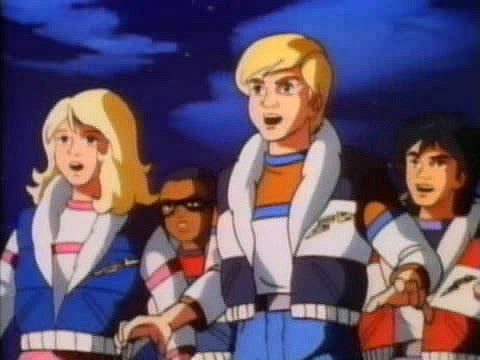
The other show, and the articles namesake, was a now little known classic called "Dinosaucers". Years before "Captain Planet" (another childhood favorite) came about, here was a show that featured a bunch of kids (teens?), who are lucky enough to meet up with a group of aliens who happen to be anthropomorphic talking dinosaurs. These kids become the "Secret Scouts", the only ones who (in general) know about these super awesome dino dudes, and the Scouts even get neat little rings, just like the Planeteers would years later. Though in this case, all the rings did was act as secret communicators to the Dinosaucers. Naturally, the Dinosaucers have enemies, otherwise there wouldn't be much of a show, and these came in the form of some real nasty baddies called "Tyrannos". All of these righteous (and bogus) characters come from a planet called "Reptilon", where everyone is an evolved, talking anthro-dino, and of course, the Tyrannos are a faction that want to ruin shit and control everything, and they've brought their fight to Earth.


These parties always get out of hand.


 So before I go any further, just for fun, let's do a quick roll call of the characters. Getting the boring ones out of the way first, the four human "Secret Scout" kids are Ryan and Sara Spencer (siblings), and their friends Paul and David. Far more importantly however:

The Dinosaucers were made up of their leader Allo the Allosaurus, Dimetro the Scottish accent Dimetrodon, Bronto Thunder the massive Apatosaurus (or as they were still also called back then, Brontosaurus, hence "Bronto"), Stego the obvious Stegosaurus, Tricero the lounge singer (just kidding, Triceratops), Bonehead the dumb but lovable Pachycephelasaurus (say that three times fast), Ichy the suave Ichthyosaurus, and last but not least, the lone girl of the group, Teryx the wise and graceful Archaeopteryx.

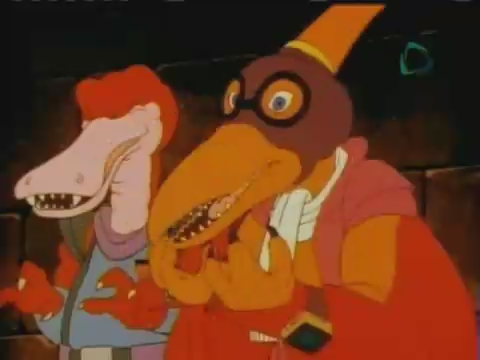
The Tyrannos consisted of their grumpy and loud-talking leader, Genghis Rex the evil Tyrannosaurus, his evil sister Princess Dei the Deinonychus (who doesn't appear much), Ankylo the bumbling Ankylosaurus, Quackpot the jokester Hadrosaurus (duck-billed guys), Styraco the Stryracosaurus, Plesio the slippery Plesiosaurus, and saving the best for last.......Terrible Dactyl, the sneaky, scheming Pterodactyl. Yes, that name is cheesy. And yes, it's fucking amazing.


He just now realized how terribly clever his name is.


As you can probably tell, from both that face-off pic up there, as well as reading all that, that the good guys and bad guys were kind of set up by the shows creators to be evenly matched and parallel to each other. Both sides have a ferocious leader, a giant long-neck (to borrow a phrase from The Land Before Time), a duck-billed guy, a horned guy, a hard-headed dumb guy, a water guy, a spike-tailed guy, and a flying person (since one is a chick). All in all, a nice set up, and many of the characters are rather entertaining, though of course the most-so would be the two pictured above, Quackpot and Terrible Dactyl himself. As was usually the case in 80s cartoons, the bad guys do tend to be hilarious and inept, but especially to a seven year old's perception, it was both epic and amazing. I wished like hell back then that I had a talking dinosaur pal. Hell, that'd still be pretty cool right now.


"Secret Scouts, HOOOOO!!!"


The show only lasted one season, sadly. It was a weekday cartoon, not a weekend one, so that season did at least consist of 65 episodes though. As was the case with most 80s cartoons, it was light in tone, and often featured incredibly silly plots and scenarios, but it was still a lot of fun, and I would even go so far as to say one of the better cartoons of that decade. And that is really saying something, as it was a decade chock full of bad ass animated content. The show featured the ongoing struggle between the two factions, which sometimes even saw them go back to their home planet Reptilon, as well as other semi-regular plot devices such as "Dinovolving", where the characters would devolve into their more primal, ancestral dinosaur forms to do battle. In some ways I think it was ahead of its time, and pretty creative all around, and it's really a damn shame, I think, that it isn't remembered and recognized up there with the likes of He-Man, Thundercats, Transformers, TMNT, etc. 

I also seriously lament the fact that no DVD of this show has ever yet been made. There's always a chance, as far more obscure shows have found their way onto DVD before. But it hasn't happened yet, and that really sucks if you ask me. Why? Because I'd buy it up in a hot minute, of course. I do believe there are still some episodes floating around on Youtube or wherever else, though they are poor quality, coming from old VHS recordings. If you get a chance, and have never experienced this show, take a look if you can find anything, because it really was one of a kind, and it is still one of my favorite shows from the 80s.


Tuesday, June 17, 2014

Childhood Memories: Pac-Man


In honor of his recent 34th birthday, I thought it was about time to give a little attention to a certain yellow dude from my past. The earliest games I remember in my life, at around age 3 or so, were Namco's Pac-Man and Dig Dug. Pac-Man was huge in the early to mid-80s, and years before Mario Mania swept the nation in the late 80s, Pac-Man Fever was a mass epidemic of epic proportions. So much so that he even had his own top ten hit single (of the same name). He had a cartoon, he had toys, he was on t-shirts and pajamas and lunch boxes, he had his own cereal and Spagettios knock off, you name it. In short, he was the very first true video game icon: a game character that was widely recognized and attained popularity that reached above and beyond the game that spawned him. Pac-Man was released in October of 1980 in the US, earlier that year in May back in Japan, and he quickly caught fire worldwide, as his game was arguably the first (besides perhaps Pong) that reached a mass audience, and appealed to men and women, children and adults alike.


Simple, elegant, addictive, classic.


I'm not sure where I first saw Pac-Man, but my earliest memory of it, is sitting at one of the table-top arcade cabinet models, at a local Roundtable Pizza when I was about 3 or 4. I didn't actually "play" the game at first, as my grandmother didn't often hand out quarters for me to "waste" (her words), at that age especially. So in those days, I would just sit down and see the "demo mode" playing, and at that age, I really couldn't tell whether I was controlling the game or not, and regardless, I just had fun pretending I was and watching the game anyway. The first time I ever did actually get a quarter to play it, I'm sure that I more than likely sucked complete ass at it, on account of, you know, being a toddler. But I still had a burning desire to play it, and it always fascinated me, what with it's foreboding mazes, scary (but fashionably colorful) ghosts, and Pac-Man's insatiable appetite for "Power Pellets".


They really don't make 'em like this anymore.


In the picture above you can see the style of arcade machine I mean. It was literally a table, that you could safely rest things like sodas and pizza on top of, to gleefully stuff your face while you blew quarter after quarter trying to master the mazes of Pac-Man. As you can also see above, Pac-Man received a (at the time unofficial) sequel of sorts in the form of "Ms. Pac-Man", a game which features slightly faster gameplay, and new mazes, as well as the astonishing graphical differences of "Ms." featuring lipstick and a bow on her head, to prove she was female. Whereas the four ghosts in the original game were called Inky (Blue), Blinky (Red), Pinky (Pink), and Clyde (Orange), in Ms. Pac-Man, the orange ghost was changed to "Sue", so that Ms. Pac-Man would have a female enemy. In the later game, Pac-Land (as well as in the Pac-Man cartoon), Sue's color is changed to purple, and she is made her own entity. As a kid,  I liked Pac-Man better, simply because "he was a boy", but I really enjoyed both games just as much.


A fun blast from the past.


As a fun bit of trivia for ya, gaming lore has it that the inspiration for Pac-Man originally came to character/game creator Toru Iwatani, while eating a pizza, and seeing that circular shape with a slice missing gave him the idea for the character of a giant mouth that ate things. The name "Pac-Man" also came from the the Japanese sound for eating, "paku-paku". Alternatively, the game upon release was originally called "Puck-Man" in some versions, because it's said the character also had a "hockey puck-like shape". Once the game was brought to America, most versions by then were officially called "Pac-Man", however. It's even been said that the American arcade publisher of the game, Bally/Midway, chose to change the name because they didn't want smart-ass kids covering the "P" in "Puck-Man" with an "F", thus making it......well, you get the gist.


A huge part of my early childhood.


What really cemented Pac-Man in my memory though, beyond just seeing/playing the game itself, was the 1982 Pac-Man cartoon. Produced by Hanna-Barbara, and featuring the voice of classic television actor Marty Ingels as Pac-Man himself, it was a cheesy but fun little show that presented the "Pac-Family" (Mr. Pac, Mrs. Pac, and Pac Jr., along with a Pac-dog and cat) as living in a "normal", Flintstones type world, where everyone were Pac-Man type persons. Except, of course, for the evil (see: mischievous) ghosts, who did the bidding of the mysterious Darth Vader look-alike, Mezmaron (a character invented just for the show, to have an arch-villain). The show featured other characters, such as Pac's nephew P.J., and later "Super-Pac", the Superman equivalent of Pac-Land (also based off of his own game, "Super Pac-Man").


Darth Sillious


During those very early years of my life, the Pac-Man cartoon was as big a deal to me, as Sesame Street, or Mr. Rogers' Neighborhood, or He-Man, or Scooby-Doo, or the Smurfs, or the Care Bears, etc. In fact, I must've seen it in re-runs, because I would've only been one or two years old at the time of it's original airing, so it obviously lasted on TV in syndication for awhile. The show was, of course, like most 80s cartoons, fairly silly in tone, but it was memorable to me, and I remember actually thinking that red-robed clown up there was actually pretty scary-looking to my 3 or 4 year old self. Each episode would more or less play out the same, Mezmaron would come up with some evil scheme to get those Power Pellets away from Pac-Man, and then somehow his ghost minions would find a way to bungle it up, Pac-Man would chomp 'em, and they'd go running back to Mezmaron's castle, just cartoony eyes, just like in the game. Naturally, I always found that absolutely hilarious.


This kooky NES cover was inspired by the look of the cartoon show.


As did the rest of the gaming world, when in the latter half of the 80s, Super Mario took over with a vengeance, I too kind of forgot about poor ol' Pac-Man a bit, and got wrapped up in the game that made me go from being just fascinated with games (Pac-Man), to the one that made me fall madly in love with them (Super Mario Bros.). But I never fully forgot about ol' Pac, and neither did the world. He got various new games, one of which I was particularly fond of, Pac-Mania, a slightly different take where Pac-Man could jump over ghosts in the maze, that I used to play on a friend's PC when I would visit. In the 90s he tried his hand at side-scroller platforming, and Tetris-style puzzling. And by the time the 3D gaming era had hit, Pac-Man was still there with us, in a bright shiny new 3D game of his own (the heavily Super Mario 64 inspired) Pac-Man World.

But through all his newer incarnations, the charm, fun, and addictively simple gameplay of that original 1980 gem, has never really been surpassed. As I bring this article to a close, it bears mentioning that right shortly after his 34th birthday passed in late May, Pac-Man was once again part of some significant gaming history, as he was officially unveiled as a new fighter in the newest entry of the popular Nintendo franchise, Super Smash Bros. It's significant, because for the first time in gaming history, we have what are basically the three single biggest gaming mascot/icons of all time, all together in one game, in the forms of Super Mario, Sonic the Hedgehog, and Pac-Man. And as an added bonus, while not quite on the superstar icon level as those three, classic gaming icon Mega Man has also been added to the mix, so it's a veritable "Who's Who" (almost) of classic video gaming superstars. Just a neat little testament to the enduring popularity of all of them, but especially the first true gaming "character", good ol' Pac-Man.


Just cool to see, honestly. :-)

Thursday, May 15, 2014

Godzilla Chronicles: The Beginning


With the release of the new American "Godzilla" film imminent, I figured it's as good a time as any to finally start blogging about the G-man in earnest. Obviously, for anyone who has followed Retro Revelations thus far, Godzilla's influence on me and my tastes is stamped all over this site, from the main banner image, to the tiny url icon, to the graphics on my Twitter and Tumblr pages. Godzilla is more or less the unofficial RR Mascot. And that's okay, because he is still to this day pretty much the biggest and most important hero/icon of my life.

That's an odd thing to say, I suppose. That a giant monster who sometimes tramples cities underfoot and goes on nigh-unstoppable rampages, would be a anyone's "hero". And yet he is, for so many, myself included. While I've mentioned "The Big G" many, many times in my articles, and have even written two on the NES games of his I played as a kid, as well as the "Godzilla-Thon" from the old TNT's MonsterVision days, I have noticeably held off on actually starting to write about his movies, for various reasons. The biggest among them probably being, that Godzilla and his films just mean so much to me, they're really special, and I want to do them justice. In the fullness of time, I will be covering many (if not eventually all) of the Godzilla films (the real, Japanese ones), under this new "Godzilla Chronicles" banner. For today, however, I'm not actually going to cover any one film. Instead, I'm going to sort of "go back to the beginning", and give a general overview of my own history with him, why I love the damn thing so much, and how he's influenced and shaped my life over time.


Ever wanted to bitch-slap a lobster? Godzilla has.


I'm certain that I must have probably been exposed to Godzilla at an even younger age than I can remember, but the first time I really remember seeing Godzilla, and consequently when my love affair with the big monster really started, was around age 8 or so, when I saw "Godzilla vs. The Sea Monster". The local Wal-Mart used to have a little VHS tape rack, with all sorts of cheap tapes for sale, with all kinds of stuff I was interested in, such as Looney Tunes and various other old cartoons (though the tapes usually had far too few actual cartoons on them). But, as Fate would have it, they also had, though not nearly as many or as frequent as I would have wanted, various old Godzilla movies. And "Godzilla vs. The Sea Monster" was the first one my grandmother ever bought me, one of the very first movies that I actually could say that I owned myself. And let me tell you, it's no overstatement to say that I absolutely fuckin' loved this movie. In my later, adult years, upon venturing into these wild internets, I discovered that to many fellow Godzilla fans, a general consensus seems to be that this was one of the "weaker" of the old "Showa Era" (50s-70s) Godzilla films. But to me, I couldn't care less, because I still love it, and to this day it is still probably my second favorite Godzilla film of all time. Plus, I just genuinely think it's a well-made, incredibly entertaining movie.


My personal favorite incarnation/suit of Godzilla.


But the most important thing to come from my exposure to "Godzilla vs. the Sea Monster", was not my critical opinion of the film. Rather, it was the genesis for my unabashed "monster crush" on the G-man himself. How do you explain to people why a little boy would fall in love with a giant, man-in-a-rubber-suit monster? Well, it's actually fairly simple, really. He was Superman, times ten. He was this impossibly enormous, ferocious badass of a creature, super strong, impervious to almost all of mankind's puny weapons, who was afraid of nothing and always ready to tackle any obstacle, with thermonuclear breath that could destroy almost anything. It likely helped that by this point in his history (the mid-60s), Godzilla was in full-blown "hero" mode. In "Godzilla vs. The Sea Monster", while the human protagonists are certainly afraid of him, and there's always the chance that he just might step on you anyway, whether it was 100% intentional or not, Godzilla does fight on the side of the good guys, and winds up saving the day, more or less. But I think that is genuinely why I loved the big guy at first, because he was sort of like the ultimate superhero. He was certainly my superhero, regardless. And it's funny too, because as a little kid, I was actually rather incensed upon seeing his earlier films, where he was just a "monster on the loose", trashing towns and killing people because he's a giant juggernaut. Or worse yet, movies like "King Kong vs. Godzilla" or "Mothra vs. Godzilla", where he was outright portrayed as the defacto "Bad Guy". AND (spoilers) in both movies he loses to the "good guy" monsters (more or less) in the end. I don't mind telling you that that really bothered the hell out of me as a kid, because A. Godzilla should obviously never lose, and B. I just hated seeing him as the bad guy. In my later years of course, I cared far less and came to love and appreciate all of his roles. But early on, I loved me some "hero" Godzilla, for sure.


The ultimate showdown, on Planet X.


Now I'm not 100% certain which of his films, precisely, was the next one I saw, but just for the sake of this article, I'm going to assume it was the one that would become my all-time favorite, "Godzilla vs. Monster Zero" (also known as "Invasion of the Astro Monster" in Japan). "Sea Monster" was good, but "Monster Zero" had it all. Cool, creepy aliens, a space adventure to Planet X, flying saucers, American actor Nick Adams teaming with the guy who is now my favorite Japanese actor of all time, Akira Takarada (who also happens to be the star in "Sea Monster"), and the flying monster Rodan. And of course, pretty much Godzilla's ultimate villain, the giant, golden-scaled, lightning spitting, three-headed space dragon King Ghidorah. If "Sea Monster" started my love affair with the big guy, "Monster Zero" cemented it for life. Cool plot, awesome monster battles, rampaging and alien invasions galore. Not to mention probably THE best work of often-time composer of Godzilla films, Akira Ifukube, whose unique style of music helped make Godzilla just as much as the work of special effects wizard (and general Godzilla creator) Eiji Tsuburaya. Those tunes from those old films have remained ingrained in my consciousness since childhood.


"Anyone up for some barbequed Kong?"


What was probably my third Godzilla film (all of which acquired from that same rack at Wal-Mart, over time), was "King Kong vs. Godzilla". Now, I had seen the original 1933 "King Kong" film early in my life as well, quite possibly before I had even seen Godzilla. So of course the idea of such a showdown film was awesome to me, even IF, as I mentioned before, they unfairly make poor Godzilla out to be the "bad guy". Also, of course, King Kong in reality (yes reality) was only like 20 feet tall, whereas Godzilla is hundreds of feet tall. But to make it a fair fight, and a more exciting film, they made him around the same size as Godzilla. But regardless, while I didn't like Godzilla technically looking like the "loser" at the end of the film, it was a fun, silly romp, with some great battles between the two titans. And if you ask me, Godzilla still "won" the fight.

Over the next few years, into the early 90s, I slowly managed to build up my catalogue, with more entries like "Rodan", "Godzilla Raids Again", "Godzilla vs. Megalon", "Godzilla vs. the Cosmic Monster" ("Godzilla vs. Mechagodzilla" in Japan), and the American version of the 50s original, "Godzilla: King of the Monsters". Then of course, as I've already documented in my MonsterVision article, I was exposed to even more G-films I'd never yet seen through the miracle of TNT's weekend-long "Godzilla Bash". There were still sadly a few "Showa Era" films that I didn't wind up getting to see until my late teen or adult years, but all in all, I did manage to see most of them as a kid, and I more or less loved them all, though of course some far more than others.


The less awesome, but still cool 70s Godzilla.


So with this new American take on "Godzilla" coming out, I must say I have some mixed feelings. For one thing, I still clearly remember how disappointed I was in the crap-fest that was the 1998 American so-called "Godzilla" movie. On it's own, it wasn't a BAD film. It had decent acting, the movie itself was okay, but hardly great. If it hadn't been called "Godzilla", I might've liked it better. But considering it WAS supposed to be Godzilla....and it wound up being a giant iguana that was nothing at all like the real deal, it was just an incredible letdown. And honestly, what do you expect from Hollywood? Which is why I still hold great reservations for this new film, even if it looks truer to the original material. If it winds up being decent, then great. But on the other hand, to me, CGI is simply not the way to go for Godzilla, or Kaiju films in general. It just doesn't do the genre, or the monsters, true justice. The concept of guys in giant rubber suits may seem silly or "cheesy" to the uninitiated, but trust me when I tell you, it is the film style that these kinds of movie monsters were born for. Or rather, these monsters are why "Suitmation" was created. They go hand in hand, and to me, even if this new American film is a raging success, this is not the direction I want Godzilla to go in over the long-term. What I want, and what I hope for the future, is for Toho, Godzilla's Japanese production company, to get off their asses and eventually make a new, genuine Godzilla film themselves someday.

But until that time comes, or even if it never comes, I'll always have the classics. And in that sense, I can honestly say, the only thing I could claim to have against the old Godzilla movies, is that there weren't even more of them. Maybe it would have been "too much of a good thing", especially when you consider the downturn some of them took in quality in the 1970s. But on the other hand, you can never REALLY have too many giant monster movies....not from that era. Even so, Godzilla earned his title as "King of the Monsters", not just of Japanese monsters, but King of ALL Movie Monsters, and no matter how old I ever get, he'll always be my ultimate hero.


****************************


Here is the full list of Godzilla Chronicles articles:


1. The Beginning

2. Gojira (aka Godzilla: King of the Monsters)

3. Godzilla Raids Again

4. King Kong vs. Godzilla

5. Mothra vs. Godzilla

6. Ghidorah, The Three-Headed Monster

7. Invasion of the Astro Monster (aka Godzilla vs. Monster Zero)

8. Godzilla vs. the Sea Monster

9. Son of Godzilla

10. Destroy All Monsters

11. All Monsters Attack

12. Godzilla vs. The Smog Monster

13. Godzilla vs. Gigan

14. Godzilla vs. Megalon

15. Godzilla vs. Mechagodzilla

16. Terror of Mechagodzilla


Tuesday, April 29, 2014

Illustrated Gaming: The Lost Art of Game Boxes

If you've been following Retro Revelations for long enough now, you've probably gotten the feeling that I have a "thing" for classic gaming. In fact, I'd go so far as to say that while, yes, I do enjoy many modern games, personally, I consider the old, sprite-based games of yore to be "true" video games. I think of most modern games, quite frankly, as "interactive entertainment", more than "video games", because to me, that just seems to be the direction that the industry has been going in now for a good decade plus.

Sufficed to say, I'll always love the classics the most. There were so many things that were unique and, yes, "special" about the good old days, from Atari 2600 on through Super NES, And not the least of which, among so many great facets such as gameplay, sprite graphics, "chip tune" music, etc., were the games' box artwork. Now mind you, not every game was created equal, naturally, and neither was all box artwork great, let alone good. Some of it, like many games themselves, just straight out sucked. But, there was also a whole lot of really, genuinely great, classic box art as well. There was even an ongoing phenomenon, dating back to the 2600, where many games had amazing box art, and that alone would lure potential buyers in, only to be revealed to have crappy games underneath once brought home.


Quite literally a work of art.


Above is a perfect example. Asteroids for Atari 2600 wasn't exactly the best port of that arcade classic. It's not terrible by any means, but the 2600 simply couldn't pull off the real thing in it's full glory. But that box art? It's absolutely fantastic! That is the stuff of classic movie posters or old sci-fi novel covers. Bottom line: it's just really good art, in and of itself. And that's what I'm talking about. You saw that a lot with old Atari games, and even those of it's direct competitors like the Colecovision or Intellivision. Even if many of the games absolutely sucked, a fair lot of them, actual game be damned, had really good looking artwork that was used specifically to sell the games.


Simple, yet elegant.


This one in particular holds memories for me. Space Invaders was one of the few 2600 games that I actually owned as a small child, inherited as a hand-me-down from an aunt of mine. While I, at the tender age of 4 or 5 years old, was absolutely no good at the game itself, and actually kinda hated it because it was so damn hard to me at the time, I really loved the artwork for it. Even though those spaceships don't look anything like the actual "Space Invader" enemies from the game itself, this art still captivated my attention as a child. I would often just hold the cartridge and stare at the seemingly giant cities in the domes on these ships, and wonder to myself where they came from and what they were all about. They say "a picture is worth a thousand words", and it really can be, as my childhood fascination with this particular box art is a testament to the power of art in general.


The epitome of "Classic".


Now when the NES first launched, its initial lineup did not sport what you would call great art. While there is a certain charm now to the old "Black Box" set of launch titles, they were hardly "artwork" at all, simply displaying sprites from the games, in a fashion. But thankfully that certainly didn't last for long, as good lord, did the NES have it's share of gorgeous game covers. The one pictured above is, I think, the quintessential perfect example. It's perfect, not only in the elaborate, great design of the artwork itself, but it's also economical in how it's used. Unlike some game art, which tells you too little or nothing at all in vague images, Castlevania's did a superior job of conveying to the buyer exactly what they were getting into and precisely what the game was about.

You have the hero, Simon Belmont, standing prominently in the foreground, brandishing his trademark whip. Next you have a mist-covered, mysterious landscape before you, with this great, foreboding castle in the distance, and above it all, the haunting, almost laughing specter of the game's main adversary, Count Dracula. In that one image, you are told everything about the game that you need to know: You are a hero, who uses a whip, and has to make his way through a haunted castle to defeat an evil vampire. The end. That is literally perfection, and I would have a hard time imagining any game box art ever crafted doing a better job.


Vague, but beautiful.


Another good example, for a different reason, is this box art for the North American version of Final Fantasy on NES. It doesn't do the same things the Castlevania art did, telling you all you need to know about the game. In fact, it kind of does the opposite in some respects. On the one hand, it does show you some medieval weapons, as well as a mysterious crystal ball, showing some kind of floating city. This does (SPOILERS) literally foreshadow a location you travel to late in the game, and that's cool. The art piece as a whole also hints to the buyer of battles and magic, things heavily featured within Final Fantasy itself. So in that respect, it does tell you a bit about the game, if you're paying attention. But on the other hand, of course, it is also incredibly vague, perhaps by design, the kind of evocative art that is meant only to grab the viewer's attention, and leave them curious enough to want to find out what it's all about. It's not the same pure classic example such as Castlevania, but at the same time, I for some reason have always loved this particular art, and think the simplicity and vagueness still serves the game very well.


So awesome, yet so misleading.


Another good, but in some ways also bad example, is the above pictured box art for the NA release of Mega Man 2. This was one of my favorite games as a kid, and one of my favorite game boxes as well, because of this art. This box art alone, similar in a fashion to the Space Invader box art of old, really sparked my imagination, and filled me with a bunch of box art fueled backstory for Mega Man that as it would turn out, sadly, would be proven dead wrong as I got older and learned more about the series and it's hero. At that young age, inspired by this infamous yet erroneous artwork, in my head evolved a story about a Mega Man who was actually a human being, who was hired by the benevolent Dr. Light to fight evil robot creations, using a souped-up robotic power suit, ala Iron Man. And if you ask me, to this day, I honestly still think that sounds pretty bad ass, and kinda wish that it was Mega Man's actual story. You see, this box art, and in fact one of the box art pieces for Mega Man 1 as well, show a very human looking hero, wielding a gun, and fighting bad guys. Now mind you, the gun bit didn't really grab me so much, I knew that he used an arm canon weapon, called the "Mega Buster", but hey, for all I knew he could have been just like another human hero who also used a suit of power armor and an arm canon: Metroid's hero Samus Aran.

Well no, in fact, as it turns out, Rock, the hero who becomes Mega Man (or Rockman in Japan), was always a robot. According the series' story, Dr. Light created him originally as a lab assistant, but later when his other creations went haywire thanks to that dastardly Dr. Wily, he refitted Rock and turned him into the "Super Fighting Robot" Mega Man, who could battle evil and save the day. Still a cool backstory, absolutely. But to this guy, somewhere deep down, the 10 year old in me still thinks that an armored dude fighting evil is somewhat cooler than a robot doing it. But I digress. As for the art itself, even though this image is somewhat infamous today as a bit of "cheese art", as some consider it, I personally consider the quality of the artwork itself to be rather good, and in spite of it's misleading bent, concerning the nature of our titular hero, it does still tell you what the game is about: you play a guy who shoots things, fighting evil robots, and taking down a mad scientist (even IF the dude pictured in the art looks more like Dr. Light, not Dr. Wily). All of that still rings mostly true, so at the end of the day, Mega Man 2's art still holds up, and does it's job.


Lighting bolts and dragons....that's pretty much all anyone needs.

The great art of Tom duBois.


As you can see, the jump from the 8-bit to the 16-bit era of gaming didn't create a lack of good box art. In point of fact, the 16-bit generation was truly the last stronghold of great, hand-drawn game art. Sega Genesis, Super NES, and even other more obscure systems like Turbo Graphx 16 and Neo-Geo, had many games with great artwork. Mystic Defender happens to be a great choice to show off, because it combines elements of what was great both about the Castlevania and Final Fantasy art, in that it tells you certain bits about what the game is, you play a guy who throws lightning and fights monsters, but at the same time, it is vague and cryptic enough to leave you wanting to know more. And then the artwork for one of my top favorite games of all time, Super Castlevania IV, much like the CV series boxes before it, is just beautiful. As in that would make a great painting in a gallery somewhere, whether it has to do with a video game or not.

But, as I intimated, the 16-bit era really was the last stand for the regular use of great, hand-drawn/painted game art. In the following generation, of the Sega Saturn, Sony PlayStation, and Nintendo 64, a new trend arose to go along with the "leap" to 3D, polygon-based graphics, and that was the prolific use of pre-rendered 3D images for game covers, in place of traditional art. Now don't get me wrong, not all of this pre-rendered stuff was bad. But feast your eyes on the picture below, just to get a taste of the difference I am talking about.


Just......blah.


This is just one example of how, as the pic quote says..."Blah" many of these "3D" game covers could look. Castlevania 64 (as it's unofficially known), was a nice first attempt at taking the series into 3D. But honestly, the series has never really worked as well in 3D, and this box art in particular was just uninspired and painful. Part of a game cover's job, is to make you want to buy the game, it's supposed to be an evocative image that jumps out at you and makes you interested enough to want to check the game out. This cover? Wouldn't make much of anyone interested, if you ask me. I rented this game because I loved the series and I wanted to try it. But people who knew nothing of Castlevania, but saw this box on store shelves? Likely would pass it up, because it just screams "Blah". Honestly, it looks like rushed demo art that they decided to slap on the box. And this wasn't uncommon in those early 3D days.


Better, but still missing something....


And in the interest of fairness, from the same early 3D era, here is the box art for Super Mario 64. A much better game with MUCH better art. It's simple, to the point, shows Mario using one of his new power-ups, shows just a glimpse of the kind of game worlds you might find when playing, and otherwise gives the viewer the sense that "It is still Mario after all". But even for all it's positives, and honestly, it looks okay, it's still just missing that "something" that the cool, hand-drawn Mario artwork of old had. Those old images looked like a cartoon. This? Just kinda looks like a....pre-rendered image. I'll fully admit that I am biased in this estimation, but I also just firmly feel that the old-style, hand-drawn game art had more "life and spirit" to it. Plus it quite simply tended to be more beautiful.

Now, game box art has come a long way, it's continued to evolve, and while it's improved, the fact remains that hand-drawn art is still used rarely, especially for home console games. It IS used, but not nearly enough. And since 3D gaming has taken on a much more "realistic" bent in modern times, you will often get modern box art that looks something like this:


Yup.

Double Yup.


The images for these games are fine, they're certainly not poorly made, they're well-rendered, and they convey what the games are about: guns, fire, smoke, explosions, war, lots of brooding, etc. They're not BAD by any means. But for my money, they also don't really spark the imagination the way that old box art used to either. It's just kind of very cut, and dry, and to the point. In some cases they're almost literally just images directly from the games, and in others, they may have stylized titles, but they're still just terribly uncreative or unimaginative. That isn't to say there aren't still some cool, creative, and interesting looking game covers. There certainly are. It's just that, as far as I've managed to notice anyway, they seem to be relatively few and far between.

I realize that in these articles of mine, in this ongoing blog of mine, I do rather often seem to frame things in a very stark "things were better back then" slant. And I don't really apologize for this, because at least in my view, when it comes to a lot of things in the realm of entertainment, things really WERE better back whenever. There's a reason it's called "Retro" Revelations, and there is most certainly a reason why I tend to focus mostly on things that are usually no younger than, let's say, 15 or more years old, usually far older. But when it comes to the matter of game box art, I really do feel like it has become a mostly lost art. And I can't help but wonder, what ever became of all of those amazing artists who used to so regularly find employment making these great (and sometimes not so great) game covers that so many of us would still wonder over for decades to come?

Whatever happened to them, I'd like to thank them for adding an important part to the overall appeal of the phenomenon that was video gaming in the 1980s and early-to-mid-90s. Because in many ways, some of those game covers are just as important, and just as classic, as the games themselves. So to you mystery men (and women), I'd just like to tip my proverbial hat, and say "Cheers".